Earth

Earth's Resources Used Up at Quickest Rate Ever in 2016 (france24.com) 323

An anonymous reader writes: In just over seven months, humanity has used up a full year's allotment of natural resources such as water, food and clean air -- the quickest rate yet, according to a new report. The point of "overshoot" will officially be reached on Monday, said environmental group Global Footprint Network -- five days earlier than last year. "We continue to grow our ecological debt," said Pascal Canfin of green group WWF, reacting to the annual update. "From Monday August 8, we will be living on credit because in eight months we would have consumed the natural capital that our planet can renew in a year."
Media

NASA: Revolutionary Camera Recording Propulsion Data Completes Test (theverge.com) 81

An anonymous reader quotes a report from The Verge: NASA has created a camera that can film slow motion footage of booming rocket engines with higher dynamic range than ever before. It's called the High Dynamic Range Stereo X camera, or HiDyRS-X (PDF), and late last week the agency released some of its footage to the public for the first time. The three-minute clip shows the most recent test of one of the boosters for NASA's upcoming Space Launch System rocket in unprecedented detail. SLS will use two of these 17-story tall solid rocket boosters, each of which is capable of burning 5.5 tons of propellant per second to create 3.6 million pounds of thrust. The problem when it comes to filming tests like these (and eventually, launches) is that the plumes of fire they produce are extremely bright. This usually leaves camera operators with two choices. They can either expose the footage for the bright plume, which will leave everything else in the shot looking dark and underexposed. Or they can expose for everything else in the shot, which leaves the plume looking bright white and void of detail. The HiDyRS-X camera solves this problem because the camera can capture all of this detail in one shot, and it does this in a fairly clever way. Where regular high-speed cameras usually only captures video one exposure at a time, HiDyRS-X can capture multiple exposures at a time. NASA did however report some failures with the test: the camera's automatic timer failed to go off, thus failing to record the igniting of the rocket, and the pressure being generated from the booster knocked the camera's power source loose.
Earth

Being Lazy Is a Sign of High Intelligence, Study Suggests (independent.co.uk) 254

An anonymous reader quotes a report from The Independent: Findings from a U.S.-based study seem to support the idea that people with a high IQ get bored less easily, leading them to spend more time engaged in thought. And active people may be more physical as they need to stimulate their minds with external activities, either to escape their thoughts or because they get bored quickly. Researchers from the Florida Gulf Coast University gave a classic test -- dating back three decades -- to a group of students. The 'need for cognition' questionnaire asked participants to rate how strongly they agree with statements such as "I really enjoy a task that involves coming up with new solutions to problems," and "I only think as hard as I have to." The researchers, led by Todd McElroy, then selected 30 'thinkers' and 30 'non-thinkers' from the pool of candidates. Over the next seven days both groups wore a device on their wrist which tracked their movements and activity levels, providing a constant stream of data on how physically active they were. Results showed the thinking group were far less active during the week than the non-thinkers. "Ultimately, an important factor that may help more thoughtful individuals combat their lower average activity levels is awareness," said McElroy, according to The British Psychological Society. "Awareness of their tendency to be less active, coupled with an awareness of the cost associated with inactivity, more thoughtful people may then choose to become more active throughout the day."
Education

Immigration Attorneys: Industry Pushes Foreign Labor, Claiming 'US Students Can't Hack It In Tech' (breitbart.com) 472

geek writes: According to Caroline May from Breitbart News, "The tech industry is seeking to bolster its argument for more white-collar foreign tech workers with the insulting claim that the education system is insufficiently preparing Americans for tech fields, according to pro-American worker attorneys with the Immigration Reform Law Institute (IRLI). [In an op-ed published at The Daily Caller, IRLI attorneys John Miano and Ian Smith take the tech industry to task for its strategy to promote the H-1B visa program -- alleging a labor shortage of apt American tech workers while importing thousands of foreign workers on H1-B visas from countries with lower educational results than the U.S.]" John Miano and Ian Smith write via The Daily Caller: "But if the H-1B program really is meant to correct the failings of our education system, as BigTech's new messaging-push implies, why is it importing so many people from India? According to results from the Programme for International Student Assessment (PISA), a global standardized math and science assessment sponsored by the OECD, India scored almost dead last among the 74 countries tested. The results were apparently so embarrassing, the country pulled out of the program all together. Not surprisingly then, there isn't a single Indian university that appears within the top 250 spots of the World University Rankings Survey. And unlike American bachelor's degrees, obtaining a bachelor's in India takes only three years of study."
Software

'Faceless Recognition System' Can Identify You Even When You Hide Your Face (vice.com) 55

schwit1 quotes a report from Motherboard: By itself, the ability to instantly identify anyone just by seeing their face already creates massive power imbalances, with serious implications for free speech and political protest. But more recently, researchers have demonstrated that even when faces are blurred or otherwise obscured, algorithms can be trained to identify people by matching previously-observed patterns around their head and body. In a new paper uploaded to the ArXiv pre-print server, researchers at the Max Planck Institute in Saarbrucken, Germany demonstrate a method of identifying individuals even when most of their photos are un-tagged or obscured. The researchers' system, which they call the "Faceless Recognition System," trains a neural network on a set of photos containing both obscured and visible faces, then uses that knowledge to predict the identity of obscured faces by looking for similarities in the area around a person's head and body. As for the accuracy of the system, "even when there are only 1.25 instances of the individual's fully-visible face, the system can identify an obscured face with 69.6 percent accuracy; if there are 10 instances of an individual's face, it increases to as high as 91.5 percent."
Education

Positive Link Between Video Games and Academic Performance, Study Suggests (theguardian.com) 100

Here's another report reaffirming that playing online video games doesn't necessarily hinder one with their grades. According to an analysis of data from over 12,000 high school students in Australia, children who play online video games tend to do better in academic science, maths and reading tests. The study says kids who played online games almost every day scored 15 points above average in maths and reading tests and 17 points above average in science. "The analysis shows that those students who play online video games obtain higher scores on Pisa (Program for International Student Assessment -- internationally recognized tests that are administered by the Organisation for Economic Cooperation and Development (OECD)) tests, all other things being equal," said Alberto Posso, from the Royal Melbourne Institute of Technology whp analyzed the data. "When you play online games you're solving puzzles to move to the next level and that involves using some of the general knowledge and skills in maths, reading and science that you've been taught during the day." The Guardian reports: The cause of the association between game playing and academic success is not clear from the research. It is possible that children who are gifted at maths, science and reading are more likely to play online games. Alternatively, it could be that more proficient students work more efficiently, and therefore have more free time, making online gaming a marker of possible academic ability rather than something that actively boosts performance. Posso also looked at the correlation between social media use and Pisa scores. He concluded that users of sites such as Facebook and Twitter were more likely to score 4% lower on average, and the more frequent the social networking usage, the bigger the difference. 78% of the teenagers said they used social networks every day. Other studies have found a link between heavy users of social networking and a low attention span, which is also linked to poorer academic performance, but the evidence is less than conclusive.
Biotech

Scientist Who Sparked 'A Revolution in Chemistry' Dies at 70 (washingtonpost.com) 41

Ahmed Zewail pioneered a technique for using lasers to monitor chemical reactions, which the Royal Swedish Academy of Sciences said sparked "a revolution in chemistry and adjacent sciences." Slashdot reader Provocateur writes, "The Washington Post has the story...citing his prizewinning research in femtochemistry..."

Slashdot covered Zewail's Nobel prize in 1999, as well as his 2001 claim to have resolved Heisenberg's Uncertainty Principle. "Mathematics, mechanics, and chemistry were among the fields that gave me a special satisfaction..." he says in the Post's article, adding "for reasons unknown (to me), my mind kept asking 'how' and 'why.' "
Medicine

Stem Cell Researchers Can Now Combine Animal and Human Embryos In The US (sciencemag.org) 92

Slashdot reader sciencehabit quotes an article from Science magazine: The National Institutes of Health announced that the agency soon expects to lift a moratorium on funding for controversial experiments that add human stem cells to animal embryos, creating an organism that is part animal, part human. Instead, these so-called chimera studies will undergo an extra layer of ethical review but may ultimately be allowed to proceed.

Although scientists who support such research welcomed the move, some were left trying to parse exactly what the draft policy will mean. It is "a step in the right direction," says Sean Wu, a stem cell researcher at Stanford University in Palo Alto, California, who co-authored a letter to Science last year opposing the moratorium. But "we still don't know what the outcome will be case by case," he adds. However, some see the proposal as opening up research in some areas that had been potentially off-limits.

Experiments could include using animals to grow human organs for transplants, although according to the article, some scientists "worry that the experiments could produce, say, a supersmart mouse."
The Military

The New F-35 Is So Stealthy, It's Harder To Train Pilots (airforcetimes.com) 343

An anonymous reader quotes a report from the Air Force Times: The F-35 Lightning II is so stealthy, pilots are facing an unusual challenge. They're having difficulty participating in some types of training exercises, a squadron commander told reporters Wednesday. During a recent exercise at Mountain Home Air Force Base, Idaho, F-35 squadrons wanted to practice evading surface-to-air threats. There was just one problem: No one on the ground could track the plane. 'If they never saw us, they couldn't target us,' said Lt. Col. George Watkins, the commander of the 34th Fighter Squadron at Hill Air Force Base, Utah. The F-35s resorted to flipping on their transponders, used for FAA identification, so that simulated anti-air weapons could track the planes, Watkins said.
Science

CERN Confirms Hints of Hypothetical Particle Have Disappeared (arstechnica.com) 205

John Timmer, writing for Ars Technica: Toward the end of last year, the people behind the Large Hadron Collider announced that they might have found signs of a new particle. Their evidence came from an analysis of the first high-energy data obtained after the LHC's two general-purpose detectors underwent an extensive upgrade. While the possible new particle didn't produce a signal that reached statistical significance, it did show up in both detectors, raising the hope that the LHC was finally on to some new physics. This week, those hopes have officially been dashed. Physicists used a conference to release their analysis of the flood of data that came out of this year's run. According to their data, the area of the apparent signal is filled by nothing but statistical noise. The search for new particles in data from the LHC starts with a calculation of the sorts of things we should expect to see at a given energy. The Standard Model, which describes particles and forces, can be used to make predictions of the frequency at which specific particles will pop out of collisions, as well as what those particles will decay into. So, for example, the Standard Model might indicate that two electrons should appear in five percent of the collisions that occur at a specific energy. Looking for new particles involves looking for deviations from those predictions.
Earth

Mysterious, Ice-Buried Cold War Military Base May Be Unearthed By Climate Change (sciencemag.org) 108

Slashdot reader sciencehabit quotes Science magazine: It sounds like something out of a James Bond movie: a secret military operation hidden beneath the Greenland Ice Sheet. But that's exactly what transpired at Camp Century during the Cold War. In 1959, the U.S. Army Corps of Engineers built the subterranean city under the guise of conducting polar research -- and scientists there did drill the first ice core ever used to study climate. But deep inside the frozen tunnels, the corps also explored the feasibility of Project Iceworm, a plan to store and launch hundreds of ballistic missiles from inside the ice.

The military ultimately rejected the project, and the corps abandoned Camp Century in 1967. Engineers anticipated that the ice -- already a dozen meters thick -- would continue to accumulate in northwestern Greenland, permanently entombing what they left behind. Now, climate change has upended that assumption. New research suggests that as early as 2090, rates of ice loss at the site could exceed gains from new snowfall. And within a century after that, melting could begin to release waste stored at the camp, including sewage, diesel fuel, persistent organic pollutants like PCBs, and radiological waste from the camp's nuclear generator, which was removed during decommissioning.

Earth

Florida District Considers Releasing GMO Mosquitos After Cayman Islands Experiment (accuweather.com) 144

It's already underway just 364 miles south of Florida, according to the Associated Press. "The first wave of genetically modified mosquitoes were released Wednesday in the Cayman Islands as part of a new effort to control the insect that spreads Zika and other viruses," according to an article shared by Slashdot reader Okian Warrior: Genetically altered male mosquitoes, which don't bite but are expected to mate with females to produce offspring that die before reaching adulthood, were released in the West Bay area of Grand Cayman Island, according to a joint statement from the Cayman Islands Mosquito Research and Control Unit and British biotech firm Oxitec.
"What could possibly go wrong?" asks The Atlantic, citing history's great pest-control fails in Hawaii and Australia. But a similar release is already being considered in the Florida Keys, though Accuweather reports it apparently depends on the results of a November referendum which could also "affect the likelihood of Oxitec trials taking place in other parts of the United States."
Transportation

Luxury Liner SS United States Cannot Be Put Back In Service (miamiherald.com) 118

tomhath writes: Once the fastest ocean liner ever built, the SS United States has been mothballed for almost 50 years. An ambitious project to refurbish the SS United States as a luxury liner has been abandoned due to insurmountable technical and commercial obstacles. Plan B, to turn it into a floating hotel/convention center, might go forward. Miami Herald provides some history of the SS United States in its report: "The iconic 1950s vessel, which was bigger than the Titanic and once carried celebrities across the Atlantic Ocean, was set for a $700 million overhaul by the Los Angeles-based luxury line, which also has offices in Miami. The SS United States was decommissioned in 1969 and has been gutted and docked in Philadelphia for two decades on the Delaware River. On its maiden voyage in 1952, the ship traversed the Atlantic in three days, 10 hours and 42 minutes -- a record it held until 1990."
Mars

NASA Celebrates Curiosity's Fourth Year On Mars With a Game (engadget.com) 35

An anonymous reader writes from a report via Engadget: In honor of Curiosity's fourth year on Mars, NASA has released a game. Engadget reports: "The glitch that shut down Curiosity in July was thankfully a temporary issue, else NASA would have mourned its loss rather than celebrating the rover's fourth year on Mars by releasing a game. It's simply called Mars Rover, and it's probably your only chance to pilot Curiosity. Mars Rover has a pretty straightforward gameplay -- you just have to press arrow keys to drive the vehicle and find underground pockets of water -- but it's harder than it seems. The virtual rover's wheels crack and break if they slam hard against rocks or heels, and when they do, it's game over. NASA derived these mechanics from Curiosity's actual mission and experiences on Mars."
Medicine

Waze's New Safety Feature Reminds Drivers Not To Forget Their Child In the Car (go.com) 76

An anonymous reader quotes a report from ABC News: The navigation app Waze has released a new safety feature that reminds users not to forget their child, pet or other loved ones in the car before getting out. The feature, called "Child reminder," was made available to the public on Thursday, when Waze released its latest update on app stores for Android and iOS. The new feature comes amid concerns over recent child hot car deaths. Since 1998, there have been 37 child heatstroke fatalities on average per year in the U.S., according to the Department of Meteorology and Climate Science at San Jose State University in California. Waze's Head of Brand, Julie Mossler said in a statement: "Just as drivers sometimes forget to turn off their headlights, they sometimes forget things in the car too. This new feature helps keep people present in the vehicle and gives them an important, possibly life-saving reminder, that drivers sometimes need." The "Child reminder" feature is opt-in and can be turned on and off in the app's "general settings." Mossler also said that drivers can customize the alert "to include their child's name or pet's name -- anything that will get their attention at the end of a drive." It will only disappear if a driver has entered a destination in Waze and has arrived at that destination.
Medicine

Man Says Tesla Autopilot Saved His Life By Driving Him To the Hospital (cnbc.com) 153

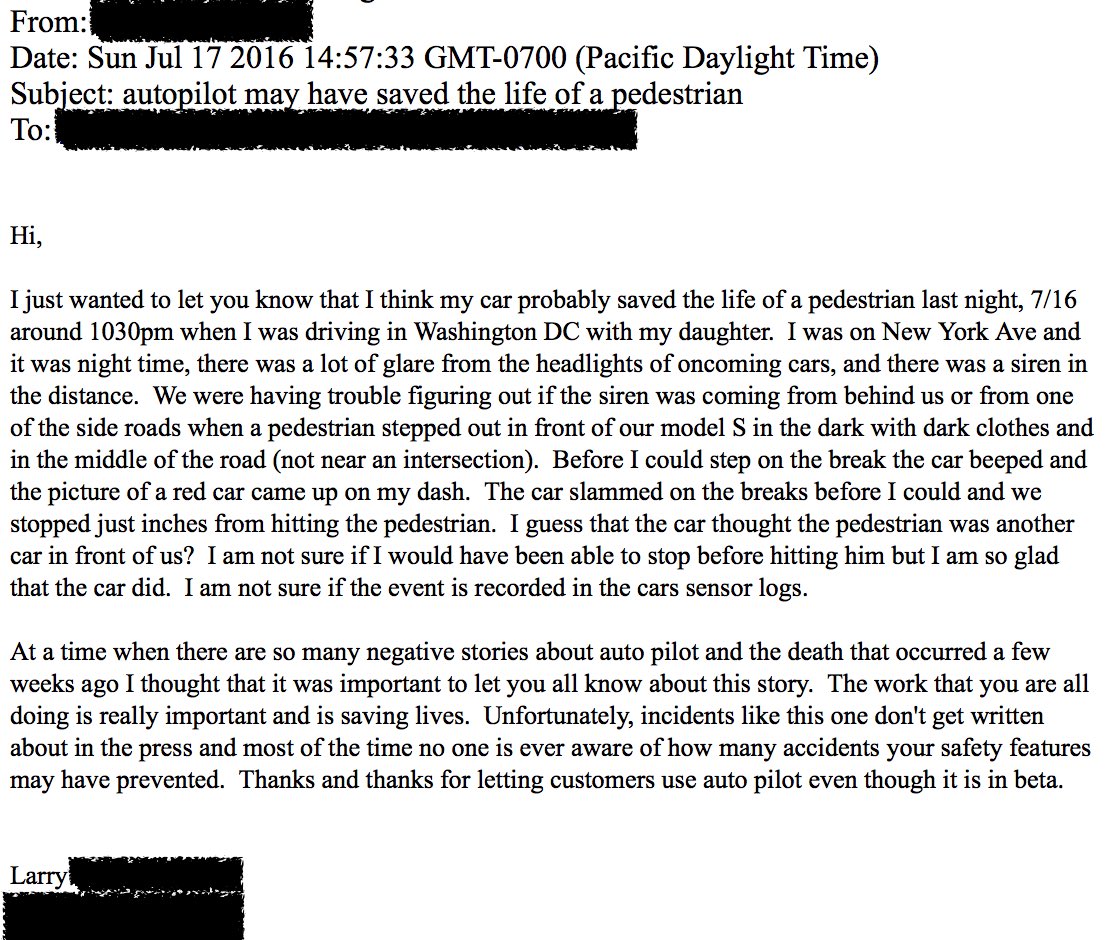
An anonymous reader writes: Last month a man sent an email to Elon Musk explaining how his Tesla Model S with Autopilot activated may have saved a pedestrian's life. Now, it appears Autopilot may have saved the life of a Tesla Model X driver. CNBC reports: "A Missouri man says his Tesla helped saved his life by driving him to the hospital during a life-threatening emergency. Joshua Neally is a lawyer and Tesla owner from Springfield, Missouri, who often uses the semi-autonomous driving system called Autopilot on his Tesla Model X. The system has come under fire after it was involved in a fatal Florida crash in May, but Neally told online magazine Slate that Autopilot drove him 20 miles down a freeway to a hospital, while Neally suffered a potentially fatal blood vessel blockage in his lung, known as a pulmonary embolism. The hospital was right off the freeway exit, and Neally was able to steer the car the last few meters and check himself into the emergency room, the report said."
Earth

X-Rays Reveal Hidden Portrait Under Painting By Edgar Degas (npr.org) 25

An anonymous reader quotes a report from NPR: Using specialized X-ray imaging, a team of researchers in Australia has revealed a striking painting of a woman's face hidden under French Impressionist Edgar Degas' Portrait of a Woman. The researchers believe the auburn-haired woman in the hidden work -- which they also attribute to Degas -- is Emma Dobigny, who was reportedly one of Degas' favorite subjects and modeled for him in 1869 and 1870. "Degas painted directly on the underlying portrait with no intermediate ground paint layer using exceptionally thin paint layers, thus little pigment is present to provide hiding power," the researchers explained in the journal Nature. "The hiding power of paint layers often decreases as oil paintings age." Even as the traces of a ghostly form emerged over the course of decades, conventional imaging technology could only provide hints of what the hidden portrait looked like. Now, an enhanced process known as X-ray fluorescence elemental mapping gives a far better picture. The technique allowed the researchers to scan for the individual elements -- such as iron, zinc and copper -- found in different colors of paint. The team said the maps "can be used to deduce pigment use based on the elements observed within the context of the painting." For example, "Fe and Mn are co-located in the hidden sitter's hair [...] strongly suggesting the use of the brown pigment umber." The researchers detected cobalt in the face, and deduced that it is "probably present as a blue pigment, which is useful in defining flesh tones." This chart shows maps of elements the researchers tested in an effort to create a representation of the hidden work.
Robotics

The Pill Robot Is Coming (bloomberg.com) 34

Bloomberg has an article on a new project that MIT's Daniela Rus has been working on. They have developed a "robot," squeezed into an inch-long, 0.09-ounce pill, but it "unfolds like an origami after it's swallowed". This robot can be guided with a tiny magnet to remove a foreign object from the stomach or treat a wound by administering medication, the report says. The equipment to manipulate the robot is pricey, but its own components cost less than $100. The article talks about the next step in this project: Rus and her team have tested the robot in a silicon-molded prototype stomach and are seeking approval from MIT's animal care committee to try it in pigs. She says they're also looking to raise more money. "The experiments they've been doing are very promising," says Ken Goldberg, a robotics professor at the University of California at Berkeley. Until now, he says, "nothing has been able to essentially walk inside the body."
Medicine

Brains of Overweight People Look Ten Years Older Than Those of Lean Peers, Says Report (theguardian.com) 184

An anonymous reader quotes a report from The Guardian: The brains of people who are obese or overweight appear to have aged an extra 10 years compared to their lean peers from middle age onwards, brain scanning research has revealed. The difference, scientists say, corresponds to a greater shrinkage in the volume of white matter, although they don't know the cause. It might be down to genes causing both brain-shrinking and obesity, or it could be that changes occurring in the brain lead to overeating. Either way, it does not appear to affect cognitive performance. White matter is tissue, composed of nerve fibers, that aids communication between different regions of the brain. The volume of white matter in a human brain increases during youth and then decreases with age for both lean people and those who are overweight or obese. But researchers have discovered that this shrinkage differs depending on a subject's BMI. "The overall message is that brains basically appear to be 10 years older if you are overweight or obese," said Lisa Ronan, first author of the study from the University of Cambridge. Despite a higher BMI being linked to a smaller volume of white matter, it did not appear to have any link to mental prowess, with no difference seen between lean and overweight or obese participants when they were subjected to IQ tests. Scientists from the University of Cambridge and Yale University have published their findings in the journal Neurobiology of Aging.
Moon

North Korea Hopes To Plant Flag On The Moon Within 10 Years (ap.org) 215

An anonymous reader quotes a report from The Associated Press: In an interview with The Associated Press, a senior official at North Korea's version of NASA said international sanctions won't stop the country from launching more satellites by 2020, and that he hopes to see the North Korean flag on the moon within the next 10 years. "Even though the U.S. and its allies try to block our space development, our aerospace scientists will conquer space and definitely plant the flag of the DPRK on the moon," said Hyon Kwang Il, director of the scientific research department of North Korea's National Aerospace Development Administration. An unmanned, no-frills North Korean moon mission in the not-too-distant future isn't as far-fetched as it might seem. Outside experts say it's ambitious, but conceivable. While the U.S. is the only country to have conducted manned lunar missions, other nations have sent unmanned spacecraft there and have in that sense planted their flags. Hyon said the current five-year plan, at the order of leader Kim Jong Un, focuses on launching more Earth observation satellites and what would be its first geostationary communications satellite -- which, technologically, would be a major step forward. He said universities are also expanding programs to train rocket scientists. "We are planning to develop the Earth observation satellites and to solve communications problems by developing geostationary satellites. All of this work will be the basis for the flight to the moon," Hyon said on July 28, adding that he personally would like to see that happen "within 10 years' time." Meanwhile, North Korea's southern neighbors are planning a similar mission to place a probe in orbit around the moon and a small lander and rover on the surface of the moon by 2020.

Slashdot Top Deals