Earth

Living Near Heavy Traffic Increases Risk of Dementia, Study Finds (theguardian.com) 118

An anonymous reader quotes a report from The Guardian: People living near a busy road have an increased risk of dementia, according to research that adds to concerns about the impact of air pollution on human health. Roughly one in 10 cases of Alzheimer's in urban areas could be associated with living amid heavy traffic, the study estimated -- although the research stopped short of showing that exposure to exhaust fumes causes neurodegeneration. Previously, scientists have linked air pollution and traffic noise to reduced density of white matter (the brain's connective tissue) and lower cognition. A recent study suggested that magnetic nano-particles from air pollution can make their way into brain tissue. The latest study, published in The Lancet, found that those who live closest to major traffic arteries were up to 12% more likely to be diagnosed with dementia -- a small but significant increase in risk. The study, which tracked roughly 6.6 million people for more than a decade, could not determine whether pollution is directly harmful to the brain. The increased dementia risk could also be a knock-on effect of respiratory and cardiac problems caused by traffic fumes or due to other unhealthy life-style factors associated with living in built-up urban environments. The study tracked all adults aged between 20 and 85 living in Ontario, Canada from 2001 to 2012, using postcodes to determine a person's proximity to major roads. The cohort's medical records were examined to see who went on to develop dementia, Parkinson's disease or multiple sclerosis. Over the study period, more than 243,000 people developed dementia, 31,500 people developed Parkinson's disease and 9,250 people developed multiple sclerosis. The scientists found no link between living near a road and Parkinson's disease or multiple sclerosis, but dementia was slightly more common in people living close to busy roads and the risk dropped off gradually in less built-up areas. Those living within 50 meters of a busy road had a 7% higher risk in developing dementia, the risk was 4% higher risk at 50-100 meters, 2% higher risk at 101-200 meters and there was no increase in risk in those living more than 200 meters away. Those who lived in a major city, within 50 meters of a major road and who did not move house for the duration of the study had the highest risk at 12%.
Biotech

Theranos Is Laying Off 155 People, About 41 Percent Of Its Workforce (cnbc.com) 52

The embattled blood-testing company Theranos is laying off 155 people, about 41 percent of its workforce, as it struggles to recover from the backlash generated when the company failed to provide accurate results to patients using its proprietary blood test technology. The job cuts announced today are similar to the cuts announced last year in October, when the company said it would shut down its blood-testing facilities and shrink its workforce by more than 40%. CNBC reports: The start-up will let go of its workers after months of regulatory setbacks as well as lawsuits and scrutiny. That would leave 220 workers to focus on its business plans, primarily its blood testing product called the miniLab. "These are always the most difficult decisions; however, this move allows Theranos to marshal its resources most efficiently and effectively," Theranos said in a statement.
Space

SpaceX Gets the Green Light To Resume Rocket Launches (fortune.com) 44

Elon Musk's SpaceX rocket company has been cleared to resume flying following a launch pad explosion four months ago, the U.S. Federal Aviation Administration said on Friday. From a report on Fortune: The decision clears SpaceX to attempt to launch a Falcon 9 rocket carrying 10 Iridium Communications satellites as early as Monday, a day later than originally planned. SpaceX, owned by Tesla Motors Chief Executive Officer Musk, on Friday declined to comment about what caused the delay. Liftoff from Vandenberg Air Force Base in California is targeted for around 10:26 a.m. PST/1:26 p.m. EST. The FAA, which oversees commercial U.S. space launches, oversaw SpaceX's investigation into why a Falcon 9 rocket burst into flames on a launch pad in Florida as it was being fueled for a routine, prelaunch test on Sept. 1. The accident destroyed the $62 million booster and a $200 million Israeli communications satellite that had been partly leased by Facebook to expand Internet access in Africa.
Medicine

Fewer People Are Dying of Cancer Than Ever Before (theoutline.com) 210

The number of Americans dying of cancer has dropped to a 25-year low, equaling an estimated 2,143,200 fewer deaths in that period, says the new annual report from the American Cancer Society. In that time, the racial and gender disparities that exist in cancer rates have also narrowed somewhat, but they remain wide in many places. From a report on The Outline: Though the incidence of cancer remained stable for women and dropped slightly -- by 2 percent -- in men, rates remain overall 20 percent higher in men while rate of death for men is 40 percent higher than in women. The rates of both incidence and death vary wildly based on the type of cancer. The data that the ACS is using run through the end of 2014 for incidents of cancer and through 2013 for deaths. Lung cancer remains the leading cause of cancer death in the United States for both men and women..
Medicine

Brain Region That Recognizes Faces Keeps Growing in Adulthood (engadget.com) 47

An anonymous reader shares an Engadget report: Neurologists thought that your brain was basically set once you hit early childhood, but researchers from Stanford have discovered one part that keeps growing. Using new MRI imaging techniques, they found that the "fusiform gyrus," which is mostly responsible for recognizing human faces, keeps expanding well after other regions have stopped. The research could lead to more sophisticated cellular analysis of the brain and help patients with a disorder called "facial blindness." Normally, our brain actually loses neurons between early childhood and puberty in a process called "pruning." That applies to visual parts of the brain that identify things like cityscape or hallways, but not faces. The researchers used two different MRI machines to scan both brain activity and density in two different parts of the brain: the region responsible for identifying faces, and an area used for other types of visual recognition. They then compared those structures in the brains of children (aged five to 12) to adults between 22 to 28. It turned out that adults had thicker fusiform gyrus regions than kids, different levels of proteins and cells and more activity. By contrast, the other visual regions showed lower levels of development.
Biotech

A Squishy Clockwork BioBot Releases Doses of Drugs Inside the Body (ieee.org) 15

the_newsbeagle writes: Making micro-machines that work inside the body is tricky, because hard silicon and metal devices can cause problems. So bioengineers are working on soft and squishy gadgets that can be implanted and do useful work. Here's a soft biobot that's modeled on a Swiss watch mechanism called a Geneva drive. With every tick forward, the tiny gizmo releases a dose of drugs. Getting the material properties just right was a challenge. "If your material is collapsing like jello, it's hard to make robots out of it," says inventor Samuel Sia.
Earth

White House Releases Strategy To Defend Against Killer Asteroids (vice.com) 135

An anonymous reader quotes a report from Motherboard: On December 30, the White House quietly released its Near-Earth Object Preparedness Strategy, a 25-page document outlining the United States' plans in the event that a giant asteroid is found to be on a collision course with Earth. Among the priorities outlined by the strategy are improving Near-Earth Object (NEO) detection, developing methods for deflecting asteroids, and developing interagency emergency procedures in the event of an NEO impact. Given the stakes, it's clear why NASA and the leading US defense and research agencies came together in January 2016 to form the Detecting and Mitigating the Impact of Earth-bound Near-Earth Objects (DAMIEN) working group to address the issues associated with killer asteroids. The DAMIEN group is behind the White House's new NEO strategy, and will be responsible for hashing out the specifics of the plan to save Earthlings from killer asteroids going forward. To assist in the search, the DAMIEN report calls for a space-based observatory dedicated to finding NEOs, which will work in cooperation with ground-based observatories. Since a telescope in space isn't limited by terrestrial weather conditions, it would greatly enhance Spaceguard's search capacity. The only plans currently underway for a space-based NEO telescope are being carried out by the non-profit B612 foundation whose Sentinel telescope was supposed to launch last December, but has been delayed due to difficulties securing the requisite $450 million in funding required for the project. NASA has also been considering the NEOCam, a space-based telescope that has received provisional funding for "detailed refinement." Unfortunately, during the latest round of budgeting for NASA's Discovery program, two other satellites were greenlit instead of NEOCam, but NASA said it would continue the asteroid-hunter's provisional funding, so there is still hope that NASA may go forward with a space-based NEO observatory in the future, especially in light of the recent White House strategy. In tandem, the report also recommends updating the capabilities of ground-based NEO observatories by endowing them with more powerful planetary radars and improved spectroscopy instruments (this would allow for more accurate determinations of the composition of an asteroid). But detection is only half the battle. In the event that an asteroid is found to be on an impact trajectory with Earth, NASA is also thinking about ways to deflect the killer asteroid. Some pretty far-out ideas have been proposed on this front, ranging from nukes in space to giant sun-powered lasers, but the most likely method is simply ramming into the asteroid to change its course. Finally, should all else fail, the report also considers what to do in an impact scenario.
Earth

A Coal-Fired Power Plant In India Is Turning Carbon Dioxide Into Baking Soda (technologyreview.com) 197

schwit1 quotes a report from MIT Technology Review: In the southern Indian city of Tuticorin, locals are unlikely to suffer from a poorly risen cake. That's because a coal-fired thermal power station in the area captures carbon dioxide and turns it into baking soda. Carbon capture schemes are nothing new. Typically, they use a solvent, such as amine, to catch carbon dioxide and prevent it from escaping into the atmosphere. From there, the CO2 can either be stored away or used. But the Guardian reports that a system installed in the Tuticorin plant uses a new proprietary solvent developed by the company Carbon Clean Solutions. The solvent is reportedly just slightly more efficient than those used conventionally, requiring a little less energy and smaller apparatus to run. The collected CO2 is used to create baking soda, and it claims that as much as 66,000 tons of the gas could be captured at the plant each year. Its operators say that the marginal gain in efficiency is just enough to make it feasible to run the plant without a subsidy. In fact, it's claimed to be the first example of an unsubsidized industrial plant capturing CO2 for use. schwit1 notes: "A 'climate change' project that doesn't involve taxpayer dollars? Is that even allowed?"
Privacy

Ultrasound Tracking Could Be Used To Deanonymize Tor Users (bleepingcomputer.com) 207

New submitter x_t0ken_407 quotes a report from BleepingComputer: Ultrasounds emitted by ads or JavaScript code hidden on a page accessed through the Tor Browser can deanonymize Tor users by making nearby phones or computers send identity beacons back to advertisers, data which contains sensitive information that state-sponsored actors can easily obtain via a subpoena. This attack model was brought to light towards the end of 2016 by a team of six researchers, who presented their findings at the Black Hat Europe 2016 security conference in November and the 33rd Chaos Communication Congress held last week. Their research focuses on the science of ultrasound cross-device tracking (uXDT), a new technology that started being deployed in modern-day advertising platforms around 2014. uXDT relies on advertisers hiding ultrasounds in their ads. When the ad plays on a TV or radio, or some ad code runs on a mobile or computer, it emits ultrasounds that get picked up by the microphone of nearby laptops, desktops, tablets or smartphones. These second-stage devices, who silently listen in the background, will interpret these ultrasounds, which contain hidden instructions, telling them to ping back to the advertiser's server with details about that device. Advertisers use uXDT in order to link different devices to the same person and create better advertising profiles so to deliver better-targeted ads in the future. The attack that the research team put together relies on tricking a Tor user into accessing a web page that contains ads that emit ultrasounds or accessing a page that contains hidden JavaScript code that forces the browser to emit the ultrasounds via the HTML5 Audio API.
Earth

New Analysis Shows Lamar Smith's Accusations On Climate Data Are Wrong (arstechnica.com) 502

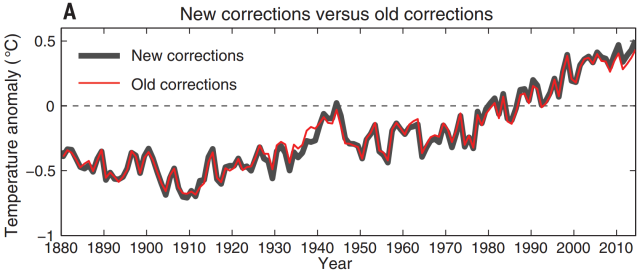
Layzej writes from a report via Ars Technica: In 2015, NOAA released version 4 of their marine temperature dataset called ERSST. The new dataset accounted for a known cooling bias introduced when ocean temperature measurements transitioned from being taken in ship engine intake valves to buoy-based measurements. The warming of the last couple decades increased ever so slightly in NOAA's new analysis. This was a red flag for U.S. House Science Committee Chair Lamar Smith (R-TX), who rejects the conclusions of climate science -- like the fact that the Earth's climate is warming. Suddenly he wanted to see the researchers' e-mails and echoed the accusations of contrarian blogs about scientists' supposedly nefarious adjustments to sea surface temperature measurements. Rather than invoking scientific conspiracies, issues like this should be settled by analyzing the data. A new study, led by University of California Berkeley's Zeke Hausfather, does just that -- and Rep. Smith won't like these results, either. To test the NOAA dataset, Zeke's team created instrumentally homogeneous temperature records from sensors available only over the last couple decades. As it happens, the Argo float data, the buoy data, and the satellite data each hew closer to the updated dataset that NOAA used. The older version (3b) gives a global average that is too cool in recent years, growing to an offset of about 0.06 degrees Celsius. The researchers repeat this same analysis for two more major sea surface datasets that are used by the UK Met Office and the Japanese Meteorological Agency for their global temperature records. Both of those datasets also drift cooler than the comparison data, but less so than NOAA's old dataset.
Communications

Astronomers Pinpoint Location of Mysterious Cosmic Radio Bursts (bbc.com) 50

New submitter Netdoctor writes: Fast Radio Bursts (FRB) are massively powerful short-lived radio bursts from far-away sources, and so far a number of theories exist on what generates them. Recently several were detected in the same general location, which adds to the mystery, as any of these pulses would be powerful enough to destroy a source. Since this group of FRBs were detected with single radio telescope dishes, the exact location was difficult to pinpoint. BBC reports here with results from the Very Large Array in New Mexico being trained on the source. From the report: "Outlining their work at a major conference, astronomers say they have now traced the source of one of these bursts to a different galaxy. Dr Chatterjee, from Cornell University, New York, and colleagues used a multi-antenna radio telescope called the Very Large Array (VLA), which had sufficient resolution to precisely determine the location of a flash known as FRB 121102. In 83 hours of observing time over six months in 2016, the VLA detected nine bursts from FRB 121102. In addition to detecting the bright bursts from FRB 121102, the team's observations also revealed an ongoing, persistent source of weaker radio emission in the same region. The flashes and the persistent source must be within 100 light-years of each other, and scientists think they are likely to be either the same object or physically associated with one another. He said some features of the radio source resembled those associated with large black holes. But he said these were typically found only in large galaxies."
NASA

NASA Unveils Two New Missions To Study Truly Strange Asteroids (space.com) 86

An anonymous reader quotes a report from Space.com: NASA's next low-cost planetary missions will attempt to unravel the mysteries of some seriously bizarre asteroids. The space agency has selected projects called Lucy and Psyche via its Discovery Program, which funds highly focused space missions to destinations throughout the solar system. The Lucy project will investigate the Trojan asteroids, which share an orbit with Jupiter, while Psyche will journey to the asteroid belt to study a huge, metallic asteroid named 16 Psyche that resides there. Lucy is scheduled to launch in October 2021. If all goes according to plan, the probe will visit an asteroid in the main asteroid belt -- located between Mars and Jupiter -- in 2025, and then go on to study six Trojan asteroids between 2027 and 2033, NASA officials said. There are two streams of Trojan asteroids. One trails Jupiter, and the other leads the giant planet around the sun. Scientists think both streams may be planetary building blocks that formed far from the sun before being captured into their current orbits by Jupiter's powerful gravity. Psyche will explore one of the oddest objects in the solar system -- a 130-mile-wide (210 kilometers) metallic asteroid that may be the core of an ancient, Mars-size planet. Violent collisions billions of years ago might have stripped away the layers of rock that once lay atop this metallic object, scientists say. Psyche is scheduled to launch in October 2023 and arrive at the asteroid in 2030, NASA officials said.
Data Storage

Scientists Turn Memory Chips Into Processors To Speed Up Computing Tasks (sciencedaily.com) 73

An anonymous reader quotes a report from Science Daily: A team of international scientists have found a way to make memory chips perform computing tasks, which is traditionally done by computer processors like those made by Intel and Qualcomm. This means data could now be processed in the same spot where it is stored, leading to much faster and thinner mobile devices and computers. This new computing circuit was developed by Nanyang Technological University, Singapore (NTU Singapore) in collaboration with Germany's RWTH Aachen University and Forschungszentrum Juelich, one of the largest interdisciplinary research centers in Europe. It is built using state-of-the-art memory chips known as Redox-based resistive switching random access memory (ReRAM). Developed by global chipmakers such as SanDisk and Panasonic, this type of chip is one of the fastest memory modules that will soon be available commercially. However, instead of storing information, NTU Assistant Professor Anupam Chattopadhyay in collaboration with Professor Rainer Waser from RWTH Aachen University and Dr Vikas Rana from Forschungszentrum Juelich showed how ReRAM can also be used to process data. This discovery was published recently in Scientific Reports. By making the memory chip perform computing tasks, space can be saved by eliminating the processor, leading to thinner, smaller and lighter electronics. The discovery could also lead to new design possibilities for consumer electronics and wearable technology.
Medicine

Scientists Identify New Organ In Humans (livescience.com) 112

Scientists have classified a new organ called the mesentery, which connects a person's small and large intestines to the abdominal wall and anchors them in place, according to the Mayo Clinic. Until recently, it was thought of a number of distinct membranes by most scientists. It was none other than Leonardo da Vinci who identified the membranes as a single structure, according to a recent review. Live Science reports: In the review, lead author Dr. Calvin Coffey, a professor of surgery at the University of Limerick's Graduate Entry Medical School in Ireland, and colleagues looked at past studies and literature on the mesentery. Coffey noted that throughout the 20th century, anatomy books have described the mesentery as a series of fragmented membranes; in other words, different mesenteries were associated with different parts of the intestines. More recent studies looking at the mesentery in patients undergoing colorectal surgery and in cadavers led Coffey's team to conclude that the membrane is its own, continuous organ, according to the review, which was published in November in the journal The Lancet Gastroenterology and Hepatology. The reclassification of the mesentery as an organ "is relevant universally as it affects all of us," Coffey said in a statement. By recognizing the anatomy and the structure of the mesentery, scientists can now focus on learning more about how the organ functions, Coffey said. In addition, they can also learn about diseases associated with the mesentery, he added.
Power

Solar Could Beat Coal to Become the Cheapest Power on Earth In Less Than a Decade (bloomberg.com) 504

Solar power is now cheaper than coal in some parts of the world. In less than a decade, it's likely to be the lowest-cost option almost everywhere, reports Bloomberg. From the article: In 2016, countries from Chile to the United Arab Emirates broke records with deals to generate electricity from sunshine for less than 3 cents a kilowatt-hour, half the average global cost of coal power. Now, Saudi Arabia, Jordan and Mexico are planning auctions and tenders for this year, aiming to drop prices even further. Taking advantage: Companies such as Italy's Enel SpA and Dublin's Mainstream Renewable Power, who gained experienced in Europe and now seek new markets abroad as subsidies dry up at home. Since 2009, solar prices are down 62 percent, with every part of the supply chain trimming costs. That's help cut risk premiums on bank loans, and pushed manufacturing capacity to record levels. By 2025, solar may be cheaper than using coal on average globally, according to Bloomberg New Energy Finance. The solar supply chain is experiencing "a Wal-Mart effect" from higher volumes and lower margins, according to Sami Khoreibi, founder and chief executive officer of Enviromena Power Systems. The speed at which the price of solar will drop below coal varies in each country. Places that import coal or tax polluters with a carbon price, such as Europe and Brazil, will see a crossover in the 2020s, if not before. Countries with large domestic coal reserves such as India and China will probably take longer.
Medicine

France Begins Opt-Out Organ Donation (theoutline.com) 445

Laura June, reporting for The Outline: France began to use a new opt-out system of organ donation on Jan. 1, making it one of a large number of European nations that now use a "presumed consent" system. This means that any adult who dies will now donate their organs by default, regardless of their survivors' wishes, unless they have signed a refusal registry in advance. The new law gets around what has historically been a stumbling block for organ donation: the surviving families of the deceased. A survey in France previously showed that while up to 80 percent of the population was in favor of donating their own organs, about 40 percent of families refuse when pressed to make the choice.
Space

SpaceX Moves Past Explosion With New Launch Plans (cnn.com) 75

SpaceX plans to resume launching rockets as soon as next week, after completing an investigation into a spectacular launch pad explosion that destroyed a rocket and a satellite in September. From a report on CNN: The news comes following an in-depth investigation into the explosion of a rocket from SpaceX's September mission. The company said in a statement Monday the botched launch was due to a failed pressure vessel in a liquid oxygen tank. The vessel buckled, causing liquid oxygen to accumulate. It believes this led to friction, sparks and the explosion. SpaceX conducted the investigation along with officials from NASA, the Federal Aviation Authority, the U.S. Air Force and the National Transportation Safety Board. The Federal Aviation Administration will have to sign off on the report and issue SpaceX a license to launch. SpaceX appears optimistic it will be launching rockets again soon.
Medicine

Baby's Skull Rebuilt With Help From A 3D Printer (newsday.com) 41

schwit1 writes: A team at Stony Brook Children's Hospital was able to use a 3-D printer to produce a replica of baby Vincent's skull, which, in turn, allowed the medical team to fully rehearse the surgery long before they stepped into the operating room. Through a collaboration with Medical Modeling in Colorado, known now as 3D Systems, Egnor and Duboys were able to virtually plan the entire surgery in advance. Duboys said images from a CT scan of baby Vincent's head were sent to the company, which then manufactured a model skull using the CT information as a template. The company also created a model of what Vincent's skull should look like after surgery.
Science

Let's Raise A Glass To The Many Tech Pioneers Who Died In 2016 (slashdot.org) 64

In technology, you're always "standing on the shoulders" of those who came before you -- and together, each individual's contribution becomes part of a larger ongoing story. So as this year finally winds to a close, click through to see our list of some of the pioneers who left us in 2016. And feel free to share any memories and reflections of your own in the comments.
Space

Astronomers Detect Mysterious Radio Signals Coming From Outside Our Galaxy (sciencealert.com) 205

This week the New York Post reported on "powerful radio signals which have been detected repeatedly in the same exact location in space," generating as much energy as the sun does in a whole day, in "the only known instance in which these signals have been found twice in the same location in space." Slashdot reader schwit1 quotes Science Alert: Back in March, scientists detected 10 powerful bursts of radio signals coming from the same location in space. And now researchers have just picked up six more of the signals seemingly emanating from the same region, far beyond our Milky Way... Currently, the leading hypothesis for the source of the Milky Way's FRB is the cataclysmic collision of two neutron stars, which forms a black hole. The idea is that as this collision happens, huge amounts of short-lived radio energy are blasted out into space. But the repeating nature of these distant signals, all coming from the same place, suggest that can't be the case... the most likely hypothesis at the moment for these outer-galactic FRB is that they're coming from an exotic object such as a young neutron star, that's rotating with enough power to regularly emit the extremely bright pulses.
But the New York Post thinks it's aliens.

Slashdot Top Deals