Power

The Flux Capacitor Becomes World's Fastest Street-Legal Electric Car (arstechnica.com) 183

An anonymous reader writes from a report via Ars Technica: Jonny Smith now has the world's fastest street-legal electric car, called the Flux Capacitor. Previously, the Flux Capacitor was only Europe's fastest street-legal electric vehicle, with a less than 11 second, 1/4-mile time under it's belt. Now it can run the quarter-mile in 9.87 seconds, thanks to the extra 44 cells added to the existing 144-cell Hyperdrive Innovation lithium-ion battery pack. That has boosted the car from 370v to 400v and the range from about 30 miles (48km) to about 50 miles (80km). "The combination of big voltage, amps, and phenomenal grip gave us early ten-second quarter miles, and when we braved the RPM limit of the motors, we managed a nine [second run]," Smith told Ars Technica. "Despite all of this power and speed, the little Enfield still felt smooth, stable, and happy, which is unbelievable given that it was designed to do 40 miles an hour."
Communications

Facebook Pitches Laser Beams As The High-Speed Internet Of The Future (pcworld.com) 93

An anonymous reader quotes a report from PCWorld: Facebook says it has developed a laser detector that could open the airwaves to new high-speed data communications systems that don't require dedicated spectrum or licenses. The component, disclosed on Tuesday in a scientific journal, comes from the company's Connectivity Lab, which is involved in developing technology that can help spread high-speed internet to places it currently doesn't reach. At 126 square centimeters, Facebook's new laser detector is thousands of times larger. It consists of plastic optical fibers that have been "doped" so they absorb blue light. The fibers create a large flat area that serves as the detector. They luminesce, so the blue light is reemitted as green light as it travels down the fibers, which are then bundled together tightly before they meet with a photodiode. It's described in a paper published on Tuesday in the journal Optica. Facebook says there are applications for the technology both indoors and outdoors. Around the home, it could be used to transmit high-definition video to mobile devices. Outdoors, the same technology could be used to establish low-cost communications links of a kilometer or more in length. In tests, the company managed to achieve a speed of 2.1Gbps using the detector, and the company thinks it can go faster. By using materials that work closer to infrared, the speed could be increased. And using yet-to-be developed components that work at wavelengths invisible to the human eye, the speed could be increased even more. If invisible to humans, the power could also be increased without danger of harming someone, further increasing speed and distance.
Medicine

Technology Is Making Doctors Feel Like Glorified Data Entry Clerks (fastcompany.com) 326

An anonymous reader writes from a report via Fast Company: The average day for a doctor consists of hours of data entry. Since the Health Information Technology for Economic and Clinical Health (HITECH) Act of 2009 took effect in January of 2011, which incentivized providers to adopt electronic medical records, hospitals have spent millions, sometimes billions, on computer systems that weren't designed to help providers treat patients to begin with. The technology was supposed to reduce inefficiencies, make doctors' lives easier, and improve patient outcomes, but in fact it has done the opposite. "Frankly, the main incentive is to document exhaustively so you cover your ass and get paid," says Jay Parkinson, a New York-based pediatrician and the founder of health-tech startup Sherpa. The systems are flooding doctors with important and utterly meaningless alerts. One of the biggest problems is that the systems have made it very difficult for doctors to share information between one another, which is what the systems were intended to do all along. Why? "Because it doesn't help the bottom line of the biggest medical record vendors or the hospitals to make it easy for patients to change doctors," reports Fast Company. Since it often takes weeks, or months for data to be sent to and from facilities, that, according to Consumers Union staff attorney Dana Mendelsohn, increases the chances of doctors ordering duplicate tests. All of this reduces the time doctors have with their patients. A recent study shows that the average time doctors spend with their patients is about eight minutes and 12% of their time, down from 20% of their time in the late 1980s. "This group is 15 times more likely to burn out than professionals in any other line of work," reports Fast Company. "And much of the research on the topic concludes that 'documentation overload' is a key factor." To help alleviate this pain, medical groups are working to reduce the data-entry burden for doctors, so they can in turn spend more of their time with patients.
Patents

Amazon Patents Way To Turn Lampposts, Church Steeples Into Drone Perches (consumerist.com) 87

An anonymous reader writes from a report via The Consumerist: Amazon has received a patent that shows what drones may be doing when they're not flying throughout the sky delivering packages: sitting on lampposts and church steeples. "Amazon was recently awarded a patent for docking and recharging stations that would be built on tall, existing structures like lampposts, cell towers, or church steeples," reports The Consumerist. "Once the drone is done making a delivery, it would be able to land on the station, recharge and refuel, as well as pick up additional packages." A "central control system" would then be able to control each docking station and connect the docked drone(s) with a local or regional packaged handling center or central facility. Based on weather or package data, the drones may be commanded accordingly. The patent says the system will not only provide directions based to the drone, but will have the ability to redirect the unmanned aerial vehicle based on the most favorable conditions, such as a route with less wind. The patent describes a system in which the drone delivers a package to the platform that then moves the item via a "vacuum tube, dumbwaiter, elevator, or conveyor to the ground level." From there, the package could be transferred to an Amazon Locker or a local delivery person. The docking stations could also act as cell towers that "provide local free or fee-based Wi-Fi services. This can enable cities to provide free Wi-Fi in public parks, buildings, and other public areas without bearing the burden of installing some, or all, of the necessary infrastructure."
Robotics

MIT's Ori Robotic Modular Furniture Is Designed To Make Small Places Feel More Roomy (archpaper.com) 68

An anonymous reader writes: MIT's Media Lab has produced Ori, a range of robotic, modular furniture designed to make small places feel more roomy. The Architect's Newspaper reports: "With its name coming from the Japanese word 'origami,' the furniture system combines robotics, architecture, and design to let interiors double-up as bedrooms, living rooms, dining rooms, and offices. Teaming up with Swiss product designer Yves Behar, founder and CEO of Ori and research scientist at MIT Hasier Larrea has his eyes set on fundamentally altering the 'experience and economics of the urban built environment.' Speaking in a press release, Larrea added that 'Ori's systems make possible the effortless and magical transformation of interior spaces, providing the totally new experience of having our interior space intelligently conform to our activities, rather than our activities being forced to conform to our interior space.' A movable mainframe, containing a variety of concealable furniture and storage, is the core concept in Ori's modular and mechatronic furniture. Using the wall mounted control panel, the module can move across the floor and deploy different pieces of furniture. This can all be done remotely through the Ori app as well." Ori is not on the market yet, but inquiries can be made via Ori's website.
Moon

Taiwan Building Lunar Lander For NASA Moon-Mining Mission (blastingnews.com) 84

MarkWhittington quotes a report from Blasting News: According to AFP, the Chung-shan Institute of Science and Technology in Taiwan is building a $47 million, 3.7 metric ton lunar lander on behalf of NASA. The vehicle is designed to carry a rover called Resource Prospector, which would roll about the lunar surface searching out deposits of oxygen, hydrogen, and water. The Resource Prospector mission is still being formulated but is envisioned to be a joint project with several national space agencies and commercial companies. The lunar lander is the first vehicle of its type to be built in Taiwan. "The Resource Prospector would take samples from about a meter beneath the lunar surface and then heat them in an oven to ascertain what the materials are that comprise it," reports Blasting News. The mission is part of the second stage to NASA's Journey to Mars program called "Proving Ground." "Should the Resource Prospector prove to be successful, the moon could be used as a base for space journeys into Mars," says Han Kuo-change, the head of CSIST's international cooperation program.
NASA

Kepler Confirms 100+ New Exoplanets (phys.org) 37

schwit1 writes: Astronomers have confirmed another 100 of Kepler's more than 3,000 candidate exoplanets. Phys.org reports: "One of the most interesting set of planets discovered in this study is a system of four potentially rocky planets, between 20 and 50 percent larger than Earth, orbiting a star less than half the size and with less light output than the Sun. Their orbital periods range from five-and-a-half to 24 days, and two of them may experience radiation levels from their star comparable to those on Earth. Despite their tight orbits -- closer than Mercury's orbit around the sun -- the possibility that life could arise on a planet around such a star cannot be ruled out, according to Crossfield." Because the host star as well as many of these other confirmed exoplanets are red dwarf stars, the possibility of life is reduced because the star and its system is likely to have a less rich mix of elements compared to our yellow G-type Sun. In May, Kepler added a record 1,284 confirmed planets, nine of which orbit in their sun's habitable zone.
Data Storage

Researchers Develop Atomic-Scale Hard Drive That Writes Information Atom By Atom (techcrunch.com) 68

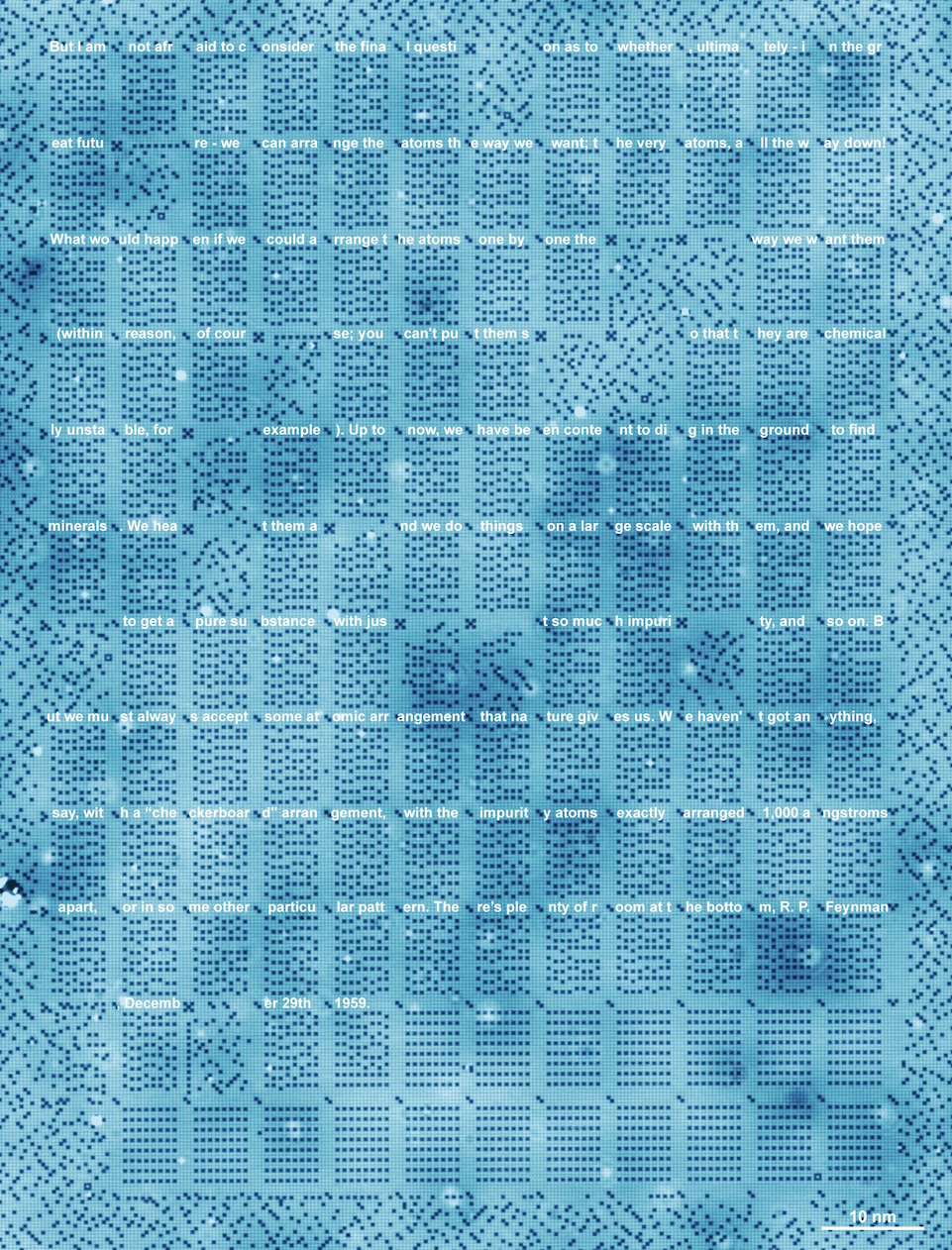
An anonymous reader quotes a report from TechCrunch: Researchers in the Netherlands have created a microscopic storage system that encodes every bit with a single atom -- allowing them to fit a kilobyte in a space under 100 nanometers across. That translates to a storage density of about 500 terabits per square inch. For comparison, those 4-terabyte hard drives you can buy today are about 1 terabit per square inch. That's because, unlike this new system, they use hundreds or thousands of atoms to store a single bit. "Every bit consists of two positions on a surface of copper atoms, and one chlorine atom that we can slide back and forth between these two positions," explained Sander Otte, lead scientist at Delft University of Technology, in a news release. Because chlorine on copper forms into a perfectly square grid, it's easy (relatively, anyway) to position and read them. If the chlorine atom is up top, that's a 1; if it's at the bottom, that's a 0. Put 8 chlorine atoms in a row and they form a byte. The data the researchers chose to demonstrate this was a fragment of a Feynman lecture, "There's plenty of room at the bottom" (PDF) -- fittingly, about storing data at extremely small scales. (You can see a high-resolution image of the array here.) The chlorine-copper array is only stable in a clean vacuum and at 77 kelvin -- about the temperature of liquid nitrogen. Anything past that and heat will disrupt the organization of the atoms. The research was published today in the journal Nature Nanotechnology.
Space

SpaceX Successfully Lands Falcon 9 Rocket On Solid Ground For the Second Time (theverge.com) 103

SpaceX successfully landed another Falcon 9 rocket after launching the vehicle into space on Sunday evening from Florida. The Verge reports: Shortly after takeoff, the vehicle touched down at SpaceX's Landing Complex 1 -- a ground-based landing site that the company leases at the Cape. It marks the second time SpaceX has pulled off this type of ground landing, and the fifth time SpaceX has recovered one of its rockets post-launch. The feat was accomplished a few minutes before the rocket's second stage successfully put the company's Dragon spacecraft into orbit, where it will rendezvous with the International Space Station later this week. It's also the first time this year SpaceX has attempted to land one of its rockets on land. For the past six launches, each rocket has tried landing on an autonomous drone ship floating in the ocean. That's because drone ship landings require a lot less fuel to execute than ground landings.
Space

The World's Most Powerful Telescope Just Discovered 1,230 New Galaxies (yahoo.com) 96

An anonymous Slashdot reader quotes a report from Vice: On Saturday night astronomers at the South African MeerKAT radio telescope array fired up 16 of its recently completed dishes and released the first ever image from what is slated to become the world's most powerful radio telescope. The initial results were incredibly promising: operating with only one quarter of the 64 dishes that will eventually comprise MeerKAT, the telescope was able to find 1300 galaxies in a small corner of the universe where only 70 galaxies were known to exist previously.
Slashdot reader schwit1 quotes a report Agence France-Presse: MeerKAT's full contingent of 64 receptors will be integrated next year into a multi-nation Square Kilometer Array (SKA) which is is set to become the world's most powerful radio telescope. The images produced by MeerKAT "are far better that we could have expected," the chief scientist of the SKA in South Africa, Fernando Camilo said at the site of the dishes near the small town of Carnarvon, 600 kilometres north of Cape Town. When fully up and running in the 2020s, the SKA... will have a discovery potential 10,000 times greater than the most advanced modern instruments and will explore exploding stars, black holes, dark energy and traces of the universe's origins some 14 billion years ago.
Government

New Study Shows Why Big Pharma Hates Medical Marijuana (washingtonpost.com) 416

HughPickens.com writes: Christopher Ingraham writes in the Washington Post that a new study shows that painkiller abuse and overdose are significantly lower in states with medical marijuana laws and that when medical marijuana is available, pain patients are increasingly choosing pot over powerful and deadly prescription narcotics. The researchers "found that, in the 17 states with a medical-marijuana law in place by 2013, prescriptions for painkillers and other classes of drugs fell sharply compared with states that did not have a medical-marijuana law... In medical-marijuana states, the average doctor prescribed 265 fewer doses of antidepressants each year, 486 fewer doses of seizure medication, 541 fewer anti-nausea doses and 562 fewer doses of anti-anxiety medication. But most strikingly, the typical physician in a medical-marijuana state prescribed 1,826 fewer doses of painkillers in a given year."

[P]ainkiller drug companies "have long been at the forefront of opposition to marijuana reform, funding research by anti-pot academics and funneling dollars to groups, such as the Community Anti-Drug Coalitions of America, that oppose marijuana legalization..."

Australia

Energy Prices Skyrocket in South Australia (yahoo.com) 269

Slashdot reader sycodon quotes an article from AFR: Turmoil in South Australia's heavily wind-reliant electricity market has forced the state government to plead with the owner of a mothballed gas-fired power station to turn it back on. The emergency measures are needed to ease punishing costs for South Australian industry as National Electricity Market prices in the state have frequently surged above $1000 a megawatt hour this month and at one point on Tuesday hit the $14,000/MWh maximum price...
"A planned outage of the Heywood Interconnector to Victoria, coupled with higher than expected gas prices and severe weather conditions have contributed to large-scale price volatility in the energy spot market in recent days," said South Australia's energy minister, Tom Koutsantonis. The Australian Associated Press adds that "The state Labor government has invested heavily in wind and solar energy at the expense of baseload power, a move critics say has left the state exposed during poor weather. Mr. Koutsantonis has described the energy volatility as a failure of the national energy market because a lack of interconnection means South Australia often produces more renewable power than it can sell into the grid. But opposition spokesman Dan van Holst Pellekaan said the government had been too hasty to invest in renewables."
Data Storage

Encrypted DNA Storage Investigated by DOE Researchers (darkreading.com) 42

Biological engineers at a Department of Energy lab "are experimenting with encrypted DNA storage for archival applications." Slashdot reader ancientribe shares an article from Dark Reading: Using this method, the researchers could theoretically store 2.2 petabytes of information in one gram of DNA. That's 200 times the printed material at the Library of Congress... Instead of needing a 15,000 square-foot building to store 35,000 boxes of inactive records and archival documents, Sandia National Laboratories can potentially store information on much less paper, in powder form, in test tubes or petri dishes, or even as a bacterial cell... "Hard drives fail and very often the data can't be recovered," explains Bachand. "With DNA, it's possible to recover strands that are 10,000 to 20,000 years old... even if someone sneezes and the powder is lost, it's possible to recover all the information by just recovering one DNA molecule."
Government

Russia Is Building a Nuclear Space Bomber (thedailybeast.com) 256

An anonymous reader quotes a report from The Daily Beast: The Russian military claims it's making progress on a space plane similar to the U.S. Air Force's secretive X-37B robotic mini-shuttle. The tech is pretty basic. But alone among space-plane developers, the Kremlin is proposing to arm its space plane. With nukes. Lt. Col. Aleksei Solodovnikov, a rocketry instructor at the Russian Strategic Missile Forces Academy in St. Petersburg who is overseeing the space plane's development, said the orbital bomber would be flight-ready by 2020. It's unclear how much money the Kremlin is investing in the project, and how serious senior officers are about actually deploying the space plane, if and when Solodovnikov and his team finish it. In any event, the military space plane could give Russia a potentially history-altering nuclear first-strike capability. "The idea is that the bomber will take off from a normal home airfield to patrol Russian airspace," Solodovnikov said, according to Sputnik, a government-owned news site. "Upon command, it will ascend into outer space, strike a target with nuclear warheads and then return to its home base." Thanks to its orbital capability, the bomber would be able to nuke any target on Earth no longer than two hours after taking off, Solodovnikov claimed.
Earth

Do You Have A Living Doppelgänger? (bbc.com) 142

HughPickens.com writes: Folk wisdom has it that everyone has a doppelganger; somewhere out there there's a perfect duplicate of you, with your mother's eyes, your father's nose and that annoying mole you've always meant to have removed. Now BBC reports that last year Teghan Lucas set out to test the hypothesis that everyone has a living double. Armed with a public collection of photographs of U.S. military personnel and the help of colleagues from the University of Adelaide, Lucas painstakingly analyzed the faces of nearly four thousand individuals, measuring the distances between key features such as the eyes and ears. Next she calculated the probability that two peoples' faces would match. What she found was good news for the criminal justice system, but likely to disappoint anyone pining for their long-lost double: the chances of sharing just eight dimensions with someone else are less than one in a trillion. Even with 7.4 billion people on the planet, that's only a one in 135 chance that there's a single pair of doppelgangers. Lucas says this study has provided much-needed evidence that facial anthropometric measurements are as accurate as fingerprints and DNA when it comes to identifying a criminal. "The use of video surveillance systems for security purposes is increasing and as a result, there are more and more instances of criminals leaving their 'faces' at a scene of a crime," says Ms Lucas. "At the same time, criminals are getting smarter and are avoiding leaving DNA or fingerprint traces at a crime scene." But that's not the whole story. The study relied on exact measurements; if your doppelganger's ears are 59mm but yours are 60mm, your likeness wouldn't count. "It depends whether we mean 'lookalike to a human' or 'lookalike to facial recognition software,'" says David Aldous. If fine details aren't important, suddenly the possibility of having a lookalike looks a lot more realistic. It depends on the way faces are stored in the brain: more like a map than an image. To ensure that friends and acquaintances can be recognized in any context, the brain employs an area known as the fusiform gyrus to tie all the pieces together. This holistic 'sum of the parts' perception is thought to make recognizing friends a lot more accurate than it would be if their features were assessed in isolation. Using this type of analysis, and judging by the number of celebrity look-alikes out there, unless you have particularly rare features, you may have literally thousands of doppelgangers. "I think most people have somebody who is a facial lookalike unless they have a truly exceptional and unusual face," says Francois Brunelle has photographed more than 200 pairs of doppelgangers for his I'm Not a Look-Alike project. "I think in the digital age which we are entering, at some point we will know because there will be pictures of almost everyone online.
Biotech

Slashdot Asks: Would You Eat Lab-Grown Meat? (dmarge.com) 351

An anonymous reader writes from a report via WIRED: Lab-grown meat appears to be coming to a supermarket near you whether you like it or not. Granted, you have some time before that becomes a reality. Scientists in Belgium and the United States are working on cultured meat substitutes that taste like real meat and cost less than real meat, but don't use as many environmental resources as meat from animals, nor does it involve the slaughtering of animals. They predict such meat substitutes will cost a lot less by the year 2020 when the efficiency of bulk production kicks in. According to a 2014 Pew poll, only 20 percent of Americans would be willing to try cultured meat, while a 2013 survey in Belgium revealed that just 13 percent of 180 subjects knew what cultured meat was. Also, vegetarians surveyed perceived man-made meat to be unhealthy and unfavorable. However, once respondents were told how the meat is grown, most said they might try it. When educated about the environmental benefits, the number of people who were willing to try it nearly doubled. A poll from The Vegan Scholar found that lab-grown meat was much more appealing to vegetarians than to vegans. Similar Reddit and SurveyMonkey polls have come to similar conclusions, but it's important to note that none of these polls were peer-reviewed. Researchers have suggested that the media greatly overestimates the importance of vegetarian and vegan opinions on lab-grown meat. Given the lack of large surveys determining the public's opinion on lab-grown meat, we thought we would pose the question to Slashdotters: Would you eat lab-grown meat?
Earth

Null Island: The Land of Lousy Directional Data (vice.com) 91

An anonymous reader writes: Null Island is one of the world's most visited places for directional data that doesn't exist in real life. The Wall Street Journal reports (Warning: source may be paywalled): "In the world of geographic information systems, the island is an apparition that serves a practical purpose. It lies at 'zero-zero,' a mapper's shorthand for zero degrees latitude and zero degrees longitude. By a programming quirk introduced by developers, those are the default coordinates where Google maps and other digital Global Positioning System applications are directed to send the millions of users who make mistakes in their searches. [About seven years ago, Mr. Kelso, who had heard the phrase used by other cartographers, encoded Null Island as the default destination for mistakes into a widely used public-domain digital-mapping data set called Natural Earth, which has been downloaded several million times. On a whim, he made the location at zero-zero appear as a tiny outcrop one-meter square. In no time at all, other mappers gave the 'island' its own natural geography, created a website, and designed T-shirts and a national flag.]" If you're feeling cognitively lazy, you can watch the short animated YouTube video explaining Null Island.
Medicine

Alzheimer's Gene Already Shrinking Brain By Age of Three (telegraph.co.uk) 62

schwit1 quotes a report from The Telegraph: The Alzheimer's gene, which dramatically raises the risk of developing dementia, is already affecting carriers by the age of three, shrinking their brains and lowering cognition, a new study suggests. Children who carry the APOEe4 gene mutation, which raises the chance of dementia by 15 fold, were found to do less well in memory, attention and function tests. Areas of the brain affected by Alzheimer's disease, such as the hippocampus and parietal gyri, were also found to be up to 22 percent smaller in volume. [Around 14 percent of people carry the APOEe4 mutation. The research is the first to show that genetic changes which can lead to Alzheimerâ(TM)s are already affecting the brain extremely early in life. Scientists from the University of Hawaii, Yale and Harvard say screening for the gene could help doctors identify which children could benefit from early interventions, such as educational help, preventative treatments, health monitoring and increased exercise. The study involved 1,187 youngsters between the age of three and 20 who took part in genetic tests and brain scans as well as undertaking a series of tests to measure their thinking and memory skills.] According to research from Oregon Health and Science University (OHSU), infrequent use of a computer in later life could be an early sign of reduced cognitive ability.
NASA

How President Jimmy Carter Saved The Space Shuttle (blastingnews.com) 237

MarkWhittington writes: Eric Berger has published an account in Ars Technica about how President Jimmy Carter saved the space shuttle program. The article is well worth reading for its detail. In essence, around 1978 the space shuttle program had undergone a crisis with technical challenges surrounding its heat-resistant tiles and its reusable rocket engines and cost overruns. President Carter was not all that enthused about human space flight to begin with, adhering to the since discredited notion that robotic space probes were adequate for exploring the universe. His vice president, Walter Mondale, was a vehement foe of human space flight programs, maintaining that money spent on them were better used for social programs.
Medicine

Obesity Is Three Times As Deadly For Men Than Women, Says Study (telegraph.co.uk) 202

An anonymous reader writes from a report via The Telegraph: Researchers at Oxford, Cambridge and Harvard universities found in the biggest ever study into weight and death that obesity is three times more deadly for men than women, and that being slightly overweight raises the risk of dying early. Telegraph reports: "Obese people can expect to lose three years of life while the average overweight person will die 12 months sooner than they would have if they were a healthy size. Usually fewer than one in five men will die before the age of 70, but that jumps to nearly one in three for the moderately obese, and eight in 10 for the morbidly obese. In contrast around one in 10 women can expect to die early, with obesity raising the risk to one in seven. While obesity raises the risk of early death by just three per cent for women, it is 10 per cent for men, more than three times as much. Around 61 per cent of adults are currently overweight or obese and the average weight of Britons has been steadily increasingly since the 1970s. In 1975 the average Briton had a BMI of 23, which is considered a healthy weight. But today that has risen to 27, with the average person now overweight. It means that since the 1970s, every person in Briton has roughly gained more than three pounds (1.5kg) per decade. Ten types of cancer are linked to excess weight which can also lead to Type 2 diabetes, heart disease, stroke, respiratory disease and a range of other health problems. Researchers compiled data from 10.6 million people who took part in 239 studies between 1970 and 2015, in 32 different countries. The study found an increased risk of premature death for people who were underweight, as well as for people classed as overweight." According to a study published in the Lancet in April, obese people now outnumber the underweight population for perhaps the first time in history.

Slashdot Top Deals