Space

Fourth SpaceX Rocket Successfully Landed on A Drone Ship (theverge.com) 71

Saturday a SpaceX rocket completed the company's fourth successful landing at sea (watched by over 100,000 viewers on YouTube and Flickr). Saturday's landing means Elon Musk's company has now recovered more than half the rockets they've launched. An anonymous Slashdot reader quotes Saturday's report from The Verge: Tonight's landing was particularly challenging for SpaceX... The Falcon 9 had to carry its onboard satellite -- called JCSAT-16 -- into...a highly elliptical orbit that takes the satellite 20,000 miles out beyond Earth's surface. Getting to GTO requires a lot of speed and uses up a lot of fuel during take off, more so than getting to lower Earth orbit. That makes things difficult for the rocket landing afterward...there's less fuel leftover for the vehicle to reignite its engines and perform the necessary landing maneuvers.

CEO Elon Musk said the company is aiming to launch its first landed rocket sometime this fall...SpaceX's president, Gwynne Shotwell, estimates that reusing these landed Falcon 9 vehicles will lead to a 30 percent reduction in launch costs.

SpaceX named their drone ship "Of Course I Still Love You."
Space

Maybe There's No Life in Space Because We're Too Early 250

Long-time Slashdot reader sehlat shares "a highly accessible summary" of a new theory about why we haven't yet find life on other planets -- that "we're not latecomers, but very, very early." From Lab News: The universe is 13.8 billion years old, with Earth forming less than five billion years ago. One school of thought among scientists is that there is life billions of years older than us in space. But this recent study in the Journal of Cosmology and Astroparticle Physics argues otherwise... "We find that the chance of life grows much higher in the distant future..."

Stars larger than approximately three times the Sun's mass will perish before life has a chance to evolve... The smallest stars weigh less than a tenth as much as the sun and will glow for 10 trillion years, meaning life has lot of time to begin on those planets orbiting them in the 'habitable zone'. The probability of life increases over time so the chance of life is many times higher in the distant future than now.

The paper ultimately concludes that life "is most likely to exist near 0.1 solar-mass stars ten trillion years from now."
The Military

How The Navy Tried To Turn Sharks into Torpedos (undark.org) 60

Long-time Slashdot reader v3rgEz writes: Documents recently declassified show one of the odder experimental weapons developed after World War II: Weaponized sharks. Guided by sharp electric shocks, the sharks were trained to deliver explosive payloads -- essentially turning them into living, breathing, remote-controlled torpedoes that could be put to use in the Pacific Theater.
Following years of research on "shark repellent," the Navy spent 13 years building a special head gear for sharks which sensed the shark's direction and tried to deliver shocks if the sharks strayed off-course. The journalist who tracked down details of "Project Headgear" published the recently-declassified information on MIT's journalism site Undark, noting that "The shark wasn't so much a 'torpedo' as a suicide bomber... "
Space

How a 1967 Solar Storm Nearly Led To Nuclear War (space.com) 66

schwit1 quotes a report from Space.com: A powerful solar storm nearly heated the Cold War up catastrophically a half century ago, a new study suggests. The U.S. Air Force began preparing for war on May 23, 1967, thinking that the Soviet Union had jammed a set of American surveillance radars. But military space-weather forecasters intervened in time, telling top officials that a powerful sun eruption was to blame, according to the study. "Had it not been for the fact that we had invested very early on in solar and geomagnetic storm observations and forecasting, the impact [of the storm] likely would have been much greater," Delores Knipp, a space physicist at the University of Colorado Boulder and the study's lead author, said in a statement. "This was a lesson learned in how important it is to be prepared." Initially, it was assumed that the Soviet Union was to blame. Since radar jamming is considered an act of war, "commanders quickly began preparing nuclear-weapon-equipped aircraft for launch." Spoiler: Solar forecasters at the North American Aerospace Defense Command (NORAD) figured out it was a flare that caused the outages, not the Soviets. You can read the abstract of the paper for free here.
China

China Starts Developing Hybrid Hypersonic Spaceplane (popsci.com) 90

hackingbear quotes a report from Popular Science: While SpaceX is making news with its recoverable rockets, China announced that it is working on the next big thing in spaceflight: a hypersonic spaceplane. The China Aerospace Science and Technology Corporation is beginning advanced research on a high tech, more efficient successor to the retired Space Shuttle, with hybrid combined cycle engines combining turbofan, ramjet, scramjet and rocket engines, that can takeoff from an airport's landing strip and fly straight into orbit. CASTC's rapid research timeline also suggests that the reports in 2015 of a Mach 4 test flight for a recoverable drone testbed for a combined cycle ramjet/turbofan engine were accurate. And China also has the world's largest hypersonic wind tunnel, the Mach 9 JF-12, which could be used to easily test hypersonic scramjets without costly and potentially dangerous flight testing at altitude. Its nearest competitor, the British Skylon in contrast uses pre-cooled jet engines built by Reaction Engines Limited to achieve hypersonic atmospheric flight, as opposed to scramjets. Both spacecraft will probably first fly around the mid 2020s.
Power

First US Offshore Wind Farm To Usher In New Era For Industry (ap.org) 188

An anonymous reader quotes a report from Associated Press: The nation's first offshore wind farm is set to open off the coast of Rhode Island this fall, ushering in a new era in the U.S. for the industry. Developers, federal regulators and industry experts say the opening will move the U.S. industry from a theory to reality, paving the way for the construction of many more wind farms that will eventually provide power for many Americans. Deepwater Wind is building a five-turbine wind farm off Block Island, Rhode Island to power about 17,000 homes. The project costs about $300 million, according to the company. CEO Jeffrey Grybowski said the Block Island wind farm enables larger projects because it proves that wind farms can be built along the nation's coast. Offshore wind farms, which benefit from strong winds because of their location, are being proposed near population epicenters that lack the space to build on land. Indeed, several states are pushing ambitious clean energy goals, which include offshore wind. Among them is California, which has a target of generating 50 percent of its power from renewable sources by 2030. Vermont hopes to hit 55 percent by next year and Hawaii has called for 100 percent renewable power by 2045.
Space

Barry Jenner, Who Played Admiral Ross On 'Star Trek: Deep Space Nine,' Dies At 75 (deadline.com) 59

New submitter bufo333 quotes a report from Deadline: Character actor Barry Jenner, best known for his pivotal role as Admiral William Ross on "Star Trek: Deep Space Nine" and with credits including recurring roles on "Dallas," "Knott's Landing," "Family Matters" and many others, died on August 9, his family has announced. He was 75.
NASA

Venus May Have Been Habitable, Says NASA (sciencedaily.com) 211

EzInKy writes: Science Daily has an article speculating that Venus may have been habitable which is suggested by NASA climate modeling, which proposes that Venus may have had a shallow liquid-water ocean and habitable surface temperatures for up to two billion years of its early history. Talk about global climate change run amok. Venus may represent a near Earth example of what is in store for the future of our world if we don't make it a number one priority to address. Science Daily reports: "Venus today is a hellish world. It has a crushing carbon dioxide atmosphere 90 times as thick as Earth's. There is almost no water vapor. Temperatures reach 864 degrees Fahrenheit (462 degrees Celsius) at its surface. Scientists have long theorized that Venus formed out of ingredients similar to Earth's, but followed a different evolutionary path. Measurements by NASA's Pioneer mission to Venus in the 1980s first suggested Venus originally may have had an ocean. However, Venus is closer to the sun than Earth and receives far more sunlight. As a result, the planet's early ocean evaporated, water-vapor molecules were broken apart by ultraviolet radiation, and hydrogen escaped to space. With no water left on the surface, carbon dioxide built up in the atmosphere, leading to a so-called runaway greenhouse effect that created present conditions."
Earth

Perseid Meteor Shower Peaks Tonight With Up To 200 Meteors Per Hour (latimes.com) 62

The Perseid meteor shower happens ever year in August, but this year it will be especially spectacular with twice as many shooting stars streaking across the night sky. Los Angeles Times reports: "In past years, stargazers would have seen up to one meteor each minute, on average, in a very dark sky. But this year, there's even more reason to stay up late or crawl out of bed in the middle of the night. 'We're expecting 160 to 200 meteors per hour,' said Bill Cooke, head of NASA's Meteoroid Environment Office. This year's 'outburst' of shooting stars was set into motion more than a year ago, when Jupiter passed closer than usual to the stream of dusty debris left in the wake of the comet Swift-Tuttle. Jupiter's gravity field tugged a large clump of the tiny particles closer to Earth's eventual path. These intense displays happen once a decade or so, Cooke said. The next one won't be until 2027 or 2028." The best viewing experience will be away from the city. Since it takes roughly 30-45 minutes for your eyes to adjust to the darkness, it's recommended you don't pull out your smartphone or excessively shine your flashlight around. The Los Angeles Times has a neat infographic of the Perseid meteor shower.
Medicine

8 Paralyzed Patients Learn To Walk Again Using Virtual Reality (gizmodo.com) 17

An anonymous reader quotes a report from Gizmodo: In a new study published in Scientific Reports, eight patients paralyzed with spinal cord injuries exhibited partial restoration of muscle control and sensations in their lower limbs following an extensive training regimen with non-invasive brain-controlled robotics and a virtual reality system. Developed by Duke University neuroscience Miguel Nicolelis and colleagues, the system tapped into the patients' own brain activity to simulate full control of their legs, causing the injured parts of their spinal cord to re-engage. Brain-machine interfaces (BMIs) work by establishing direct communication between the brain and a computer, which then allows patients to control external devices with their thoughts, including prosthetic limbs or exoskeletons. Earlier this year, Nicolelis showed that it was possible for a monkey to control a wheelchair with its mind, though with an implanted brain chip. In the new experiment, the system non-invasively recorded hundreds of brain patterns emitted by the brain, collecting these motor commands from those signals, and then translating them into movements. During the year long experiment, Nicolelis and his team investigated the ways in which BMI-based training could influence the ability of paraplegics to walk using a brain-controlled exoskeleton. To augment this process, they turned to virtual reality, which assisted with visualization and mind-body awareness. While in a virtual reality environment, and when hooked up to the exoskeletons, the patients could see virtual representations of the own bodies, and even receive tactile feedback.
The Almighty Buck

A Bit of Cash Can Keep Someone Off the Streets For 2 Years or More (sciencemag.org) 618

An anonymous reader writes: If someone is about to become homeless, giving them a single cash infusion, averaging about $1000, may be enough to keep them off the streets for at least 2 years. That's the conclusion of a new study, which finds that programs that proactively assist those in need don't just help the victims -- they may benefit society as a whole. "I think this is a really important study, and it's really well done," says Beth Shinn, a community psychologist at Vanderbilt University in Nashville who specializes in homelessness but was not involved in the work. Homelessness isn't just bad for its sufferers -- it shortens life span and hurts kids in school -- it's a burden on everyone else. Previous studies have concluded that a single period of homelessness can cost taxpayers $20,000 or more, in the form of welfare, policing, health care, maintaining homeless shelters, and other expenses. To combat homelessness, philanthropic organizations have either tried to prevent people from losing their homes in the first place or help them regain housing after they are already destitute. But there aren't many data on whether giving cash to people on the brink of becoming homeless actually prevents them from living on the street.
Education

Bill Gates Has Spent $1+ Million To Get Mark Zuckerberg's Software In Schools 105

theodp writes: "Today is a milestone for personalized learning," boasted Mark Zuckerberg in a Facebook post Tuesday. "For the first time, more than 100 new schools will adopt personalized learning tools this school year. [...] A couple of years ago, our engineering team partnered with Summit [a Zuckerberg, Facebook, and Gates Foundation supported charter school network] to build out their personalized learning software platform so more schools could use it. [...] Congratulations to the Summit team, the new Basecamp schools and the entire personalized learning community on an exciting milestone!" Perhaps Zuckerberg should have also given a shout-out to the Bill and Melinda Gates Foundation, which awarded a $1.1 million grant last year "to support the Summit BaseCamp Program that will bring Next Generation learning at no cost to all partner schools that are accepted into the program." The New York Times characterized the Facebook-Summit partnership as "more of a ground-up effort to create a national demand for student-driven learning in schools." Before you scoff at that idea, consider that an earlier Gates-Zuckerberg collaboration helped give rise to a national K-12 Computer Science crisis!
Mars

NASA Awards Companies $65 Million To Develop Habitats For Deep Space (techcrunch.com) 88

An anonymous reader writes from a report via TechCrunch: NASA has committed $65 million to six companies over the course of two years for the purpose of developing and testing deep-space habitats that could be used for future missions to Mars. TechCrunch reports: "It's part of the organization's NEXTStep, an ongoing partnership program under NASA's Advanced Exploration Systems that funds private research into technology for space exploration. Last year's NEXTStep contracts were for a variety of things, but this year they're all on the same track: "deep space habitats where humans will live and work independently for months or years at a time, without cargo supply deliveries from Earth." The lucky companies are all taking slightly different approaches to the problem of deep space habitation." The six companies include Bigelow Aerospace, Boeing, Lockheed Martin, Orbital ATK, Sierra Nevada Corporation's Space Systems and NanoRacks.
Businesses

Google Ventures CEO and Founder Bill Maris Is Leaving (recode.net) 13

According to a report from Recode, the founder and CEO of Google Ventures (GV), Bill Maris, is leaving the firm and its parent company, Alphabet. Recode reports: "Sources say Maris is being replaced by David Krane, a managing partner for the venture arm and one of the earliest corporate communications managers at Google. Maris, an early web entrepreneur, founded Google's venture capital arm in 2009 and quickly built it into a formidable presence in Silicon Valley. In 2015, the firm managed upwards of $2.4 billion in capital. Although GV cut back on investments in Europe and with early stage companies, the firm is still willing to cut checks. For the first six months of this year, it passed Intel Capital as the most active corporate venture arm, according to CB Insights. Under Maris, GV has had some high-profile misses -- most notably, the disastrous app Secret. But those were outweighed by early bets in gigantic startups like Uber, Nest, Slack and Jet.com, which just went to Walmart for $3 billion. Lately, GV has upped its investment in startups working on health and biotech, a strong interest of Maris's." Recode followed up with Maris in a separate report and asked him several questions. When asked why he is leaving, Maris said, "I'm leaving because everything is great."
Communications

Online Drug Sales Triple After Silk Road Closure, Says Report (nbcnews.com) 95

The closure of Silk Road -- a marketplace where internet users could purchase drugs and other illegal goods -- in 2013 has had little to no effect on drug sales. According to a new report from RAND, online drug sales have tripled since the site was shut down. NBC News reports: "Since then, an estimated 50 'cryptomarkets and vendor shops where vendors and buyers find each other anonymously to trade illegal drugs, new psychoactive substances, prescription drugs and other goods and services,' have emerged to fill the void, according to the report. The research, which was commissioned by the Netherlands Ministry of Security and Justice, examined data from January and found dealers in the United States had the largest market share with 35.9 percent, followed by the United Kingdom at 16.1 percent and Australia at 10.6 percent. Marijuana was the top seller in January, accounting for 33 percent of illicit drug sales online, followed by prescription medication at 19 percent and stimulants at 18 percent."
Medicine

Soylent Coffee: Nootropics, Fat, Carbs, Protein -- But Will It Give You The Toots? (arstechnica.com) 148

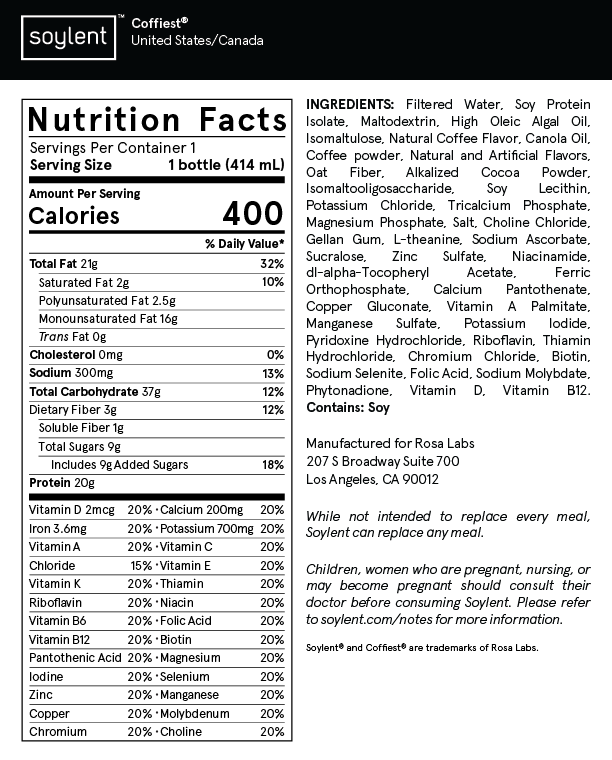
An anonymous reader writes from a report via Ars Technica: Soylent has ventured in a new direction with its latest beverage: breakfast. Called Coffiest, the new offering has the same ingredient makeup, nutritional mix, and 47/33/20 percent fat/carb/protein calorie distribution as the 2.0 premixed version, but it also adds coffee flavoring, 150mg of caffeine per serving, and 75mg of the nootropic L-Theanine. According to Soylent founder Rob Rhinehart, a bottle of Coffiest supplies the drinker with about 400 kilocalories and about 20 percent of the daily recommended values for "all essential vitamins and minerals." "A lot of people are skipping breakfast," Rhinehart told Ars in a phone interview. "We wanted to provide a convenient and also really tasty option for them to enjoy in the morning." Additionally, the company will also be releasing a nutrition bar, called the Soylent Bar. This one will deliver 250 kilocalories per bar, and has a macronutrient breakdown of 38/43/19 percent fat/carb/protein. "Coffee flavor is extremely complex," Rhinehart told Ars. "The direction I gave was a little bit of a more darker, richer roast it's a little darker coffee. A little bit of cocoa powder, just a barely perceptible amount, but it rounds out the flavor nicely." "It was a huge challenge to develop a coffee flavor that would survive processing," he continued. "You can't take any risks with health or safety, so we have to eliminate any sources of contamination from the product and that involves heat. So we had some great food scientists and flavor scientists work out a flavor system that combines natural coffee extracts with an artificial flavor system. And it turned out pretty great." As for the toots, neither Coffiest nor the Soylent Bar will cause consumers to erupt with "horse-killing farts," a complaint made by many of Soylent's customers as well as Ars Technica writer Lee Hutchinson. For those interested in Soylent's latest concoction, Coffiest is available for purchase today at the Soylent site for about $40 for a pack of 12 servings (or $37.05 with a recurring subscription). The Soylent Bar will launch later for about $2 per bar. You can view Coffiest's nutrition facts here.
China

China To UK: 'Golden' Ties At Crucial Juncture Over Nuclear Delay (reuters.com) 170

mdsolar quotes a report from Reuters: China has cautioned Britain against closing the door to Chinese money and said relations were at a crucial juncture after Prime Minister Theresa May delayed signing off on a $24 billion nuclear power project. In China's sternest warning to date over May's surprise decision to review the building of Britain's first nuclear plant in decades, Beijing's ambassador to London said that Britain could face power shortages unless May approved the Franco-Chinese deal. "The China-UK relationship is at a crucial historical juncture. Mutual trust should be treasured even more," Liu Xiaoming wrote in the Financial Times. "I hope the UK will keep its door open to China and that the British government will continue to support Hinkley Point -- and come to a decision as soon as possible so that the project can proceed smoothly." The comments signal deep frustration in Beijing at May's move to delay, her most striking corporate intervention since winning power in the political turmoil which followed Britain's June 23 referendum to leave the European Union.
Mars

NASA Publishes a Thousand Photos of Mars (engadget.com) 62

An anonymous reader writes from a report via Engadget: NASA has released a huge number of high-resolution photos of Mars captured from the Mars Reconnaissance Orbiter's HiRise camera, which has been capturing images of the planet since 2005. The latest dump consists of over a thousand images that can familiarize you with the red planet's many craters, impact sites, dunes, mountains, ice caps and other features. You can view every single photo captured on HiRise's official website. Popular Science mentions that every 26 months or so, Mars and the sun are on the opposite sides of the Earth, allowing MRO to transmit a massive amount of photos from the planet's surface.
Earth

6 Million Americans Exposed To High Levels of Chemicals In Drinking Water, Says Study (businessinsider.com) 166

An anonymous reader quotes a report from Business Insider: A new study out Tuesday in the journal Environmental Science and Technology Letters looked at a national database that monitors chemical levels in drinking water and found that 6 million people were being exposed to levels of a certain chemical that exceed what the Environmental Protection Agency considers healthy. The chemicals, known as poly- and perfluoroalkyl substances, or PFASs, are synthetic and resistant to water and oil, which is why they're used in things like pizza boxes and firefighting foam. They're built to withstand the environment. But PFASs also accumulate in people and animals and have been observationally linked to an increased risk of health problems including cancer. And they can't be easily avoided, like with a water filter, for example. You can view the chart to see the tested areas of the U.S. where PFASs exceed 70 ng/L, which is what's considered a healthy lifetime exposure.
Medicine

University Collects Medical Samples Via Drones In Madagascar (phys.org) 20

An anonymous reader quotes a report from Phys.Org: Stony Brook University is using drones to transport medical samples for laboratory analysis to and from remote parts of Madagascar. Phys.Org reports: "The drones are about the size of a large picnic table and have two sets of wings. They take off and land like helicopters and have a flight range of about 40 miles. Blood and other medical samples can be secured in small compartments in the body of the aircraft. Drones are being used in other parts of the developing world to deliver medications and other supplies to remote areas, but Stony Brook officials say theirs is one of the first efforts involving a small unmanned aircraft that actually lands in remote villages and returns quickly to a laboratory. Diagnosis of ailments, like tapeworm disease, which causes life-threatening seizures and contributes to malnutrition in villages on the island, can now be completed within a few hours, said Dr. Peter Small, founding director of Stony Brook's Global Health Institute. To reach these villages, medical workers have had to travel on foot -- there are no roads -- a trip that takes five to nine hours each way. By drone, they can dispatch the medical samples back to Stony Brook's Centre ValBio research station and get lab results within an hour or two, said Patricia Wright, the station's executive director."

Slashdot Top Deals