Science

Complex Quantum Teleportation Achieved For the First Time (phys.org) 17

An anonymous reader quotes a report from Phys.Org: Researchers from the Austrian Academy of Sciences and the University of Vienna have experimentally demonstrated what was previously only a theoretical possibility. Together with quantum physicists from the University of Science and Technology of China, they have succeeded in teleporting complex high-dimensional quantum states. The research teams report this international first in the journal Physical Review Letters. In their study, the researchers teleported the quantum state of one photon (light particle) to another distant one. Previously, only two-level states ("qubits") had been transmitted, i.e., information with values "0" or "1". However, the scientists succeeded in teleporting a three-level state, a so-called "qutrit." In quantum physics, unlike in classical computer science, "0" and "1" are not an 'either/or' -- both simultaneously, or anything in between, is also possible. The Austrian-Chinese team has now demonstrated this in practice with a third possibility "2".

The quantum state to be teleported is encoded in the possible paths a photon can take. One can picture these paths as three optical fibers. Most interestingly, in quantum physics a single photon can also be located in all three optical fibers at the same time. To teleport this three-dimensional quantum state, the researchers used a new experimental method. The core of quantum teleportation is the so-called Bell measurement. It is based on a multiport beam splitter, which directs photons through several inputs and outputs and connects all optical fibers together. In addition, the scientists used auxiliary photons -- these are also sent into the multiple beam splitter and can interfere with the other photons. Through clever selection of certain interference patterns, the quantum information can be transferred to another photon far from the input photon, without the two ever physically interacting. The experimental concept is not limited to three dimensions, but can in principle be extended to any number of dimensions, as Erhard emphasizes.

United States

Seattle Has Figured Out How To End the War On Drugs (nytimes.com) 316

Nicholas Kristof writes in an opinion piece for The New York Times about Seattle's "bold approach to narcotics that should be a model for America." Instead of being prosecuted for being caught with small amounts of drugs, that person is steered toward social services to get help. "In effect, Seattle is decriminalizing the use of hard drugs," writes Kristof. "It is relying less on the criminal justice toolbox to deal with hard drugs and more on the public health toolbox." From the report: This model is becoming the consensus preference among public health experts in the U.S. and abroad. Still, it shocks many Americans to see no criminal penalty for using drugs illegally, so it takes courage and vision to adopt this approach: a partial retreat in the war on drugs coupled with a stepped-up campaign against addiction. The number of opioid users has surged, and more Americans now die each year from overdoses than perished in the Vietnam, Afghan and Iraq wars combined. And that doesn't account for the way drug addiction has ripped apart families and stunted children's futures. More than two million children in America live with a parent suffering from an illicit-drug dependency.

So Seattle is undertaking what feels like the beginning of a historic course correction, with other cities discussing how to follow. This could be far more consequential than the legalization of pot: By some estimates, nearly half of Americans have a family member or close friend enmeshed in addiction, and if the experiment in Seattle succeeds, we'll have a chance to rescue America from our own failed policies. Decriminalization is unfolding here in part because of Dan Satterberg, the prosecuting attorney for King County, which includes Seattle. It's also arguably underway because of what happened to his little sister, Shelley Kay Satterberg. At the age of 14, Shelley ran away from home because her parents wouldn't let her go to a concert on a school night. It was a rebellion that proved devastating. She was away for several months, was gang-raped by two men, was introduced to hard drugs and began to self-medicate with those drugs to deal with the trauma of rape. Dan told me that he was angry at Shelley -- angry that she had made terrible choices, angry that she had hurt their parents. But over time he also concluded that his own approach of prosecuting drug users accomplished little, except that it isolated them from the family and friends who offered the best support system to escape addiction.
The report mentions a program called Law Enforcement Assisted Diversion (LEAD) that appears to be working. It was started in 2011 by Satterberg and others and has spread across the country, with 59 localities now offering LEAD initiatives or rolling them out. "The idea is that instead of simply arresting drug users for narcotics or prostitution, police officers watch for those who are nonviolent and want help, and divert them to social service programs and intensive case management," writes Kristof.

One 2017 peer-reviewed study found that drug users assigned to the program "were 58 percent less likely to be rearrested, compared with a control group." It also found that "participants were almost twice as likely to have housing as they had been before entering LEAD, and 46 percent more likely to be employed or getting job training." And while it costs about $350 per month per participant to provide case managers, it is still cheaper than jail, courts and costs associated with homelessness.
Science

Graphics That Seem Clear Can Easily Be Misread (scientificamerican.com) 54

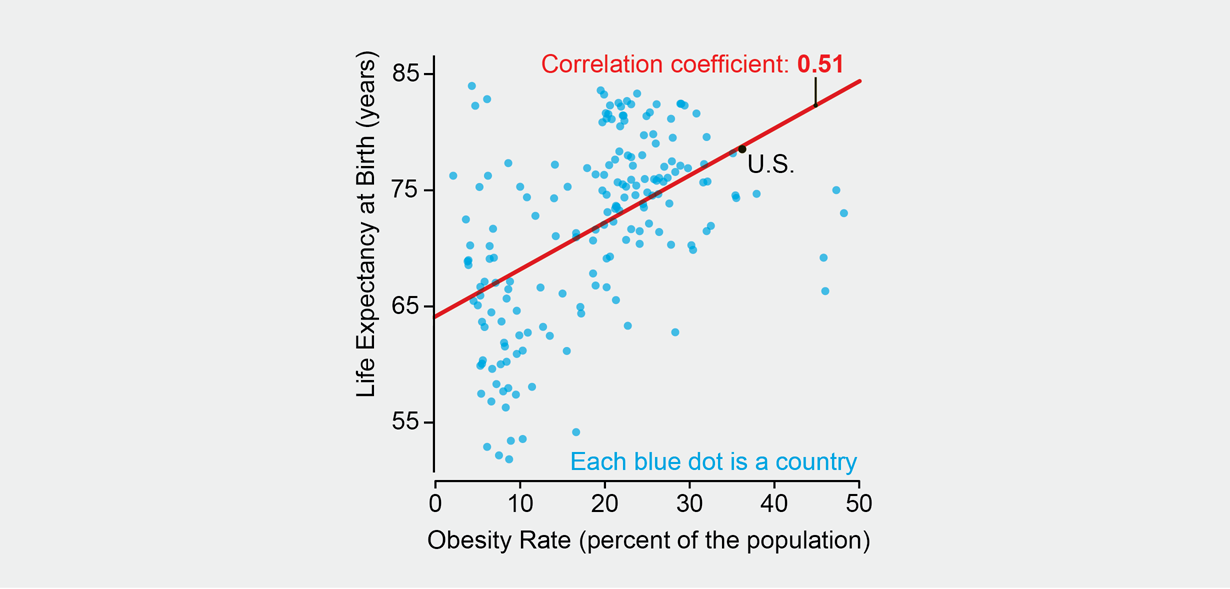
An anonymous reader shares a report: "A picture is worth a thousand words." That saying leads us to believe that we can readily interpret a chart correctly. But charts are visual arguments, and they are easy to misunderstand if we do not pay close attention. Alberto Cairo, chair of visual journalism at the University of Miami, reveals pitfalls in an example diagrammed here. Learning how to better read graphics can help us navigate a world in which truth may be hidden or twisted. Say that you are obese, and you've grown tired of family, friends and your doctor telling you that obesity may increase your risk for diabetes, heart disease, even cancer -- all of which could shorten your life. One day you see this chart. Suddenly you feel better because it shows that, in general, the more obese people a country has (right side of chart), the higher the life expectancy (top of chart). Therefore, obese people must live longer, you think. After all, the correlation (red line) is quite strong.

The chart itself is not incorrect. But it doesn't really show that the more obese people are, the longer they live. A more thorough description would be: "At the national level -- country by country -- there is a positive association between obesity rates and life expectancy at birth, and vice versa." Still, this does not mean that a positive association will hold at the local or individual level or that there is a causal link. Two fallacies are involved. First, a pattern in aggregated data can disappear or even reverse once you explore the numbers at different levels of detail. If the countries are split by income levels, the strong positive correlation becomes much weaker as income rises. In the highest-income nations (chart on bottom right), the association is negative (higher obesity rates mean lower life expectancy). The pattern remains negative when you look at the U.S., state by state: life expectancy at birth drops as obesity rises. Yet this hides the second fallacy: the negative association can be affected by many other factors. Exercise and access to health care, for example, are associated with life expectancy. So is income.

Medicine

Vaping Is Suspected In Severe Lung Illnesses (theverge.com) 166

U.S. health authorities from the Centers for Disease Control and Prevention are investigating the cases of 153 people, mostly teenagers and young adults, who developed several lung illnesses after using electronic cigarettes (Warning: source paywalled; alternative source). The Wall Street Journal reports: The cases have occurred in 16 states over the past two months, with many of the injured rushing to emergency rooms with difficulty breathing and other symptoms. No deaths have been reported, but some patients were so ill they spent days in intensive-care units on mechanical ventilators, the health authorities said. What exactly is causing the acute illnesses is unknown, though health experts suspect vaping plays a role. Vaping refers to the use of an electronic cigarette to inhale.

Many of the injured have told doctors or health authorities they were vaping products containing tetrahydrocannabinol, or THC, a key ingredient in marijuana, according to the Centers for Disease Control and Prevention, which is working with state health departments to identify the cause. At least some of the products were purchased from unlicensed sellers. "Investigators have not identified any specific product or compound that is linked to all cases," the CDC said in a statement. The Food and Drug Administration said it is testing e-cigarette products that the patients used. The health effects of vaping any product, even a well-known brand name, are under research and not yet fully known, tobacco researchers said.

Medicine

Maglev Heart Could Keep Cardiac Patients Alive 49

Bivacor is working toward human trials of their artificial heart after the implant successfully kept a calf alive for 90-days, helping it stay healthy, energetic, and gain weight at a normal rate. It even jogged on a treadmill for 30-minute stretches. Artificial hearts have been discussed among cardiac surgeons and biomedical engineers for more than 50 years, but what makes Bivacor's artificial heart so unique is its use of a levitating disk, suspended in a magnetic field, that spins 2,000 times per minute to keep blood flowing. IEEE Spectrum reports: We had to overcome many technical challenges to make an artificial heart that's small, biocompatible, energy efficient, and durable. Consider that the human heart beats about 112,000 times a day, which adds up to 42 million times a year, and you'll understand the magnitude of the challenge. We've tested the Bivacor heart in 15 cows so far. While the need for animal testing is unfortunate, it's the only way to prove the device's safety and move forward to clinical trials in humans. These Corriente calves, which are relatively small, are the right size to serve as analogues for adult patients. We've also implanted the Bivacor heart in several sheep, which are more representative of patients with smaller bodies, including children. Our tests have shown that the heart holds up well: With its one moving part levitating in a magnetic field, there's no worry that friction and mechanical wear will cause the machine to give out. Our tests have also shown that the device can adapt to the user's cardiovascular requirements.

The Bivacor heart would fit in the palm of your hand -- it's about 650 grams, slightly heavier than an adult human heart. Its shell is made of titanium, a noncorroding material that almost never triggers an immune response. Patients will wear a 4-kg external controller pack that contains two rechargeable batteries (providing about 5 hours of operation each), although they can also plug in directly to a power outlet. Throughout our design process, we used 3D printers to make both titanium and plastic parts for our prototypes, allowing us to rapidly experiment with different geometries. For testing, we built a hardware simulation of the human circulatory system in our engineering office in Los Angeles; this mock-up allows us to validate a device's function thoroughly and repeatedly in a controlled environment, and reduces the need for animal testing.
Science

Researchers Are Creepily Close To Predicting When You're Going To Die (arstechnica.com) 77

An anonymous reader quotes a report from Ars Technica: If death is in the cards, it may also be in your blood. Measurements of 14 metabolic substances in blood were pretty good at predicting whether people were likely to die in the next five to 10 years. The data was published this week in Nature Communications. A team of researchers led by data scientists in the Netherlands came up with the fateful 14 based on data from 44,168 people, aged 18 to 109. The data included death records and measurements of 226 different substances in blood. Of the 44,168 people, 5,512 died during follow-up periods of nearly 17 years.

The researchers then put their death panel to the test. They used the 14 blood measurements to try to predict deaths in a cohort of 7,603 Finnish people who were surveyed in 1997. Of those Finns, 1,213 died during follow-up. Together, the 14 blood measurements were about 83% accurate at predicting the deaths that occurred within both five years and 10 years. The accuracy dropped to about 72% when predicting deaths for people over 60 years old, though.

Facebook

How Flat Earthers Nearly Derailed a Space Photo Book (nytimes.com) 167

An anonymous reader writes: A photographer trying to raise money for a self-published book of historical space artifacts had his Facebook ads repeatedly removed by Facebook because flat-Earthers and Moon hoax conspiracy theorists were offended. About 24 hours after the ads were approved, he got a notification telling him the ad had been removed. He resubmitted it. It was accepted -- and then removed again -- 15 or 20 times, he said. The explanation given: He had run "misleading ads that resulted in high negative feedback."

He understood that it was Facebook's algorithm that rejected the ads, not a person. Getting additional answers proved difficult, a common complaint with advertising on Facebook. The best clues he could find came in the comments under the ads, which he and his colleagues captured in screenshots before they were removed and in responses to other posts about the project: There were phrases such as "The original moon landing was faking" and "It's all a show," along with memes mocking space technology. Some comments were hard to gauge, with users insisting that the earth was flat but that they'd buy the book anyway.

Mr. Redgrove didn't entirely blame the commenters. If these were their beliefs, then of course they were going to be annoyed by the ads. But how these individuals had ended up with the power to derail his campaign perplexed him. "They don't really have their systems in place to protect people," Mr. Redgrove said of Facebook. Facebook said it could not immediately comment on what had gone wrong. On Thursday, after the publication of this article, a representative for the company said it had investigated the issue and had confirmed that, as Mr. Redgrove had said, all the ads were originally approved.

Medicine

Pig To Human Heart Transplants 'Possible Within Three Years' (theguardian.com) 83

An anonymous reader quotes a report from The Guardian: Adapted pig hearts could be transplanted into patients within three years, according to a report citing the surgeon who pioneered heart transplantation in the UK. On the 40th anniversary of the first successful heart transplant, Sir Terence English told The Sunday Telegraph that his protege from that operation would try to replace a human kidney with a pig's this year. "If the result of xenotransplantation is satisfactory with porcine kidneys to humans, then it is likely that hearts would be used with good effects in humans within a few years," the 87-year-old said. "If it works with a kidney, it will work with a heart. That will transform the issue." The anatomy and physiology of a pig's heart is similar to that of a human's, so they are used as models for developing new treatments.
Space

NASA Mission To Jupiter Moon Europa Moves Step Closer To Launch (theguardian.com) 26

A NASA mission to explore the most tantalizing of Jupiter's 79 moons has been given the green light to proceed to the final stages of development. From a report: Europa -- which is slightly smaller than our own moon -- has long been considered a possible candidate in the hunt for alien life. Evidence suggests there is an ocean below the moon's thick, icy crust that might be tens of miles deep. Scientists believe this body of water could contain the right chemical cocktail for life and could even be home to some form of living organisms. Europa appears to have the hat-trick of conditions needed to kick off life: water, possibly chemistry, and energy in the form of tidal heating, a phenomenon arising from gravitational tugs acting on the moon. This could not only drive chemical reactions but also aid movement of chemical substances between rock, surface and ocean, possibly through hydrothermal vents.

It is proposed that the NASA mission, named Europa Clipper, will make a number of close flybys -- it cannot orbit the moon as Jupiter's radiation belt would fry its electronics -- carrying cameras and intruments to measure the moon's magnetic field. The mission will look for subsurface lakes and provide data on the thickness of the moon's icy crust. The team also hope to confirm the presence of plumes of water, previously detected by NASA's Galileo spacecraft and the Hubble space telescope. If confirmed, it would mean scientists would not need to find a way of hacking through the moon's icy crust to explore the makeup of the ocean.

Science

A Diet Based on Caloric Restriction Might Make You Live Longer. It'll Certainly Feel Like Longer. (technologyreview.com) 168

A diet based on caloric restriction might make you live longer. It'll certainly feel like longer. Called Prolon, it's a five-day, $250 meal kit which arrives in a white cardboard container a little bigger than a shoebox. It involves eating about 800 calories each day. The idea is that temporarily shifts your body into a starvation state, prompting your cells to consume years of accumulated cellular garbage before unleashing a surge of restorative regeneration. The idea that starving yourself while still taking in crucial nutrients will let you live longer is not new. The practice, called caloric restriction, is the only proven way to extend life in a wide variety of creatures. There are currently trials underway to see if the diet might help protect human patients from the ravages of chemotherapy, too. However, experiments have found that doing it for extended periods is a problem, and probably not practical for most people. Research on the "fast-mimicking diet" is still limited, but the Prolon diet has been sold in 15 countries and tried by more than 150,000 people. Read how Adam Piore got on when he tried it out.
Space

How SpaceX Plans To Move Starship From Cocoa Site To Kennedy Space Center (clickorlando.com) 42

New submitter RhettLivingston writes: Real plans for the move of Starship Mk 2 from its current construction site in Cocoa to the Kennedy Space Center have finally emerged. A News 6 Orlando report identifies permit applications and observed preparations for the move,which will take a land and sea route. Barring some remarkably hasty road compaction and paving, the prototype will start its journey off-road, crossing a recently cleared path through vacant land to reach Grissom Parkway. It will then travel east in the westbound lanes of SR 528 for a short distance before loading to a barge in the Indian river via a makeshift dock. The rest of the route is relatively conventional, including offloading at KSC at the site previously used for delivery of the Space Shuttle's external fuel tanks. Given the recent construction of new facilities at the current construction site, it is likely that this will not be the last time this route is utilized. SpaceX declined to say how the company will transport the spacecraft or when the relocation will occur.

SpaceX's "Mk2" orbital Starship prototype is designed to test out the technologies and basic design of the final Starship vehicle -- a giant passenger spacecraft that SpaceX is making to take people to the Moon and Mars.
Space

Scientists Are 99 Percent Sure They Just Detected a Black Hole Eating a Neutron Star (vice.com) 41

An anonymous reader quotes a report from Motherboard: On Wednesday, a gravitational wave called S190814bv was detected by the U.S.-based Laser Interferometer Gravitational-Wave Observatory (LIGO) and its Italian counterpart Virgo. Based on its known properties, scientists think there is a 99% probability that the source of the wave is a black hole that ate a neutron star. In contrast to black hole mergers, neutron star collisions do produce a lot of light. When a gravitational wave from a neutron star crash was detected in 2017, scientists were able to pinpoint bright emissions from the event -- called an optical counterpart -- in the days that followed the wave detection. This marked the dawn of a technique called "multi-messenger astronomy," in which scientists use multiple types of signals from space to examine astronomical objects.

Ryan Foley, an astronomer at UC Santa Cruz, was part of the team that tracked down that first optical counterpart, a feat that has not yet been repeated. He and his colleagues are currently scanning the skies with telescopes, searching for any light that might have been radiated by the new suspected merger of a black hole and neutron star. If the team were to pick up light from the event within the coming weeks, they would be witnessing the fallout of a black hole spilling a neutron star's guts while devouring it. This would provide a rare glimpse of the exotic properties of these extreme astronomical objects and could shed light on everything from subatomic physics to the expansion rate of the universe.
"We've never detected a neutron star and a black hole together," said Foley. "If it turns out to be right, then we've confirmed a new type of star system. It's that fundamental." He added: "If you learn about how neutron stars are built, that can tell you about how atoms are built. This is something that is fundamental to everything in our daily life works."
Moon

Newt Gingrich Trying To Sell Trump on a Cheap Moon Plan (politico.com) 95

WindBourne writes: Newt Gingrich and an eclectic band of NASA skeptics are trying to sell President Donald Trump on a reality show-style plan to jump-start the return of humans to the moon -- at a fraction of the space agency's estimated price tag. The proposal, whose other proponents range from an Air Force lieutenant general to the former publicist for pop stars Michael Jackson and Prince, includes a $2 billion sweepstakes pitting billionaires Elon Musk, Jeff Bezos and other space pioneers against each other to see who can establish and run the first lunar base, according to a summary of the plan shared with POLITICO. That's far less taxpayer money than NASA's anticipated lunar plan, which relies on traditional space contractors, such as Boeing and Lockheed Martin, and is projected to cost $50 billion or more. Backers of the novel approach have briefed administration officials serving on the National Space Council, several members of the group confirmed, though they declined to provide specifics of the internal conversations.
Science

Researchers Find New State of Matter, Claim It Could Aid Quantum Computing and Data Storage (nyu.edu) 19

"A team of physicists has uncovered a new state of matter -- a breakthrough that offers promise for increasing storage capabilities in electronic devices and enhancing quantum computing," according to an announcement from NYU: "Our research has succeeded in revealing experimental evidence for a new state of matter -- topological superconductivity," says Javad Shabani, an assistant professor of physics at New York University. "This new topological state can be manipulated in ways that could both speed calculation in quantum computing and boost storage...."

In their research, Shabani and his colleagues analyzed a transition of quantum state from its conventional state to a new topological state, measuring the energy barrier between these states.... "The new discovery of topological superconductivity in a two-dimensional platform paves the way for building scalable topological qubits to not only store quantum information, but also to manipulate the quantum states that are free of error," observes Shabani.

The research was funded, in part, by a grant from the U.S. Department of Defenseâ(TM)s Defense Advanced Research Projects Agency (DARPA).

Youtube

YouTube's Algorithms Blamed For Brazil's Dangerous Conspiracy Video-Sharing on WhatsApp (nytimes.com) 69

Sunday the New York Times reported that YouTube "radicalized" Brazil -- by "systematically" diverting users to conspiracy videos. Yet conventional wisdom in Brazil still puts the blame on WhatsApp, the Times reported in a follow-up story on Thursday shared by Slashdot reader AmiMoJo.

"Everything began to click into place when we met Luciana Brito, a soft-spoken clinical psychologist who works with families affected by the Zika virus." Her work had put her on the front lines of the struggle against conspiracy theories, threats and hatred swirling on both platforms. And it allowed her to see what we -- like so many observers -- had missed: that WhatsApp and YouTube had come to form a powerful, and at times dangerous, feedback loop of extremism and misinformation. Either platform had plenty of weaknesses on its own. But, together, they had formed a pipeline of misinformation, spreading conspiracy theories, campaign material and political propaganda throughout Brazil.

The first breakthrough came when we spoke to Yasodara Cordova, who at the time was a researcher at Harvard's Berkman Center for Internet and Society. Illiteracy remains widespread in some parts of Brazil, she said, ruling out text-based social media or news sources for many people. And TV networks can be low-quality, which has helped drive YouTube's stunning growth in many parts of Brazil, particularly on mobile. But YouTube has had less success in poorer regions of Brazil for one simple reason: Users cannot afford the cellphone data. "The internet in Brazil is really expensive," Ms. Cordova said. "I think it's the fourth or fifth country in terms of internet prices."

WhatsApp has become a workaround. The messaging app has a deal with some carriers to offer free data on the app, and poorer users found that this offered them a way around YouTube's unaffordability. They would share snippets of YouTube videos that they found on WhatsApp, where the videos can be watched and shared for free. Ms. Cordova suspected that the WhatsApp-spread misinformation had often come from videos that first went viral on YouTube, where they had been boosted by the extremism-favoring algorithms that we documented in our story earlier this week... It was like an infection jumping from one host to the next.

Some of the videos blame the mosquito-bourne Zika virus on vaccines or suggest an international conspiracy, while some were "staged to resemble news reports or advice from health workers," the Times reports -- adding that as of Thursday the videos were still being recommended by YouTube's algorithm. (A spokesperson for YouTube "called the results unintended, and said the company would change how its search tool surfaced videos related to Zika.")

Researchers say conspiracy videos were even shown to people who'd searched for reputable information on the virus, the Times reports. "The videos often spread in WhatsApp chat groups that had been set up to share information and news about coping with Zika, turning users' efforts to take control of their families' health against them."

YouTube told the Times that their recommendation system now drives 70% of total time spent on YouTube -- and according to their article Thursday, Dr. Brito estimates that she now receives serious threats on her life about once a week.

Slashdot Top Deals