Privacy

Washington Restaurants Will Need To Track Diners' Info As Part of Reopening Requirements (eater.com) 226

If you choose to go out to eat at a restaurant in Washington, you will have to give the restaurant your name, phone number and email to facilitate contact tracing. This is just one of the guidelines that restaurants must adopt before resuming dine-in services during "phase two" of Washington's reopening plan. Eater Seattle reports: As announced previously, dining rooms can reopen at 50 percent capacity in this phase, with no more than five people at a table. But now there are several other strict requirements, including eliminating bar seating, distributing single-use menus, and logging diners' personal info to facilitate contact tracing, a rigorous method of tracking and monitoring those who may have been exposed to the novel coronavirus. That last requirement is one that perhaps may generate the most discussion. According to the state's phase two playbook, restaurants that offer table service must plan to keep a daily log of phone numbers, emails, and arrival times for everybody who comes in to eat. Diners are already used to giving restaurants such details to make a reservation, but Washington's rules state that all customers must be logged, not just one per party. At a press conference on Tuesday, Gov. Jay Inslee addressed some concerns over privacy, saying that the state would have the legal authority to prevent any data collected from restaurants for being used for purposes other than contact tracing (such as advertisements). "We would monitor it, we would audit it," Inslee said, adding that he's still working with leaders in the restaurant industry on coming up with a set of protocols that make sense. "It's very important for us to maintain privacy in this entire endeavor."
United States

Large Chunks of a Chinese Rocket Missed NYC By About 15 Minutes (arstechnica.com) 185

An anonymous reader quotes a report from Ars Technica: A week ago, China launched the newest version of its largest rocket, the Long March 5B, from its southernmost spaceport. The launch proceeded normally and represented another success for China as it seeks to build a robust human spaceflight program. Over the next few years, this rocket will launch components of a modular space station. Notably, because of this rocket's design, its large core stage reached orbit after the launch. Typically during a launch, a rocket's large first stage will provide the majority of thrust during the first minutes of launch and then drop away before reaching an orbital velocity, falling back into the ocean. Then, a smaller second stage takes over and pushes the rocket's payload into orbit. However, the Long March 5B rocket has no second stage. For last week's launch, then, four liquid-fueled strap-on boosters generated most of the thrust off the launch pad. After this, the core stage with two YF-77 main engines pushed an experimental spacecraft into orbit before the payload separated.

This left the large core stage, with a mass slightly in excess of 20 tons, in an orbit with an average altitude of about 260km above the Earth. Because the perigee of this orbit was only about 160km above the planet, the core stage was slowly drawn back toward the planet as it interacted with the planet's upper atmosphere. This is a rather large object to make an uncontrolled return to Earth. According to Jonathan McDowell, an astronomer at the Harvard-Smithsonian Center for Astrophysics and keen observer of satellites, this is the largest vehicle to make an uncontrolled reentry into Earth's atmosphere since 1991, when the Soviet Salyut 7 space station broke up over Argentina. [...] It is perhaps worth noting that before it entered Earth's atmosphere, the core stage track passed directly over New York City. Had it reentered the atmosphere only a little bit earlier, perhaps 15 to 20 minutes, the rocket's debris could have rained down on the largest metro area in the United States.

United States

Fauci Warns 'Little Spikes' of Coronavirus Might Turn Into Outbreaks if States Reopen Too Soon (nbcnews.com) 401

Dr. Anthony Fauci on Tuesday warned of serious consequences if governors reopen state economies prematurely, saying he fears spikes in coronavirus infections could morph into further outbreaks of the disease. From a report: Testifying by videoconference before the Senate Health, Education, Labor and Pensions Committee, Fauci, the nation's top infectious disease expert, ticked through the criteria that the White House said states should meet before reopening. "My concern [is] that if some areas, city, states, or what have you, jump over those various checkpoints and prematurely open up without having the capability of being able to respond effectively and efficiently, my concern is that we will start to see little spikes that might turn into outbreaks," Fauci said in response to a question from Sen. Patty Murray, D-Wash.

Fauci and two of the other witnesses -- Dr. Robert Redfield, director of the Centers for Disease Control and Prevention, and Stephen Hahn, the head of the Food and Drug Administration -- are testifying by videoconference Tuesday because they self-quarantining after possible exposure to COVID-19. The fourth witness, Adm. Brett Giroir, assistant secretary for health and the administration's coronavirus testing coordinator, also testified remotely but is not in self-quarantine. Murray, the top Democrat on the committee, said in her opening statement that the U.S. needs "dramatically more testing," but added that testing "alone won't be enough to reopen our country."

Space

Scientists Get Their Best-Ever Look At Jupiter's Atmosphere and Storms (space.com) 13

Scientists have gotten their most detailed view of the wild storms that swirl through the gas giant's atmosphere. Space.com reports: Every 53 days, Juno skims over Jupiter's cloud tops in a close approach called a perijove, gathering data all the while. Among the spacecraft's instruments is a microwave radiometer, which is tuned to identify lightning strikes and study what ammonia and water vapor are doing in the gas giant's atmosphere. The scientists behind the new research arranged to target Hubble and Gemini to study Jupiter in coordination with Juno's schedule. So while Juno studies a swath of the gas giant as it passes overhead, Hubble and Gemini study the bigger picture of atmospheric activity on Jupiter.

Juno has made 26 flybys of the gas giant to date, which means the trio of observatories have built up quite a data set about Jupiter's atmosphere, and scientists have only released the most preliminary findings to date. But those findings already suggested that lightning was most common in a feature that scientists call a filamentary cyclone. "These cyclonic vortices could be internal energy smokestacks, helping release internal energy through convection," Michael Wong, an astronomer at the University of California, Berkeley, and lead author on the new research, said in the NASA statement. That convection pulls layers of Jupiter's atmosphere up and down depending on factors like temperature and humidity. Earth's atmosphere does this as well, but not in exactly the same way.

In the meantime, the researchers behind the observatory collaboration have already answered one longstanding question about Jupiter's atmosphere, specifically the Great Red Spot storm that has roiled for centuries. Astronomers had long wondered whether transient seemingly dark spots in the storm are caused by a different compound in the atmosphere or by gaps in the cloud cover. And combining the data gathered in close succession by Hubble and Gemini allowed scientists to answer that question: because the dark spots shine brightly in infrared, as deep water clouds do, they seem to represent gaps in upper clouds.
"The scientists are also using the data set to analyze zonal winds, atmospheric waves, convective storms, cyclonic vortices and polar atmospheric phenomena like hazes -- and, of course, they anticipate that plenty of other scientific puzzles will benefit from the observations as well," the report adds.
Medicine

Ask Slashdot: How Are You Handling COVID-19? 313

turp182 writes: What's your story? How are you doing? What do you predict? Below is a summary of the stats I've been following, some assumptions, and an overview of my personal situation. Anyway, how you all doing?
Medicine

WHO Conditionally Backs Covid-19 Vaccine Trials that Infect People (theguardian.com) 71

Controversial trials in which volunteers are intentionally infected with Covid-19 could accelerate vaccine development, according to the World Health Organization, which has released new guidance on how the approach could be ethically justified despite the potential dangers for participants. From a report: So-called challenge trials are a mainstream approach in vaccine development and have been used in malaria, typhoid and flu, but there are treatments available for these diseases if a volunteer becomes severely ill. For Covid-19, a safe dose of the virus has not been established and there are no failsafe treatments if things go wrong. Scientists, however, increasingly agree that such trials should be considered, and the WHO is the latest body to indicate conditional support for the idea. "There's this emerging consensus among everyone who has thought about this seriously," said Prof Nir Eyal, the director of Rutgers University's Center for Population-Level Bioethics in the US.
Space

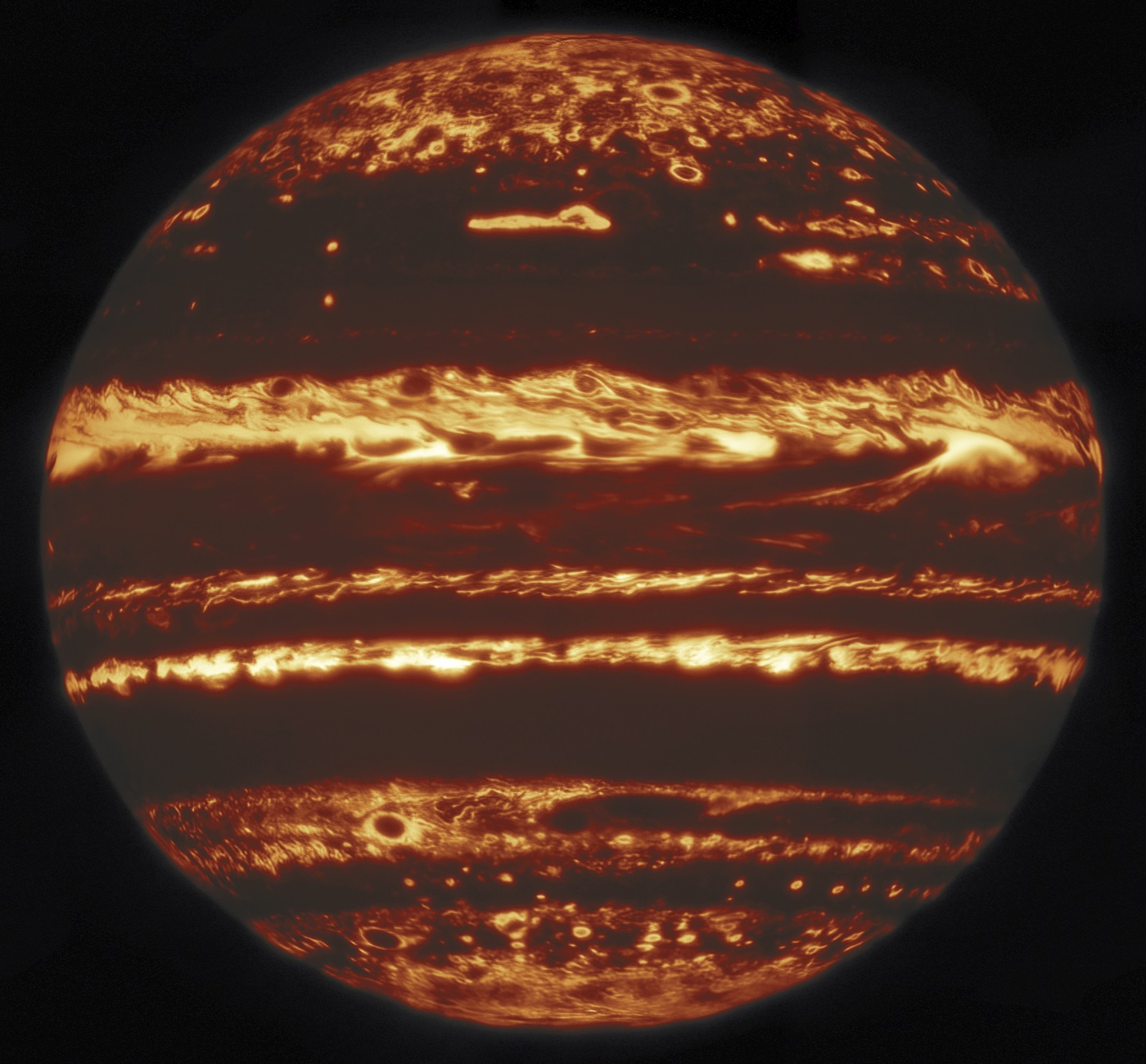
High-Resolution Telescope Images Solve a Mystery About Jupiter's Great Red Spot (gemini.edu) 34

Researchers have collected some of the highest resolution images of Jupiter ever obtained from earth -- by combining images from Hawaii's Gemini North telescope with images from the Hubble Space Telescope and NASA's Juno probe (currently orbiting Jupiter).

The images -- assembled from three years of observations -- "confirm that dark spots in the famous Great Red Spot are actually gaps in the cloud cover and not due to cloud color variations," explains an announcement from the Gemini Observatory. Gemini North's Near Infrared Imager (NIRI) allows astronomers to peer deep into Jupiter's mighty storms, since the longer wavelength infrared light can pass through the thin haze but is obscured by thicker clouds high in Jupiter's atmosphere. This creates a "jack-o-lantern"-like effect in the images where the warm, deep layers of Jupiter's atmosphere glow through gaps in the planet's thick cloud cover... A large number of very short exposure images are obtained and only the sharpest images, when the Earth's atmosphere is briefly stable, are used...

The ultra-sharp Gemini infrared images complement optical and ultraviolet observations by Hubble and radio observations by the Juno spacecraft to reveal new secrets about the giant planet... The detailed, multiwavelength imaging of Jupiter by Gemini and Hubble has, over the past three years, proven crucial to contextualizing the observations by the Juno orbiter, and to understanding Jupiter's wind patterns, atmospheric waves, and cyclones. The two telescopes, together with Juno, can observe Jupiter's atmosphere as a system of winds, gases, heat, and weather phenomena, providing coverage and insight much like the network of weather satellites meteorologists use to observe Earth.

The resolution was so high, the astronomer leading the observations says their telescope "could resolve the two headlights of a car in Miami, seen from New York City."
The Media

'Murder Hornet' Meme Inspires Stupid Americans To Kill Pollinators En Masse (latimes.com) 169

An anonymous reader writes: You really can't make this stuff up, but Americans across the country, out of fear of "murder hornets," have begun killing all kinds of bees en masse. According to Doug Yanega, senior museum scientist for the Department of Entomology at UC Riverside, a national panic has led to the needless slaughter of native wasps and bees, beneficial insects whose populations are already threatened...

"Folks in China, Korea and Japan have lived side by side with these hornets for hundreds of years, and it has not caused the collapse of human society there. My colleagues in Japan, China and Korea are just rolling their eyes in disbelief at what kind of snowflakes we are..."

"I don't want to downplay this — they are logistically dangerous insects. But having people in Tennessee worry about this is just ridiculous. The only people who should be bothering experts with concerns about wasp IDs are living in the northwest quadrant of Washington (state). And really, right now, nobody else in the country should even be thinking about this stuff," he continued.

"The facts are, experts said, two dead hornets were found in Washington last December, a lone Canadian live nest was found and wiped out last September and no live hornets have yet been seen this year," reports the Associated Press.

And when they spoke to the Washington Agriculture Department entomologist working on the state's response, he issued an additional correction for all the journalists covering this story. "They are not 'murder hornets.' "They are just hornets."
Biotech

Paris Tries AI That Counts How Many People are Wearing Face Masks (theverge.com) 14

"France is integrating new AI tools into security cameras in the Paris metro system to check whether passengers are wearing face masks," reports the Verge: The software, which has already been deployed elsewhere in the country, began a three-month trial in the central Chatelet-Les Halles station of Paris this week, reports Bloomberg. [Alternate source] French startup DatakaLab, which created the program, says the goal is not to identify or punish individuals who don't wear masks, but to generate anonymous statistical data that will help authorities anticipate future outbreaks of COVID-19... "The goal is just to publish statistics of how many people are wearing masks every day."

The pilot is one of a number of measures cities around the world are introducing as they begin to ease lockdown measures and allow people to return to work. Although France, like the US, initially discouraged citizens from wearing masks, the country has now made them mandatory on public transport. It's even considering introducing fines of €135 ($145) for anyone found not wearing a mask on the subway, trains, buses, or taxis....

The software is lightweight enough to work on location wherever installed, meaning no data is ever sent to the cloud or to DatakaLab's offices. Instead, the software generates statistics about how many individuals are seen wearing masks in 15-minute intervals. The company has already integrated the software into buses in the French city of Cannes in the south of the country. It added small CPUs to existing CCTV cameras installed in buses, which process the video in real time. When the bus returns to the depot at night, it connects to Wi-Fi and sends the data on to the local transport authorities.

The Military

US Space Force Releases First Recruitment Video, Acknowledges Netflix Comedy 'Space Force' (cnet.com) 45

The newly-created U.S. Space Force has released its first recruitment video, CNET reports: In a video posted Wednesday to Twitter showing rockets, mission control-types rooms and U.S. Space Force members in spacesuits, a voice-over says, "maybe your purpose on this planet isn't on this planet." Secretary of the Air Force Barbara Barrett said during a livestream Wednesday that so far recruitment hasn't been a problem for the Space Force. "There's been an avalanche of applicants." This sixth branch of the US military was established in December 2019 and will be operational by mid-2021.
CNET notes the video appeared "a day after Netflix dropped a trailer for its upcoming comedy Space Force. And the leader of the U.S. Space Force says he's looking forward to the Netflix comedy co-created by Steve Carell.

"The one piece of advice I'd give to Steve Carell is to get a haircut," Gen. Jay Raymond, the U.S. Space Force Chief of Space Operations, said Wednesday during a webinar hosted by the nonprofit Space Foundation. Raymond is bald, and joked that Steve Carell is "looking a little too shaggy if he wants to play the Space Force chief."
Businesses

Elon Musk Threatens to Move Tesla's HQ After County Blocks Its Reopening (arstechnica.com) 359

Saturday Elon Musk announced he'd "immediately" relocate Tesla's headquarters and "future programs" to Texas and Nevada, reports Ars Technica.

While California lifted its restrictions on manufacturers and businesses, the county of Alameda (where Tesla is located) says the company's manufacturing plant does not yet meet the county's requirements for safely reopening. "Frankly, this is the final straw," Musk tweeted. Musk also announced his intent to file a lawsuit against Alameda County officials "immediately," adding, "The unelected & ignorant 'Interim Health Officer' of Alameda is acting contrary to the Governor, the President, our Constitutional freedoms & just plain common sense!" Musk also encouraged Tesla shareholders to file a class-action suit against the county.

The latest back-and-forth between Tesla and Alameda County officials began on Thursday, when a memo sent to Tesla employees indicated that its Fremont plant would reopen "at 30% our normal headcount per shift," as reported by TechCrunch. Alameda officials responded on Friday with a firm reminder that the county's stay-in-place order would remain in effect for Tesla, and all other "non-essential" operations in the county, until May 31, with the exception of "basic" operations...

"We have informed Tesla of all of the conditions that must exist for phasing in the safe reopening of various sectors of the economy and the community. Tesla has been informed that they do not meet those criteria and must not reopen. We welcome Tesla's proactive work on a reopening plan so that once they fit the criteria to reopen, they can do so in a way that protects their employees and the community at large."

Biotech

3D Printed N95 Montana Mask Design Released Under GPLv3 (makethemasks.com) 52

Long-time Slashdot reader blackbearnh writes: Since the COVID-19 pandemic has made Personal Protective Equipment worth it's weight in gold, Makers have been trying to help bridge the gap. While sewn masks have been the most common solution, the 3D printing community has been pitching in as well. The Montana Mask has been one of the most popular designs...

Thursday, the group Make the Masks announced that the design files and STLs to print the mask have been released under the GNU General Public License v3, allowing anyone to print, sell, remix or improve the design, as long as they conform to the license. Importantly, the GPLv3 includes an international non-exclusive patent grant, meaning that even if the inventors decide to apply for a patent, it will not restrict anyone from using the design.

Medicine

Largest Study To Date Finds Hydroxychloroquine Doesn't Help Coronavirus Patients (time.com) 236

A new hydroxychloroquine study -- "the largest to date" -- was published Thursday in the prestigious New England Journal of Medicine. It concluded that Covid-19 patients taking the drug "do not fare better than those not receiving the drug," reports Time: Dr. Neil Schluger, chief of the division of pulmonary, allergy and critical care medicine at Columbia, and his team studied more than 1,300 patients admitted to New York-Presbyterian Hospital-Columbia University Irving Medical Center for COVID-19. Some received hydroxychloroquine on an off-label basis, a practice that allows doctors to prescribe a drug that has been approved for one disease to treat another — in this case, COVID-19. About 60% of the patients received hydroxychloroquine for about five days.

They did not show any lower rate of needing ventilators or a lower risk of dying during the study period compared to people not getting the drug.

"We don't think at this point, given the totality of evidence, that it is reasonable to routinely give this drug to patients," says Schluger. "We don't see the rationale for doing that." While the study did not randomly assign people to receive the drug or placebo and compare their outcomes, the large number of patients involved suggests the findings are solid. Based on the results, Schluger says doctors at his hospital have already changed their advice about using hydroxychloroquine to treat COVID-19. "Our guidance early on had suggested giving hydroxychloroquine to hospitalized patients, and we updated that guidance to remove that suggestion," he says.

In another study conducted at U.S. veterans hospitals where severely ill patients were given hydroxychloroquine, "the drug was found to be of no use against the disease and potentially harmful when given in high doses," reports the Chicago Tribune.

They also report that to firmly establish whether the drug has any effect, the Bill and Melinda Gates Foundation is now funding a randomized, controlled trial at six medical institutions of hundreds of people who've tested positive for Covid-19.
Science

Caddis Fly Larvae Are Now Building Shelters Out of Microplastics (arstechnica.com) 26

An anonymous reader quotes a report from Ars Technica: Crawling along the world's river bottoms, the larvae of the caddis fly suffer a perpetual housing crisis. To protect themselves from predators, they gather up sand grains and other sediment and paste them all together with silk, forming a cone that holds their worm-like bodies. As they mature and elongate, they have to continuously add material to the case -- think of it like adding rooms to your home for the rest of your life, or at least until you turn into an adult insect. If the caddis fly larva somehow loses its case, it's got to start from scratch, and that's quite the precarious situation for a defenseless tube of flesh. And now, the microplastic menace is piling onto the caddis fly's list of tribulations.

Microplastic particles -- pieces of plastic under 5 millimeters long -- have already corrupted many of Earth's environments, including the formerly pristine Arctic and deep-sea sediments. In a study published last year, researchers in Germany reported finding microplastic particles in the cases of caddis flies in the wild. Then, last month, they published the troubling results of lab experiments that found the more microplastic particles a caddis fly larva incorporates into its case, the weaker that structure becomes. That could open up caddis flies to greater predation, sending ripple effects through river ecosystems.
In the lab, the researchers found that the larvae chose to use two kinds of microplastics to build their cases, likely because the plastic is lighter than the sand, so it's not as hard to lift. The problem is that the cases with more plastic and less sand collapse more easily, weakening the larvae's protection from predatory fish, among other things.

A more long-term concern is bioaccumulation. "A small fish eats a larva, a bigger fish eats the smaller fish, all the way on up, and the concentrations of microplastic and associated toxins accumulate over time," the report says. "The bigger predators that people eat, like tuna, may be absorbing those microplastics and the chemicals they leach."

The study has been published in the journal Environmental Science and Pollution Research.
Space

SpaceX's Starship SN4 Prototype Fires Rocket Engine For First Time (space.com) 19

SpaceX's newest Starship prototype has fired its engine for the first time, potentially paving the way for a test flight in the very near future. Space.com reports: The SN4, the latest test version of SpaceX's Mars-colonizing Starship vehicle, aced a "static fire" Tuesday night (May 5), lighting up its single Raptor engine briefly while remaining on the ground at the company's South Texas facilities. "Starship SN4 passed static fire," SpaceX founder and CEO Elon Musk said via Twitter late on Tuesday. [You can see video of the static fire here.] With the static fire in the rearview mirror, SpaceX can begin prepping the SN4 for its next big moment: an uncrewed test flight, which Musk has said will take the vehicle to a target altitude of about 500 feet (150 meters).

Slashdot Top Deals