Medicine

Human Zika Antibodies Prevent Infection in Mice (voanews.com) 12

An anonymous reader quotes VOA News: Chinese researchers have identified broadly neutralizing human antibodies from a Zika patient that protected mice against infection with the mosquito-borne illness. The substances are part of a growing arsenal of antibody-related treatments to fight the disease, which causes severe birth defects in babies... Unlike other Zika-neutralizing antibodies that have been isolated from human patients, the newly-discovered antibodies only target the virus.
Medicine

RIP Dr. Henry Heimlich, Inventor of the Heimlich Maneuver (bbc.com) 51

tomhath quotes the BBC: Dr Heimlich died at the age of 96. He invented the lifesaving technique, which uses abdominal thrusts to clear a person's airway, in 1974. In May he used the technique himself to save a woman at his retirement home. He dislodged a piece of meat with a bone in it from the airway of an 87-year-old woman, telling the BBC: "I didn't know I really could do it until the other day."
Power

Scientific American Column: 'It's Not Cold Fusion...But It's Something' (scientificamerican.com) 188

An anonymous reader writes: Scientific American magazine has published a guest column on low-energy nuclear reactions (LENR) [putting] into context the history of what was mistakenly referred to as cold fusion and what happened. The bottom line is that there is compelling cumulative evidence for nuclear reactions taking place, including shifts in the abundance of isotopes, element transmutations, and localized melting of metals. Furthermore, those reactions do not have the characteristics of either nuclear fission or nuclear fusion. Despite sharp criticism from much of the scientific community after the 1989 announcement by Fleischmann and Pons, the Department of the Navy's Space and Naval Warfare Systems Center and other reputable organizations continued the research and published many papers. The article reports that "to the surprise of many people, a new field of nuclear research has emerged," adding that even in the early 20th century, atomic scientists were already reporting "inexplicable experimental evidence of elemental transmutations."
Moon

Apollo 11 Moon Rock Bag Belongs To Buyer, Not NASA, Judge Rules (behindtheblack.com) 63

schwit1 quotes a report from Behind The Black: A federal judge has ruled that NASA has no right to confiscate an Apollo 11 lunar rock sample bag that had been purchased legally, even though the sale itself had been in error. CollectSPACE.com reports: "Judge J. Thomas Marten ruled in the U.S. District Court for Kansas that Nancy Carlson of Inverness, Illinois, obtained the title to the historic artifact as 'a good faith purchaser, in a sale conducted according to law.' The government had petitioned the court to reverse the sale and return the lunar sample bag to NASA. 'She is entitled to possession of the bag,' Marten wrote in his order." This court case will hopefully give some legal standing to the private owners of other artifacts or lunar samples that NASA had given away and then demanded their return, decades later. Space.com's report adds: "The zippered cloth pouch, which was labeled in bold black letters 'Lunar Sample Return,' was used on July 20, 1969, as an 'outer decontamination bag' to protect the first moon rocks retrieved from the surface of the moon as they were delivered to Earth by Apollo 11 astronauts Neil Armstrong, Buzz Aldrin and Michael Collins. Carlson purchased the bag for $995 in February 2015, at a Texas auction held on behalf of the U.S. Marshals Service. The bag had been forfeited along with other artifacts found in the home of Max Ary, a former curator convicted in 2006 of stealing and selling space artifacts that belonged to the Cosmosphere space museum in Hutchinson, Kansas."
Earth

Researchers Find Roads Shatter the Earth's Surface Into 600,000 Fragments (phys.org) 143

An international team of conservation scientists have released a new global map of roadless areas that shows that the Earth's surface is shattered by roads into more than 600,000 fragments. While roads allow humans to travel to nearly every region in the world, they severely reduce the ability of ecosystems to function effectively. Phys.Org reports: Recent research carried out by an international team of conservation scientists and published in the journal Science used a dataset of 36 million kilometers of roads across the landscapes of the earth. They are dividing them into more than 600,000 pieces that are not directly affected by roads. Of these remaining roadless areas only 7 percent are larger than 100 km2. The largest tracts are to be found in the tundra and the boreal forests of North America and Eurasia, as well as some tropical areas of Africa, South America and Southeast Asia. Only 9 percent of these areas undisturbed by roads are protected. Roads introduce many problems to nature. For instance, they interrupt gene flow in animal populations, facilitate the spread of pests and diseases, and increase soil erosion and the contamination of rivers and wetlands. Then there is the free movement of people made possible by road development in previously remote areas, which has opened these areas up to severe problems such as illegal logging, poaching and deforestation. Most importantly, roads trigger the construction of further roads and the subsequent conversion of natural landscapes, a phenomenon the study labels "contagious development."
Power

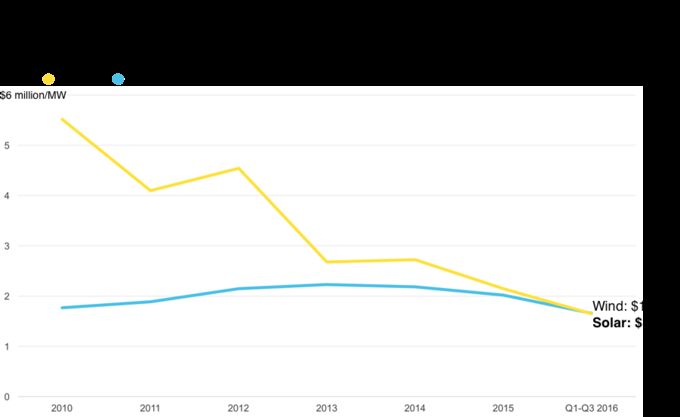
World Energy Hits a Turning Point: Solar That's Cheaper Than Wind (bloomberg.com) 220

A transformation is happening in global energy markets that's worth noting as 2016 comes to an end: Solar power, for the first time, is becoming the cheapest form of new electricity. From a report on Bloomberg: This has happened in isolated projects in the past: an especially competitive auction in the Middle East, for example, resulting in record-cheap solar costs. But now unsubsidized solar is beginning to outcompete coal and natural gas on a larger scale, and notably, new solar projects in emerging markets are costing less to build than wind projects, according to fresh data from Bloomberg New Energy Finance. The chart shows the average cost of new wind and solar from 58 emerging-market economies, including China, India, and Brazil. While solar was bound to fall below wind eventually, given its steeper price declines, few predicted it would happen this soon.
Medicine

Vitamin D Deficiency During Pregnancy Linked To Autism (newatlas.com) 216

New submitter future guy quotes a report from New Atlas: The researchers examined around 4,200 blood samples from pregnant women and their children and discovered a link between autism and low levels of vitamin D. More specifically, they found that pregnant women who were vitamin D deficient at 20 weeks gestation were more likely to have a child with autistic traits by the age of six. Rather than taking in more sunlight and the heightened risk of skin cancer that it carries, the researchers suggest that making inexpensive and safe vitamin D supplements available to at-risk groups may be a better path forward. "This study provides further evidence that low vitamin D is associated with neurodevelopmental disorders," says Professor John McGrath from the University of Queensland. "Just as taking folate in pregnancy has reduced the incidence of spina bifida, the result of this study suggests that prenatal vitamin D supplements may reduce the incidence of autism." The research was published in the journal Molecular Psychiatry.
Medicine

Aging Process May Be Reversable, Scientists Claim (theguardian.com) 253

New submitter TheNinjaCoder writes: A new type of gene therapy is showing promise in reversing the aging process. The scientists are not claiming that aging can be eliminated, but say that in the foreseeable future treatments designed to slow the process could increase life expectancy. The Guardian explains the scientists' experiment in its report: "The rejuvenating treatment given to the mice was based on a technique that has previously been used to 'rewind' adult cells, such as skin cells, back into powerful stem cells, very similar to those seen in embryos. These so-called induced pluripotent stem (iPS) cells have the ability to multiply and turn into any cell type in the body and are already being tested in trials designed to provide 'spare parts' for patients. The treatment involved intermittently switching on the same four genes that are used to turn skin cells into iPS cells. The mice were genetically engineered in such a way that the four genes could be artificially switched on when the mice were exposed to a chemical in their drinking water. The scientists tested the treatment in mice with a genetic disorder, called progeria, which is linked to accelerated aging, DNA damage, organ dysfunction and dramatically shortened lifespan. After six weeks of treatment, the mice looked visibly younger, skin and muscle tone improved and they lived 30% longer. When the same genes were targeted in cells, DNA damage was reduced and the function of the cellular batteries, called the mitochondria, improved. Crucially, the mice did not have an increased cancer risk, suggesting that the treatment had successfully rewound cells without turning them all the way back into stem cells, which can proliferate uncontrollably in the body." The study has been published in the journal Cell.
Earth

Iceland Seeking 'Supercritical Steam' For Power Source (bbc.com) 160

New submitter FatdogHaiku writes: Already getting over 25% of its electrical power from geothermal sources, Iceland hopes to break new ground using "supercritical steam" from a 5 km deep borehole. Is it just me, or does this sound like the start of a movie where everything that can go wrong does in fact go wrong? It's not like they are new to the tech, but working with geologic sources at 450C to ~600C is a new ball game for anyone. It should be noted that Iceland also uses direct geothermal for most of its space heating. "In this area at Reykjanes, we typically drill to 2km or 3km depth to harness the steam, to run power plants and produce clean, renewable electricity," explained Asgeir Margeirsson, CEO of the Iceland Deep Drilling Project (IDDP). "We want to see if the resources go deeper than that." The "supercritical steam" holds more energy than a liquid or a gas. The team wants to bring it up to the surface to convert into electricity, as they believe it could produce up to 10 times as much energy as the steam from conventional geothermal wells.
Medicine

Lack of Penis Bone In Humans Linked To Monogamous Relationships and Quick Sex, Study Says (theguardian.com) 279

The penis bone can be as long as a finger in a monkey and two feet long in a walrus, but the human male has lost it completely. According to a new report published in Proceedings of the Royal Society, the lack of a penis bone in human males may be a consequence of monogamy and quick sex. The Guardian reports: Known as the baculum to scientists with an interest, the penis bone is a marvel of evolution. It pops up in mammals and primates around the world, but varies so much in terms of length and whether it is present at all, that it is described as the most diverse bone ever to exist. Prompted by the extraordinary differences in penis bone length found in the animal kingdom, scientists set out to reconstruct the evolutionary story of the baculum, by tracing its appearance in mammals and primates throughout history. They found that the penis bone evolved in mammals more than 95 million years ago and was present in the first primates that emerged about 50 million years ago. From that moment on, the baculum became larger in some animals and smaller in others. Kit Opie who ran the study with Matilda Brindle at University College London, said that penis bone length was longer in males that engaged in what he called "prolonged intromission." In plain English, that means that the act of penetration lasts for more than three minutes, a strategy that helps the male impregnate the female while keeping her away from competing males. The penis bone, which attaches at the tip of the penis rather than the base, provides structural support for male animals that engage in prolonged intromission. Humans may have lost their penis bones when monogamy emerged as the dominant reproductive strategy during the time of Homo erectus about 1.9 million years ago, the scientists believe. In monogamous relationships, the male does not need to spend a long time penetrating the female, because she is not likely to be leapt upon by other amorous males. That, at least, is the theory.
United States

First Offshore Wind Farm In US Waters Delivers Power To Rhode Island (arstechnica.com) 196

An anonymous reader quotes a report from Ars Technica: On Monday, energy company Deepwater Wind announced that its wind farm three miles off the coast of Block Island, Rhode Island, has the all-clear to sell electricity to the regional power grid. The Block Island Wind Farm is the first offshore wind energy plant in the U.S., and it's expected to produce 30 MW of electricity at full capacity. Deepwater Wind is slowly ramping up energy output and still must provide additional paperwork to the Rhode Island Coastal Resources Management Council, but the executive director of that organization, Grover Fugate, told the Providence Journal, "we don't anticipate any major issues" to getting the wind farm fully online. The one hitch in the Deepwater's plan is that one of the five turbines was recently damaged when a drill bit was left in a critical part of turbine. According to the Providence Journal, "the bit had caused damage to an unspecified number of the 128 magnet modules that line the circular generator and are critical to producing energy." Although the magnet modules can apparently be replaced easily, Deepwater needs to have the components shipped from France, where General Electric, the manufacturer of the wind turbines, makes them. For now, four turbines capable of churning out 6 MW of power each are operational. The Providence Journal notes that National Grid will pay Deepwater Wind 24.4 cents per kilowatt hour of power, with the price escalating over time to 47.9 cents per kilowatt hour. Because the residents of Block Island have some of the most expensive electricity rates in the nation, they will actually see energy savings, despite the price. Mainland Rhode Islanders, on the other hand, will pay an extra $1.07 per month on average.
Mars

SpaceX Delays First Crewed Flight Of Its Dragon Capsule For NASA (theverge.com) 39

NASA says the first crewed test flight of SpaceX's Dragon vehicle has been delayed until May 2018. From a report on The Verge: In the wake of its September 1st rocket explosion, SpaceX has officially delayed the first crewed flight of its Crew Dragon vehicle -- the capsule that the company is building to take NASA astronauts to and from the International Space Station. Originally planned for late 2017, the first flight of the Crew Dragon with people on board is now slated to take place in May of 2018, according to a NASA blog post. Prior to that flight, SpaceX will perform a demonstration mission of Crew Dragon in November 2017 -- a flight that won't include any astronauts. There had been heavy speculation that the flight would be delayed following the accident, in which a Falcon 9 rocket exploded as it was being fueled on a Florida launch pad. And SpaceX says the move was made as the company finalizes its investigation into the accident. "As this investigation has been conducted, our Commercial Crew team has continued to work closely with NASA and is completing all planned milestones for this period," SpaceX said in a statement to The Verge. "We are carefully assessing our designs, systems, and processes taking into account the lessons learned and corrective actions identified. Our schedule reflects the additional time needed for this assessment and implementation."
China

Why China Can't Lure Tech Talent (bloomberg.com) 219

China may have been hoping to attract tech talent to its nation, but it is unlikely that people in the tech industry will move there. A columnist at Bloomberg explains why: The biggest problem is government control of the internet. For a software developer, the inconvenience goes well beyond not being able to access YouTube during coffee breaks. It means that key software libraries and tools are often inaccessible. In 2013, China blocked Github, a globally important open-source depository and collaboration tool, thereby forcing developers to seek workarounds. Using a virtual private network to "tunnel" through the blockades is one popular option. But VPNs slow uploads, downloads and collaboration. And it isn't just developers who suffer. Among the restricted sites in China is Google Scholar, a tool that indexes online peer-reviewed studies, conference proceedings, books and other research material into an easily accessible format. It's become a crucial database for academics around the world, and Chinese researchers -- even those with VPNs -- struggle to use it. The situation grew so dire this summer that several state-run news outlets published complaints from Chinese scientists, with one practically begging the nationalist Global Times newspaper: "We hope the government can relax supervision for academic purposes." The cumulative impact of these restrictions is significant. Scientists unable to keep up with what researchers in other countries are publishing are destined to be left behind, which is one reason China is having difficulty luring foreign scholars to its universities. Programmers who can't take advantage of the sites and tools that make development a global effort are destined to write software customized solely for the Chinese market. The author has raised several other reasons to make his case.
Medicine

Quest Diagnostics Says Personal Health Information of 34,000 Customers Hacked (cbsnews.com) 69

Quest Diagnostics has said in a statement that a hack of an internet application on its network has exposed the personal health information of nearly 34,000 people. "Quest Diagnostics has notified affected individuals via mail and established a dedicated toll-free number to call with questions regarding this incident," the company said. CBS News reports: The Madison, New Jersey-based company says âoean unauthorized third partyâ on Nov. 26 gained access to customer information including names, dates of birth, lab results and in some instances, telephone numbers. The stolen data did not include Social Security numbers, credit card accounts, insurance details or any other financial information. Quest said Monday it is working with a cybersecurity firm and law enforcement to investigate the breach, while taking steps to prevent similar incidents from recurring. If you think you're affected by this hack, you can call (888) 320-9970.
Earth

Rapid Rise In Methane Emissions In 10 Years Surprises Scientists (theguardian.com) 293

An anonymous reader quotes a report from The Guardian: Emissions of the powerful greenhouse gas methane have surged in the past decade, threatening to thwart global attempts to combat climate change. Scientists have been surprised by the surge, which began just over 10 years ago in 2007 and then was boosted even further in 2014 and 2015. Concentrations of methane in the atmosphere over those two years alone rose by more than 20 parts per billion, bringing the total to 1,830ppb. This is a cause for alarm among global warming scientists because emissions of the gas warm the planet by more than 20 times as much as similar volumes of carbon dioxide. In the meantime, emissions of carbon dioxide -- the main component of manmade greenhouse gases in the atmosphere -- have been leveling off. The new research, published in the peer-review journal Environmental Research Letters, suggests that the world's attempts to control greenhouse gases have failed to take account of the startling rises in methane. The authors of the 2016 Global Methane Budget report found that in the early years of this century, concentrations of methane rose by only about 0.5ppb each year, compared with 10ppb in 2014 and 2015. The scientists speculate that agriculture may be the main source of the additional methane that has been recorded. However, they cannot be sure of all the sources, owing to a lack of monitoring. At least a third of methane comes from the exploitation of fossil fuels, including fracking and oil drilling and some coal mining, where methane is viewed as a waste gas and is frequently allowed to escape or, in some cases, flared off, which is less harmful. Unlike carbon dioxide emissions, however, which have been tracked in various ways since the 1950s, emissions of methane are poorly understood and could represent a threat that scientists have still not accounted for.
Power

Fossil Fuel Divestment Has Doubled In the Last 15 Months (vice.com) 263

An anonymous reader quotes a report from Motherboard: A little over a year ago, it was big news that thousands of people and hundreds of institutions controlling more than $2.6 trillion in total assets had pledged to remove their investments from stocks, mutual funds, and bonds that invest in fossil fuel companies. A year later, that number has doubled. According to a report by DivestInvest, a philanthropy helping to lead the movement, more than 688 institutions and 60,000 individual investors worth $5.2 trillion have pulled their investments from fossil fuel companies and have reinvested a portion of their assets into clean energy companies. In September 2015, 436 institutions and 2,040 individuals worth $2.6 trillion had divested. For comparison, the total net worth of investors who had pulled out of the fossil fuel market was just $52 billion in September 2014. Divestment is increasingly seen as one of the stronger moves that private citizens and companies can take to support the move to clean energy. The movement started in earnest in 2011 when college students began petitioning their institutions to remove their assets from stocks, bonds, and mutual funds that invest in fossil fuel companies. What was seen as a gimmick at the time appears to be gaining real momentum a year after the Paris Climate Treaty was signed.
AI

IBM's Watson Used In Life-Saving Medical Diagnosis (businessinsider.co.id) 83

"Supercomputing has another use," writes Slashdot reader rmdingler, sharing a story that quotes David Kenny, the General Manager of IBM Watson: "There's a 60-year-old woman in Tokyo. She was at the University of Tokyo. She had been diagnosed with leukemia six years ago. She was living, but not healthy. So the University of Tokyo ran her genomic sequence through Watson and it was able to ascertain that they were off by one thing. Actually, she had two strains of leukemia. They did treat her and she is healthy."

"That's one example. Statistically, we're seeing that about one third of the time, Watson is proposing an additional diagnosis."

ISS

Japan Sends Its New Space Junk-Fighting Technology To The ISS (phys.org) 64

What floats 249 miles in the sky, stretches 2,300 feet, and took over 10 years to develop? An anonymous reader quotes Phys.org: Japan launched a cargo ship Friday bound for the International Space Station, carrying a "space junk" collector that was made with the help of a fishnet company... Researchers are using a so-called electrodynamic tether made from thin wires of stainless steel and aluminum... The electricity generated by the tether as it swings through the Earth's magnetic field is expected to have a slowing effect on the space junk, which should, scientists say, pull it into a lower and lower orbit. Eventually the detritus will enter the Earth's atmosphere, burning up harmlessly long before it has a chance to crash to the planet's surface.
Bloomberg has some interesting background: The experiment is part of an international cleanup effort planning to safeguard astronauts and about $900 billion worth of space stations, satellites and other infrastructure... Satellite collisions and testing of anti-satellite weapons have added thousands of debris fragments in the atmosphere since 2007, according to NASA... With debris traveling at up to 17,500 miles an hour, the impact of even a marble-size projectile can cause catastrophic damage.
Japan

Japanese City Tags Elderly Dementia Sufferers With Barcodes (japantimes.co.jp) 115

"The Japanese city of Iruma has introduced scannable adhesive barcodes to tag fingernails of senior citizens with dementia who are prone to getting lost as a way to help concerned families find missing loved ones," writes HughPickens.com, citing this article from Japan Times: The adhesive QR-coded seals for nails -- part of a free service launched last month and a first in the country -- measure just 1 cm (0.4 inches) in size. "Being able to attach the seals on nails is a great advantage," says a city worker. "There are already ID stickers for clothes or shoes but dementia patients are not always wearing those items." If an elderly person becomes disorientated, police will find the local city hall, its telephone number and the wearer's ID all embedded in the QR code. Japan is grappling with a rapidly aging population, with senior citizens expected to make up a whopping 40 percent of the population around 2060.
The article describes Japan as "a country where 4.8 million people aged 75 or older hold a license... Last month, police started offering discounts for noodles at local restaurants to elderly citizens who agreed to hand in their driving licenses."
Medicine

Researchers Successfully Fight Colon Cancer Using Immunotherapy (nytimes.com) 40

Slashdot reader schwit1 quotes the New York Times: The remarkable recovery of a woman with advanced colon cancer, after treatment with cells from her own immune system, may lead to new options for thousands of other patients with colon or pancreatic cancer, researchers are reporting. (Shorter non-paywalled version of the article here). Her treatment was the first to successfully target a common cancer mutation that scientists have tried to attack for decades... so resistant to every attempt at treatment that scientists have described it as "undruggable"... The researchers analyze tumors for mutations -- genetic flaws that set the cancer cells apart from normal ones. They also study tumor-infiltrating lymphocytes, looking for immune cells that can recognize mutations and therefore attack cancerous cells but leave healthy ones alone.
The patient, a 50-year-old database programmer in Michigan, is now cancer-free, according to the article. "Researchers twice denied her request to enter the clinical trial, saying her tumors were not large enough, she said. But she refused to give up and was finally let in."

The treatment ultimately eliminated six of her seven tumors, and because it targeted a cell mutation that's common in colon cancer patients, "Researchers say they now have a blueprint that may enable them to develop cell treatments for other patients as well."

Slashdot Top Deals