

Galaxy Zoo Produces a Rare Specimen 188
We discussed the Galaxy Zoo project soon after it launched last summer. Science News is now following developments about an odd celestial object
that is fueling a lot of excitement among astronomers around the world. In August, a Dutch schoolteacher named Hanny, in the process of characterizing galaxy images, noticed a peculiar object and posted a query about it on the Galaxy Zoo blog. She called it a "Voorwerp," which Science News says is Dutch for "thing" but which Google translates as "subject." Hanny's Voorwerp emits mostly green light (the earlier report said blue). The best guess astronomers have now is that the Voorwerp is emitting "ghost light," i.e. it is "lit by the ultraviolet light and X-rays from a quasar that has vanished in the last 100,000 years," to quote astronomer Bill Keel. "As far as we can tell, it's an unprecedented thing," Keel added. Researchers are scrambling to book time on the Hubble and other major telescopes to get a closer look.
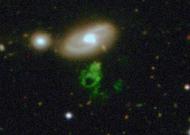


image in the post? (Score:5, Funny)
Re:image in the post? (Score:5, Funny)
Do you mean Borg Gates isn't good enough for you?
Re:image in the post? (Score:5, Interesting)
I was thinking exactly the same thing.
I've been reading this site since 2000 and I can't recall *ever* seeing an image on the front page, I don't even think there was one for that monster thread about 9/11 as it unfolded...
Re: (Score:2)
Game reviews frequently have 3-4 screenshots if you click through to the full review. Well, they used to-- there haven't been any game reviews in awhile, not that I recall.
Re: (Score:2)
How about 2004? The Penny Arcade series were pretty popular:
http://games.slashdot.org/article.pl?sid=04/12/17/188258 [slashdot.org]
Re: (Score:3, Funny)
Images on slashdot is about as dangerous as images in email. At least they included an alt tag.
Re: (Score:2, Insightful)
Re: (Score:1)
Re: (Score:1, Insightful)
Re:image in the post? (Score:5, Informative)
It isn't a hotlink:
http://images.slashdot.org/articles/08/06/voorwerp-wht1.jpg [slashdot.org]
An image hosted on your server and placed inside an anchor tag is called a 'link'. Putting an image hosted on another server inside an image tag is a 'hotlink'.
Re: (Score:2)
An image hosted on your server and placed inside an anchor tag is called a 'link'. Putting an image hosted on another server inside an image tag is a 'hotlink'.
Note: this is a neologism. "Hotlink" had been synonymous with "link" for a long time before that distinction was made; in fact, this is the first I've heard of it. Look for old Usenet posts [google.com] where "hotlink" just meant a link to another site.
Re: (Score:2, Funny)
this is the first time I've ever seen slashdot put an image in the post- welcome to 2001, guys!
They figured we were all blinded by goatse.
Re: (Score:2)
Re: (Score:2)
At this pace, in 25 years or so, there might even be a youtube video embedded in a Slashdot post.
Re: (Score:2, Informative)
GAAH!
http://idle.slashdot.org/article.pl?sid=08/05/24/1335258 [slashdot.org]
Re: (Score:2)
I prefer it to NOT do that. Clutters up the main page more than usual. I thought it got done once or twice in the past but was immediately removed?
Re: (Score:2, Informative)
Sadly, the image is not in the RSS feed. This follows the age old practice of also not including the in-article links in RSS, requiring unnecessary extra clicks and bandwidth usage.
Re: (Score:2)
Re: (Score:2)
That's what I was thinking, however I hope this does not become standard. I can read the links if I want pictures.
Even the text-only version includes tons of javascript and other crap ... takes a long time to load. Functions completely borked on text-only browsers, etc.
I need a "luddite version" of viewing. :-)
Re: (Score:2)
They are really splurging on a whole 3,950 bytes.
Voorwerp = Thing (Score:5, Informative)
Re:Voorwerp = Thing (Score:5, Informative)
"Item" is a better translation of "voorwerp". "Subject" would be "onderwerp".
Re: (Score:2, Insightful)
Re:Voorwerp = Thing (Score:5, Informative)
Actually, "object" is an even better translation of "voorwerp".
And it makes better sense in context too: "astronomers find mystery object" sounds find. "Astronomers find mystery thing" sounds stilted.
Re: (Score:2)
It sounds like someone whose been kicked in the beans as they approached the business end of the sentence, and it reads like it's actually an english word printed backwards, until you stare at it long enough to imagine it backwards and realise it makes just as much sense backwards as it does forwards.
Also, WINDMILLS DO NOT WORK THAT WAY.
Re:Voorwerp = Thing (Score:5, Informative)
"Object" would be the most accurate translation, taking into account the subject matter.
Re: (Score:2, Informative)
'wat een prachtig voorwerp' translates to 'what a beautiful object'
Even with Google.
Not always a 1:1 translation (Score:5, Interesting)
I grew up in South Africa, speaking mainly English, but also Afrikaans (a derivative of Dutch) and Zulu. My father and I would often mix all three in one sentence to get the words we wanted.
Re: (Score:1, Insightful)
Probably the English word "object" would be more appropriate here then "thing". And as a plus, it directly translates to Dutch and back again.
Re: (Score:2)
Technically, the correct translation would be 'object', in the 'thing' sens of the word.
"Objects in mirror are closer than they appear"
It it that important? (Score:2)
Re: (Score:2)
Voorwerp shmoorwerp
It's a cosmic frog
Re: (Score:2)
Voorwerp = object (Score:1, Informative)
The correct translation would be 'object'. I can understand the confusion with 'subject', but Dutch people would then say 'onderwerp', never 'voorwerp'.
Re: (Score:2, Informative)
Hey.... (Score:5, Funny)
It is an Excession.. (Score:5, Funny)
Re: (Score:2)
The Death Star (Score:1)
Voorwerp? (Score:5, Funny)
I didn't know that was a word.
That was the sound I made last time I threw up.
Whodathunkit.
Re:Voorwerp? (Score:4, Funny)
Re:Voorwerp? (Score:5, Informative)
Voorwerp is actually an odd word now that I really think about it. It is both generic, which is why it can be properly translated as "thing", and specific, in that it implies a purpose in the item it refers to (the exact purpose to be determined by the context it is used in). It can be translated as tool, thing, object, or item depending on the context it is used in.
Example uses of voorwerp, which all have different translations:
lijdend voorwerp - object (in grammar) [wikipedia.org]
meewerkend voorwerp - dative case [wikipedia.org]
gevonden voorwerpen - lost & found [wikipedia.org] (typically referring both to the items and the booth/office to reclaim them)
onbekend vliegend voorwerp - unidentified flying object [wikipedia.org]
Regarding the context of TFA, there is a very subtle implication which gets lost in whatever translation you may attempt: voorwerp implies a solid (crafted) object, which is why "thing" is the best translation in this case. It is very odd to refer to a celestial cloud as a solid item, and it says a lot about the peculiarity of the voorwerp...
Re: (Score:2)
It's a name that kind of stuck rather than being chosen by a large committee discussing all the details, to be honest!
Re: (Score:2)
I put the over/under on American /. users who get this reference at about 5%.
Re:Voorwerp? (Score:5, Funny)
Mind if I go off-topic for a moment, since there is an expert in the room? No, good.
Several years ago, when I was in France, I took a group of children to racing stables where they bred racing horses - a stud farm. While we were walking around, we met a charming, well-spoken Dutch couple in their 60s who chatted about this and that, and then indicating the breeding stables asked "So, tell me - do you have fuckeries like this England?" At least that's what I'm 90% sure they said.
I presume that "fuck" exists in the Dutch language and that their on-the-fly translation attempt misfired?
Re:Voorwerp? (Score:5, Informative)
Re:Voorwerp? (Score:5, Funny)
A Dutch guy talks to an English guy:
D: I fok horses!
E: Pardon?
D: Yes, paarden!
Explanation: the term "fok horses" is the above misconjunction of fokken -> to fuck, instead of breed, and pardon, when spoken, can be misconstrued as "paarden" which is dutch for "horses".
ALL TAKE NOTE (Score:2, Insightful)
Re: (Score:2)
Mind if I go off-topic for a moment, since there is an expert in the room? No, good.
Several years ago, when I was in France, I took a group of children to racing stables where they bred racing horses - a stud farm. While we were walking around, we met a charming, well-spoken Dutch couple in their 60s who chatted about this and that, and then indicating the breeding stables asked "So, tell me - do you have fuckeries like this England?" At least that's what I'm 90% sure they said.
I presume that "fuck" exists in the Dutch language and that their on-the-fly translation attempt misfired?
Holland suddenly sounds more interesting.
Re: (Score:2)
Well, now that I know about it, it's the name of my next World of Warcraft character!
Re: (Score:3, Funny)
Oh, come on, I speak 3 languages and I still thought it was fucking hilarious.
Slashdotted! (Score:1)
I would translate "Voorwerp" as "Object".
It's weird. That thing, whatever it might be, is probably quadrillions times bigger than our Earth, it's looking at us, and we have no idea what it is.
I for one welcome our new Voorwerp-overlords.
Obviously An Ad For... (Score:4, Funny)
Re:Obviously An Ad For... (Score:5, Funny)
Re: (Score:2)
What's the rush? (Score:4, Funny)
Re:What's the rush? (Score:5, Insightful)
To beat the other astronomers.
Re: (Score:2, Funny)
Some astronomers want to use the Hubble telescope to beat other astronomers?
I always thought these guys were just a bunch of nerds, but now they're going to get physical and become violent?
Re:What's the rush? (Score:5, Funny)
To beat the other astronomers.
Re:What's the rush? (Score:5, Insightful)
Re: (Score:1, Troll)
Re: (Score:3, Informative)
The Hubble, however, will most definitely not [wikipedia.org].
Re: (Score:2, Informative)
Green, Blue? (Score:5, Interesting)
How far away is this 'thing' and what sort of red shift should we be factoring into its true color?
Once that has been answerd, what sorts of atoms would emit that wavelength when excited by a radiation source?
Re:Green, Blue? (Score:5, Informative)
for the first part, ... z = 6.96.", and if i interpret the formulas there correctly, emittedWavelength = observedWavelength / (z + 1), so if this thing has the maximum known redshift and the observed wavelength is say 550nm, then the emitted wavelength would be about 70nm or 7e-6cm, so pretty well in the UV [sciencebuddies.org].
according to wikipedia [wikipedia.org], "the highest confirmed spectroscopic redshift of a galaxy is
for the second part, atoms emit across a wide range of wavelengths [gsu.edu].
so it's more a matter of how much energy is driving the emission.
Re:Green, Blue? (Score:4, Informative)
Bill Keel has made a page devoted to Hanny's Voorwerp with links to relevant sites; all the current data can be accessed from here: http://www.astr.ua.edu/keel/research/voorwerp.html
p.s. Hi Waveney!
Re:Green, Blue? (Score:5, Informative)
It's a redshift of 0.05 - six or seven hundred million light years away. We also have spectra of the voorwerp, so we know something about the atoms that make it up. You'll see some of these spectra at http://www.galaxyzooblog.org/2008/03/20/voorwerp-fever/ with the elements emitting the lines labelled.
Web dev here (Score:2)
Re: (Score:2)
It's out of gamut, unless you have an RGBUV monitor.
Whatever you do ... (Score:2)
Andy
Zoo (Score:2, Funny)
Where is the "Don't feed the Voorwerp" sign?
Re: (Score:2)
Well, it seems they stopped feeding the central mouth of the Voorwerp a while ago. So it may be they had the sign, but they already moved it to another exhibit.
Just a speculation, mind you.
Re:Zoo (Score:4, Interesting)
Dutch != Deutsch == German
The proper Dutch translation would be:
Voorwerp niet voeren!
Or, the Dutch funny edition:
Niet voeren da Voorwerp!
Or, the Anglo-Dutch funny edition:
Niet food'n da Voorwerp!
Re: (Score:2)
Frogs in Space (Score:2)
Did anyone else see Kermit the Frog in this image?
Re: (Score:2)
"It's not easy being green."
I'd say... (Score:1)
Re: (Score:3, Funny)
Re: (Score:2)
Indeed. I'm letting you guess how God made clouds of comets [wikipedia.org]. If then you consider the theories of panspermia, you'll eventually realise the real nature of our planet.
That's right, the Earth is an ovule. Now you know.
The Vorrwerp Story (Score:5, Informative)
Green vs. Blue (Score:1)
Re:Green vs. Blue (Score:5, Informative)
No.
Its because those pics only use 3 of the 5 colour channels.
As there are no R/G/B sensors, everything is an approximation.
Some of the early ones looked blue, even though green would be a better optical equivalent (most likely because they weighted some near UV radiation as blue)
Re: (Score:2)
Dutch does have this distinction. Green is 'groen' and blue is 'blauw'.
Re: (Score:2)
Re: (Score:2)
Re: (Score:2, Informative)
Re: (Score:2)
For the language nerds, it might be interesting to know that 'voorwerp' is in fact a direct loan translation [wikipedia.org] of Latin 'obiectum' (object).
Re: (Score:2)
And "voor" is pronounced like door. "Werp" uses an "e" like in nanny (the way somebody from Texas would pronounce it). Then you have the r's which are really pronounced as the r in, well, "really". The P is really sharp as well.
OK, now try to pronounce it, it should be good for a few laughs :)
It might be a threat. Destroy it! (Score:2, Funny)
I recommend photon torpedoes.
Thing at sector 5, 7 : "AAAAAIIIIIIIEEEEEEEAAAAAAAUUUUUUGGGGGGGHHHHHHHHHH!!!"
Thing at sector 5, 7 : "HACK! HACK! COUGH! *CHOKE!*"
Mr. Spock : "FASCINATING!"
Voorwerp? (Score:2)
Looks more like a Quagaar to me.
Re: (Score:2)
whoever did that (Score:3, Funny)
To answer, "Why the rush?" (Score:5, Interesting)
Folks ask, "Why the rush?" to get time on the Hubble and other instruments.
Simply put, astronomical events can be extremely short lived. Yes, it happened millions of years ago. And it could continue for millions of years. But just as it appeared, it could go out.
Think what happens to novas and super novas. They blink into existence and then disappear. The same could happen here. Having never seen this class of voorwerp (object, thing, etc.), it is possible it could go out tomorrow or change dramatically in way which would make baseline data of the current status incredibly valuable.
Going a bit off topic here, I have to say it is totally cool to see a reference to my old friend and fellow Geek, Bill Keel here on Slashdot.
Bill and I attended UC Santa Cruz in the 1980s. I entered as a Freshman while Bill was finishing up his Phd in Astronomy (by the way, UC Santa has the top graduate program in Astronomy).
Even then he was the galaxy nerd and his dissertation was on the topic of, if I remember correctly, formation of spiral galaxies. I remember helping him with nroff and troff as he put his dissertation together.
During his Post-Doc years, he would come back frequently to perform observations at Lick Observatory (above San Jose) and to crunch data using a program written in Forth that ran on a handful of systems in the world (one of which was at UCSC).
Our friendship continued over the years (I was even one of his groomsmen).
Bill is a passionate teacher and researcher. He is very supportive of amateur astronomy (one of the few fields left where a non-professional, non-academic can have a major impact).
If you want to learn more about galaxies, check out one of his many web pages here: http://www.astr.ua.edu/keel/galaxies/ [ua.edu].
the hell? (Score:2)
Voorwerp? Sounds something like the Juffo-wup the Mycon were interested in.
Re: (Score:2)
Re: (Score:2)
Nice to know people still remember that game. :)
Its Real Origins (Score:2)
You can't really see this from a static picture, but I think I have figured out the true nature of this object. Subsequent pictures should show the lower half (the part that looks like an open mouth) is actually a pair of huge legs in a seemingly closed position. These legs actually open and close in a predictable rhythm. Also not shown in the picture is the turret moving around attempting to track this thing as it rapidly zips back and forth across the cosmos, getting ever closer to the turret below.
If
The hi-res version.... (Score:2)
Re: (Score:2)
Re: (Score:2, Informative)