


Colorization of Mars Images? 784
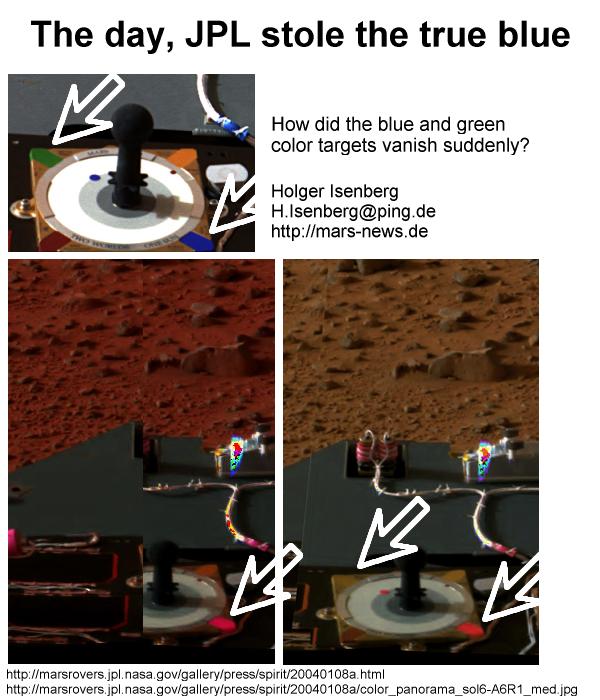
ares2003 writes "There is no scientific reason, why JPL is colorizing Mars in that dull red tint as in their press release images. In the latest panorama image, there is a hint, that they deliberately altered the colors, as the blue and green spots on the color calibration target (the sundial) suddenly converted to bright red and brown. Source of original images: 1, 2 - (for highres replace "br" with "med"). At normal weather conditions, as we have at the moment, there should be a blue sky on Mars and earthlike colors. Furthermore the sky looks overcasted on the pictures as it cannot be considering the sharp shadows on the sundial. If the sky was overcast, then because of diffuse lighting, there would be no shadows. A few years ago, I did an investigation about that very same topic for the Viking and Pathfinder missions."


Gary Larson Reference (Score:3, Funny)
Re:Gary Larson Reference (Score:5, Funny)
Roses are Blue,
JPL saw it,
and now you will too.
Re:one more verse (Score:5, Funny)
Make such a todo
'bout images they ibue
With an altered hue
'Tis nothing that's new
This thing they do
With pix they do screw
Boo hoo, boo hoo.
Check the links, editors (Score:5, Interesting)
Way to go, Michael.
He he (Score:3, Interesting)
Check the final paragraph of this page [mars-news.de]
Re:Check the links, editors (Score:4, Interesting)
Re:Check the links, editors (Score:5, Informative)
Re:Check the links, editors (Score:5, Informative)
However, in general you are right, the colour corrections are arbitrary and don't match the "real" colours. Moreover, the brightness stretching and image processing often changes the colour in strange ways. There's a recent paper [soton.ac.uk] which discusses the problem and presents some solutions.
Re:Check the links, editors (Score:5, Funny)
Try convincing the University of Michigan Admissions Office of that, the next time you claim your blond dreadlocks make you one of the oppressed.
Well, it didn't work for me, anyway.
Re:Check the links, editors (Score:5, Funny)
As a special experiment, to complement today's coverage of the Chandra XRay observatory, pages C12-C14 have been printed in a ink containing a number of radioisotopes, so as to more accurately depict the XRay emitting stars Chandra has discovered.
Please note that these pages are not recyclable.
Also, for our younger readers, "Erlenmeyer and Lever" have prepared a special edition of the "Science For Kids" column entitled "Fun with XRays"
1. Ask your parents to cut out the section labeled "Warning: Radiological Hazard", and
Re:Check the links, editors (Score:4, Insightful)
Note that in those photos they have 'greyed out' the portion of the photograph containing the atmosphere and surface of the planet.
Re:Check the links, editors (Score:4, Informative)
Re:Check the links, editors (Score:5, Informative)
Re:Check the links, editors (Score:5, Informative)
There's another even more important reason...most of the colors are for wavelengths of light that could not be seen anyway.
The last time I checked I could not see UultraViolet, Infrared, or X-rays.
Anyway, the color dots on the lander SHOULD look different as the lighting conditions are different on Mars due to the scattering properties of that atmosphere. Colors under Flourescent lights like we all sit under are very different than those out in the sunlight. If the images from Mars had the color corrected to pure colors, it would not be a true representation of what we would see if we were standing there.
Re:Check the links, editors (Score:4, Informative)
So the images are clearly color-doctored. Whether this is part of some grand martian conspiracy I leave as an exercise to the reader...
It's the filter, according to NASA Tv (Score:5, Informative)
Re:Check the links, editors (Score:5, Insightful)
Go out and by some theatrical gel filters ("tough no green" or "tough 1/2 green" will do). Cut them into strips, roll them to make tubes and slide tubes over each of the fluorescent lights in a room. Now:
- Turn on the lights and leave the room for about 10 minutes.
- Look into the room and notice how everything looks pinkish in the room.
- Enter the room (everything still looks "wierd") and look at objects outside of the room (they look "normal").
- Wait 10 minutes and try the above step again.
You will notice that once you have become accustom to the light in the room that objects in the room sort of look "normal" (not quite though) and everything outside of the room looks pink.Now I ask you, in both cases you have a "pink" area and a "normal" area, so which area is showing true colors and what will your Canon PowerShot A60 show?
My point: color perception can be fooled quite easily and what you see as red may not be red or not what I see as red and certainly not necessarily the same tint or red the anyone/anything else sees it as. Ambient lighting conditions do have an effect on what color objects are precieved to be. This effect may not necessarily be the same for your eyes and a camera.
Merlin.
For those of you curious: the above experiment was done to some offices where I use to work as the persons working in them found the shifted light reduced eye strain.
Re:Check the links, editors (Score:4, Funny)
Re:Check the links, editors (Score:4, Funny)
Re:Check the links, editors (Score:5, Funny)
Re:Check the links, editors (Score:5, Informative)
And, yes, NASA has to color correct just about every image one of their probes or landers takes. It's necessary because of now the images are taken. That ain't no cheap digital camera up there.
Re:Check the links, editors (Score:5, Informative)
The scientists understand the real colors, the public (who funds it, after all) expects it to be red. They want red, we'll give 'em red. I'm not saying I agree with that, but I understand where they're coming from.
The veracity of the person who brought this up (Mr. Martian Pyramids and such) isn't something I'll do much commenting on.
HST Images (Score:5, Interesting)
The data that comes off the HST is reserved for one year to the requesting individual/organisation (and, yes, this is controversial). But it is nothing like the images that NASA releases for the general public. The HST data comes down in a series of CCD output prints, often with whatever spectroscopy data has been requested, most often as a wavelength/intensity matrix. You can't dump that easily into any image editor; it's just a string of numbers. Equally if you dump all the spectra onto one image you will see a nearly black and white picture. So you select the spectra that interest you, and look for anomalies. The resulting pictures used are of little use to the non-astronomer - they aren't full colour, and are often just 4-bit colour showing intensity of a particular spectrum. The pretty pictures come from working out what looks good and combining it, so all images are 'false colour' in some way or another.
I don't know about the Spirit mission, but I'd guess the same applied
Re:HST Images (Score:5, Informative)
Valid reasons for this (Score:5, Informative)
I got the impression that many of the fiters that ARE within the visual portion of the spectrum were only letting in narrow bands of the spectrum. Exactly what color SHOULD infra-red images be? For obvoius reasons keeping them in their "orignal" spectrum would be fairly useless - though "red" would be as close as we can come.
For just pretty pictures rather than scientific data NASA is color-correcting the images - I think it is more involved than simply colorizing a black and white image. They mentioned compositing together several images from different filters to get a fair approximation of what the human eye would percieve if it was there.
Re:Valid reasons for this (Score:3, Informative)
That's just it. The camera captures separate images through various filters (possibly red, green, and blue), which are then merged back on earth to produce a color photo. With only a finite number of filters, this always involves some "color correction". The colored spots on the sundial act as a calibration guide for this process, since they have known
Re:Voyager backdrops (Score:4, Funny)
Re:Check the links, editors (Score:5, Funny)
coincidentally after this story was posted.
Re:Check the links, editors (Score:5, Funny)
I am trying to do some serious research into the truth that has been hidden from my eyes. I finally find a source of hidden knowledge that is better than the one buried under the sphinx, and you geeks have to go and wreck it. _bastards_
Re:Check the links, editors (Score:4, Funny)
You failed to mention his proof of giant hair-like structures on Uranus.
But Wait, There's More! (Score:3, Funny)
It really, makes me stumble over his words.
Solution (Score:5, Funny)
It's o.k. if you read it in a William Shatner voice.
Re:Check the links, editors (Score:5, Informative)
Re:Check the links, editors (Score:5, Funny)
Re:Check the links, editors (Score:5, Insightful)
Feynman (Score:5, Insightful)
Re:Feynman (Score:5, Insightful)
All they hear is "I don't know."
"Well Jeeeeezus. I thought you were supposed to be some kind of expert or something. If I wanted to be told 'I don't know' I could have asked my retard cousin Vinnie. I'm gonna go watch the FOX special on this. Those boys talk straight and tell me The Answer.
The problem is fostered in our lower schools. They are taught "facts," and are given tests to determine if they have memorized those facts well enough to regurgitate them, i.e. give the "right" answer to the question. Even mathmatics is treated as simple arithmetic where you manipulate some numbers to come up with a predetermined correct outcome.
All of this teaches science not just as facts, but as a field where things are simply either correct or incorrect. Knowledge as a collection of preapproved facts and for every question there as an answer.
Whereas science, that is to say the real sort of science that Feynman is talking about, isn't about known true facts so much as it's about the limitations on our knowledge and why those limitations exist and what we might do to expand those limitations.
If they haven't had the proper background, fairly early in life, when you explain these things to people as well as it's possible to explain them all the vast majority hear is:
"I don't know."
Then wander off muttering that the problem with scientists is that they refuse to give you straight answer, never suspecting that that's good science.
After a decade or four of this even most scientist legitimately trying to exlain things properly get frustrated and devise a set of stock answers. When given these stock answers people respong "Whoooooa! Really? Hey, that's pretty neat" and walk away with a smile on their face. Perhaps a wee bit better educated on a facts basis but no wiser.
It doesn't stop me from telling things as they are, but I've found over the years that the only real audience is children. They listen, they pay attention, they learn.
And I hope they then grow up to hear more than "I don't know" when told the truth as we actually know it, especially if they get elected to congress.
For that matter I hope they grow up to be scientists who tell the truth . . . and get elected to congress.
KFG
Don't believe should be a blue sky (Score:3, Interesting)
Re:Don't believe should be a blue sky (Score:5, Informative)
But the same light refraction phenomenon that gives Earth a blue sky as seen from the ground should give Mars a blue sky as seen from the ground as well. Enough dust in the atmosphere could interfere with that sufficiently to create a red hue, but this should not be the norm in calm weather conditions.
Re:Don't believe should be a blue sky (Score:3, Informative)
Mars' atmosphere is pinkish because of the dust suspended in it.
Re:Don't believe should be a blue sky (Score:3, Informative)
This guy's web page provides the description (http://world.std.com/~mmcirvin/bluesky.html#sky) :
Re:Don't believe should be a blue sky (Score:3, Informative)
Thinner would make blacker, not bluer - in other words, less scattering total, but the frequency range won't change. Outside of dust, Mars' atmosphere won't be much red. I'm not sure what wave
Re:Don't believe should be a blue sky (Score:3, Informative)
Check this panoramic photo [nasa.gov] (warning, 4.1 MB). Here's a small example [namu.free.fr] of what it should look like to human eyes, without the stupid NASA red tint. See the rainbow around the sun ? It's because of ice in the upper atmosphere.
Mod Parent down- incorrect info (Score:5, Informative)
Incoming light colors
atmosphere make-up
atmosphere density
angle of incidence
the eye of the observer
That's why Mars has a butterscotch sky- very low density atmosphere made up almost entirely of CO2
Carly's Home? (Score:3, Funny)
This explains her recent tech outbursts.
No Secret (Score:5, Informative)
Pictures are taken over time!! (Score:5, Informative)
That means that the colors you see on the sundial don't match all frames of the final picture you get.
NASA therefore alters the colors to match the pictures as closely as possible. Maybe this disturbs the color? Not sure though. What do you think?
Re:Pictures are taken over time!! (Score:4, Interesting)
That makes for a completely different light to that of a day overcast with clouds. generally clouds will completely remove distinct shadows, whereas red dust in the air will give an eerie dull appearance to the light, but keep much of the definition in shadows. Exactly like the mars image shows.
The sky may look "overcasted" but anyone commenting that the cast from a dust storm is anything like that from an overcast cloudy day has rocks in their head. (martian or terran will do either way)
There may be no scientific reason (Score:5, Insightful)
Obviously doctored (Score:5, Funny)
They're faked, obviously. (Score:3, Funny)
OK, I admit it. (Score:5, Funny)
My kids had lots of fun with those airbags, BTW.
Re:OK, I admit it. (Score:3, Funny)
Colorization is worth it (Score:5, Interesting)
We here on Slashdot rant about NASA budgets, and lack of interest in a manned space program. The only way to increase public interest is by catching their attention. Grayscale images simply are not going to cut it. I see no problem at all in colorizing images if it means more viewers are going to be interested, and therefore want to learn more.
Sure, the purist in me finds it a bit irritating, but as with many things, the pros far outweigh the cons.
Bullshit (Score:4, Informative)
Second, the images *need* processing. They are taken in ambient light which does not contain the same distribution of frequencies as "white" light on Earth. The cameras are designed to be calibrated with the ambient light actually found when they land for later postprocessing.
Buy out. (Score:5, Funny)
"ballistic approach to punctuation" (Score:5, Funny)
Re:"ballistic approach to punctuation" (Score:5, Funny)
-h-
Re:"ballistic approach to punctuation" (Score:5, Funny)
HOLY COW!!! William Shatner posts on SLASHDOT!!!
Re:"ballistic approach to punctuation" (Score:5, Funny)
My God, imagine a two man broadway show with Walken and Shartner in a 90 minute dialogue.
The "Moon": A Ridiculous Liberal Myth (Score:3, Funny)
Documentaries such as Enemy of the State have accurately portrayed the elaborate, byzantine network of surveillance satellites that the liberals have sent into space to spy on law-abiding Americans. Equipped with technology developed by Handgun Control, Inc., these satellites have the ability to detect firearms from hundreds of kilometers up. That's right, neighbors
Of course, this all works fine during the day, but what about at night? Even the liberals can't control the rotation of the Earth to prevent nightfall from setting in (only Joshua was able to ask for that particular favor!) That's where the "moon" comes in. Powered by nuclear reactors, the "moon" is nothing more than an enormous balloon, emitting trillions of candlepower of gun-revealing light. Piloted by key members of the liberal community, the "moon" is strategically moved across the country, pointing out those who dare to make use of their God-given rights at night!
Yes, I know this probably sounds paranoid and preposterous, but consider this. Despite what the revisionist historians tell you, there is no mention of the "moon" anywhere in literature or historical documents -- anywhere -- before 1950. That is when it was initially launched. When President Josef Kennedy, at the State of the Union address, proclaimed "We choose to go to the moon", he may as well have said "We choose to go to the weather balloon." The subsequent faking of a "moon" landing on national TV was the first step in a long history of the erosion of our constitutional rights by leftists in this country. No longer can we hide from our government when the sun goes down.
Re:The "Moon": A Ridiculous Liberal Myth (Score:4, Funny)
and last time i checked, there were more than eleven stars.
Filters (Score:5, Informative)
Re:Filters (Score:4, Informative)
The MER-A people gave a very detailed account of the filters in yesterday's press conference, and of why the coloured spots on the calibration targets on the image from Mars really didn't appear to match up with the identical version they had in front of them.
Apparently, they know the response to light of lots of different frequencies for each of the coloured tabs - the blue one, for instance, also reflects strongly in the near infra-red, which is why it appears bright red in the image from Mars and blue to human eyes. They know this, and calibrate accordingly - in fact, the blue target was chosen specifically for this behaviour.
The rest of the colours in the image are as good an approximation to the real colours as they can get, based both on the calibration targets and on the results from other landers and from what astronomers can see with the naked eye through telescopes.
And as I write this, I see that Jugulator has already posted something very similar, and which goes into more depth. Never mind, I'll submit this anyway.
If they left the sky blue... (Score:3, Funny)
Uh, yeah. (Score:5, Funny)
BELIEVE THAT MARS IS RED!
Thanks for alerting us to that potential communist menace, senator.
It's not strange, they're trying out filters (Score:5, Informative)
The "sudden" change happened as NASA "suddenly" applied another filter for the camera. They do this to better detect certain things in the picture I suppose. They spoke about it on a press conference when they was asked this question.
From Mozilla guru Asa Dotzler's weblog [mozillazine.org]:
Q. Then what we're seeing that's in that Pancam image doesn't correspond to what we'd see if we were standing there?
Jim: we have a pair of red filters that give us stereo. The red you're asking about is the infrared filter which is different from the red humans see. We can convert that red easily. We also have a red filter that matches human sight red but we prefer to use the infrared filter to get matchup with both cameras. Two cameras each have 8 filters. One filter on one eye is a dense welder-like filter to look at the sun. On the left camera is low frequency and the right camera is higher frequencies. Total of 11 unique wavelengths.
infrared image posted (Score:5, Funny)
Mars has become a political agenda (Score:5, Informative)
USA Today has a good article [usatoday.com] about how Mars is shifting from science to politics.
The Washington Post explains better the goals of the current US gov [washingtonpost.com].
I'm not saying it's necessarily a bad thing because that's usually how space projects get more funding but it might explain why the photos are looking more "nice to the user" than "scientifically realistic".
Re:Mars has become a political agenda (Score:5, Insightful)
Wait a minute. You're suggesting that missions to other celestial bodies might have... political or nationalistic overtones that often far dwarf the actual scientific value of the mission?
Um... do you know anything about the space race between the U.S. and Soviet Union?
And in other news... (Score:4, Insightful)
These plans are all very exciting folks, but our grandchildren are going to be paying the bill one day. It's time for the current administration to cut up the credit cards and start taking packed lunches instead of eating out, for a day of reckoning is coming and the American taxpayer is going to suffer badly. Entry into the third world awaits....
To put the conspiracy theories to rest: (Score:5, Interesting)
So put the conspiracy theory to rest.
Re:To put the conspiracy theories to rest: (Score:3, Informative)
Bill Nye saves the day (Score:5, Informative)
The sundial from a little while ago helps find tint and all. The pics need calibration.... doesn't sound like a conspiracy to me.
To heck with the recolored images... (Score:5, Funny)
Why does the Spirit rover [nasa.gov] have an Atari game console joystick installed on it?
to CYA, natch (Score:5, Funny)
Probably to protect the rover in case of this scenario [kudla.org].
There is actually an answer to this... (Score:5, Informative)
What I'd like to see (Score:5, Interesting)
Re:What I'd like to see (Score:5, Informative)
Re:What I'd like to see (Score:5, Informative)
For geek's sake:
Our moon has an apparent size in the sky of about 1800 arcseconds. This is found by arctan(radius of the moon/distance to the moon) * 2 [google.com].
By comparison, Phobos would appear to be about 900 [google.com] arcseconds from the surface of Mars. Deimos would be about 200 [google.com] arcseconds.
So actually Phobos would appear to be about half the diameter of our moon and Deimos would appear to be about 1/9 the diameter. I suppose that's not terribly small, but you also need to recognize that far less light will be hitting them and then reflecting off. Phobos would be much dimmer than our moon, and Deimos is dark in color, so it may not be easy to see even with the naked eye.
I imagine capturing an image of the moons with the camera on board a rover would be difficult.
Re:What I'd like to see (Score:5, Informative)
Mosaic (Score:5, Interesting)
Re:Mosaic (Score:5, Insightful)
Re:Mosaic (Score:3, Interesting)
Left & Right camera images being used (Score:4, Informative)
Due to the different viewpoints (it looks likes they're a couple of feet apart) the mosaics have issues... but I suspect that once they downlink a full set of either left or right images the panorama will instantly get much much better.
The Martian Sky is butterscotch, not blue (Score:5, Insightful)
This story should be pulled, it is wrong in too many places, and is just a bunch of conspiracy mumbo-jumbo. The pictures are slightly modded for color, but that's because it's a collage
As evidenced, here [nasa.gov], the Martian sky is more yellow/butterscotch (they used the Viking landers American flag to balance the colors properly,pictures are on the website). The Martian sky doesn't really get "overcasted" as there is no moisture in the air to create clouds! There is dust, yes, but the atmosphere is so thin, the sunlight can still go through it. Ares2003 has a few loose screws-My guess is that the digital image of the craft itself was taken later in the martian day, and modifying the color of the photo was the only way to make it look like it "fit in". Mars should not have "earth-like" colors. Any glance through a moderately-powerful telescope will show that the "red planet" is, in fact, red in color (iron oxide dust). Those more yellow pictures of Mars floating around are actually not real photographs, but generated images from the Mars Orbiter Laser Altimeter data.
To see lots of pictures and some scientific conjecture and analysis, you can go here [the-planet-mars.com]
To all "it's not the right color" conspiracies :) (Score:3, Funny)
Just use Photoshop or Gimp (Score:3, Funny)
Anybody else notice... (Score:3, Insightful)
Sorry, not buying this story. Even if Nasa did colorize it, so what? I spent a day at a major news network once. I got to watch how they get their stories up. EVERY photo that goes up for a story is retouched. When I was there, there was a big story about a wildfire eating up a lot of land. They took some stock footage of a firefighter putting out a fire in the woods. Then, they highlighted the fire itself and used a tool to make it look brighter and hotter. (Note: This wasn't supposed to be a photo of the fire itself, but rather one of those illustrations that appears behind the news anchor as he announces the story..)
The point? The reason they brightened the fire was to draw attention to the audience. Highlight the important elements of the scene. There's no crime or dishonest happening here. If Nasa boosted the saturation of their images to make their images more recognizable Mars, so what? Damn them for presenting their findings more clearly.
Get a clue (Score:3, Interesting)
Any colors captured on Mars are subject to various elements that would alter color. Such as different atmosphere than Earth, changing atmosphere during day, changing angle of light source, light reflected off surroundings. Even if calibrated against the sundial, changing the direction the camera is pointed will change things.
Mars isn't exactly a controlled environment like a studio.
All color images are colorized (Score:5, Informative)
You think Jupiter is a really garish ball of swirling colorful gasses? Think again. All the Galileo and Voyager images have saturation boosted a great deal, and the contrast is stretched mightily. Furthermore, the luminance layer is deconvolved to bring subtle spatial details into sharper relief. To the human eye, Jupiter is a rather bland beige-ish ball with some hint of subtle color here and there, and not much obvious detail. The same goes for Io, which is usually depicted as a bright yellow/orange malestrom. It's "real" colors - what a human in orbit would see - are also rather bland.
It's obvious! Doppler shift! (Score:5, Funny)
Conspiracy Theory Made E-Z:
1. Assume people care enough about you to fool you.
2. Add scientific terms and definitions to give credibility, even if it really doesn't have much to do with the theory
3. ???
4. Profit!
____________________________________________
"Red shift shows increasing totalitarian domination of the outer reaches of the universe. Write your congressman!" - from Science Made Stupid
Here's how it works (Score:3, Informative)
Once again.... THERE ARE NO "ORIGINAL" COLOR IMAGES, just black & whites shot through filter wheels. The best we can do is color transformations and approximations, to give you the best sense possible. As for the paranoid nonsense about the sundial/calibration target changing color, THAT'S SUPPOSED TO HAPPEN! What do you think a "calibration" target is??? You certainly wouldn't expect to see a bright blue spot if you looked at it through a red filter, would you? It will look different depending on what particular filters they used that day, and what color transforms they used to put it on the Internet.
Lastly, that bullcr*p about how the "sky should be blue" is just that---bullcr*p. Mars has almost no atmosphere, and what there is is filled with reddish dust. In the first horizon image we got from Mars (Viking), which the poster referenced, they screwed up the color transformation... it looked too red to be real so they fiddled with the data to make it "look right" [1]. They admitted it right away and all subsequent, peer-reviewed images have shown the correct, reddish sky.
[1] On Mars: Exploration of the Red Planet 1958-1978, p.384 (NASA History Series).
If ya don't like their colors, then do it yourself (Score:5, Informative)
The pan cam is black and white, and uses filters to pick out certain colors in the images it takes. If you want, you can read more about what filters are on which half of the pancam (l and r). There are 8 on a side, each with its own particular wavelength and bandpasses. The description of each as well as the numbering scheme is available from the Athena instruments website at Cornell University [cornell.edu]
The raw images are being freely distributed from the JPL MER website [nasa.gov]. You'll notice camera (l or r) and filter (1-8) used is described from the naming of the pancam files (eg. 2P126471535EDN0000P2303L6M1.JPG)
Just from this last days images, they have quite a few images in differant filters, of the color wheel itself, for calibration. For a better description of the filters themselves, and of the way they plan to (and have *BEGUN* to) calibrate the images, check out several [usra.edu] differant [usra.edu] publications [nasa.gov]. (thanks to JPL-Gene and doug_ellison of #maestro irc.freenode.net for the links).
I, for one, am thankful that they're releasing the raw data/images at all, considering the scale of the global-slashdotting currently going on. The speedy data turnaround, and amazing openness with which they are conducting this mission is really impressive compared to anything else of this scale. Thanks to everyone at JPL, Cornell, and NASA as a whole for all the incredible work from this meager enthusiast.
Holger Isenberg is a kook. (Score:5, Informative)
Holger Isenberg, the guy behind mars-news.de, is one of many [earthlink.net] kooks [badastronomy.com] out there who are too ugly and interpersonally incompetent to ever hope to get laid in this life time. He must therefore resort to enclosing himself into his imaginary universe of in-bred conspiracy theories [earthlink.net]. enjoy.
NASA has always made raw data available to the public, which is what you can leverage thru the Maestro the software. The red tint observed in composite pictures made available to the public are, in fact, a fairly accurate representation of the truth [nasa.gov]. Pictures MUST be composited to be available in a JPEG format Joe Six Pack can look at in his browser, hence some level of alteration is necessary. There is no lie. There is no conspiracy. Even your average Joe Six Pack can grok the fact that some basic alterations are necessary to represent flat images. Otherwise Joe Six Pack can always download Maestro.
Why the calibration in the composite looks wrong (Score:5, Informative)
In other exciting news, this morning they showed some of the mini-TES (thermal emission spectrometer) images. That data is very hard to interpret, so it is ripe for crackpot articles that can be posted on
This is not true. (Score:5, Informative)
The Viking landers used a scanning (spot) camera, which was slow but which was also one of the first really good scientific cameras sent on a space probe. It was designed to provide a very repeatible color readout of what it saw, but, like most such cameras, was subject to drift, so color calibration targets were included on top of each lander.
When Viking Lander 1 landed, the first color pictures released had a blue sky. These were done with the color balance adjusted "by eye" at JPL. When they had time to analyze the color targets, they released that they had made a mistake, and that the sky was red.
I specifically remember hearing that they had adjusted the color balance in the first release image, and had to adjust it back to get true color.
They had no reason to lie and were a little embarassed to have made the initial mistake.
So I regard thiis article as being without merit.
I'm probably too late, but the answer is BLACK (Score:5, Informative)
That is, as most of know, because the very low air density at higher altitudes refracts far less light.
The average surface air density on Mars is more or less the same as it is on Earth at 30'000 meters. That means that the sky on Mars will probably be almost black with a small band of colour on the horizon.
That band of colour will be due to so called rayleigh scattering, by which air molecules scatter the light passing through them. Oxygen and Nitrogen on earth, being small molecules will scatter light of a smaller wavelength (blue) than on mars, where the atmosphere is mostly carbon dioxide. The light thus produced on mars will be NOT be red and NOT be blue but somewhere in the middle (yellow/brown) as the larger carbon dioxide molecules will scatter light of larger wavelengths than on earth, but not enough to make the light seem red as that would require a gas of larger molecules such as methane or propane which, of course, is the main atmospheric component on Titan, saturns moon, and lo and behold, we get a deep orange light there.
Re:It's quite simple really (Score:5, Insightful)
Catering to it is no better than being an advocate of the conspiracy theories in the first place.
Anyone ever used a "camera?" (Score:4, Informative)
Procure a color chart. If you cannot, procure a box of crayons and make several large marks of relatively uniform saturation using the colors "Red" "Green" and "Blue." If you're truly adventurous, you may try a nice burnt umber or perhaps attempt various gradations from black to white.
Place this color chart on the ground.
Using the exact same settings on your camera, photograph this chart at sunrise, high noon and sunset. Do this on days of varying weather conditions.
If possible, start a large brush fire. Wait for large reddish clouds to filter the sunlight. Photograph your chart again. This is probably illegal, so wait until someone else does this for you.
Now wait until midnight. Photograph your chart using a flash.
In Photoshop, adust the color balance of all of your photos to match the last image.
Voila, all of your images are now completely indistinguishable from each other and you have lost all of the information you recorded by making photographs in varying lighting conditions.
DUH.