
Low-Energy Laser Etching May Replace Fruit Labels 475
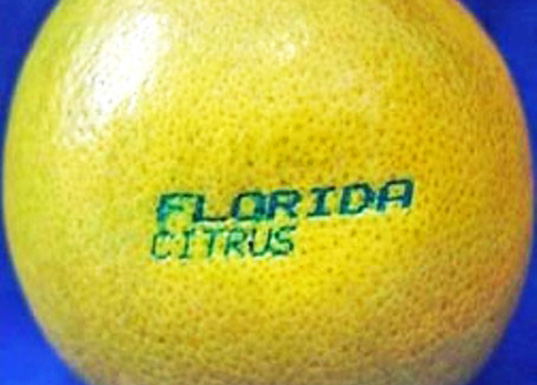
MikeChino writes "How many times have you bit into a piece of fruit only to find that you're also chomping on a sticker label? The small sticky labels have long been the bane of waste-conscious fruit and vegetable eaters, but that might all change thanks to new technology that uses a low-energy carbon dioxide laser beam to etch information directly onto produce. No more peeling those annoying labels! So far the technology is being used on a number of fruits and vegetables in New Zealand, Australia, and Pacific Rim countries, and it's currently going through the final stages of review by the FDA. Once the technology is approved in the US, researchers from the University of Florida and the USDA Agricultural Research Service hope that it will be used in Florida's massive grapefruit industry."

Lecture Fruit! (Score:5, Funny)
Re:Lecture Fruit! (Score:5, Funny)
No, they'll just etch "This unit not labeled for individual sale" on each one and make you buy them by the bag instead.
Re:Lecture Fruit! (Score:5, Funny)
Re: (Score:3, Funny)
Great, now Apple will have to sell their MacBooks in packs of two.
Re: (Score:3, Funny)
Re:Lecture Fruit! (Score:4, Insightful)
You know, this is one of the things about organic fruit and vegetables that bugs me. My grocer tends to have the organic fruits and veggies pre-packaged rather than lose. I might only want 3 apples, but guess what, they only come in 6 packs. Want a few organic bananas, too bad. The organic ones have a sticky plastic strip around them so you can't just break off the amount you want.
I'm pretty selective about what I buy and I only want to buy what I need. And I definitely don't need a bunch of extra packaging. In the end, I often end up buying non-organic food just because I end up wasting less that way.
Re:Lecture Fruit! (Score:5, Funny)
Even better, you will soon be able to custom-engrave your fruit. Popular choices:
etc.
Re:Lecture Fruit! (Score:5, Funny)
"This Fruit Intentionally Left Blank"
Re: (Score:3, Insightful)
and next thing will be company xyz etching commercials , or marketing crap into it.
Re: (Score:2)
I sample the produce aisle, eat said cash crop, and personally fertilize my field the next day.
Um, not to destroy your business model here, but isn't fertilizing with human manure illegal?
Re:Lecture Fruit! (Score:5, Funny)
fertilizing with human manure illegal
Shouldn't be. Human manure, especially that from politicians and lawyers, is some of the finest crap on the planet.
Re: (Score:2)
I can't find it now, but several years ago someone floated this idea. Etching ads on fruit with a laser.
While technically possible, it was roundly rejected by the "consumer test group".
I guess an apple just doesn't taste the same when an add for Preparation H is tattooed on it.....
Corporate advertising. (Score:5, Funny)
"This Apple brought to you by Apple"
Re:Corporate advertising. (Score:5, Funny)
That's nothing. If Apple starts making laser etched fruit trendy, soon they'll have a whole produce division! Couple that with genetic modification and one day I'll be able to compare Apple's Oranges to Orange Apples and.....oh no, I've gone cross-eyed....
Re:Corporate advertising. (Score:5, Funny)
Re: (Score:3, Insightful)
No, no, no... you have to take the bite. It's not the Apple logo unless you take the bite.
We need more moderation choices (Score:2)
because I would select "Scary but True +1" for your post.
We could have the reverse too "Turn in your tinfoil hat -1"
Re: (Score:3, Insightful)
Yeah, yeah, the big nasty government has been waiting for the day when it could piss you off by putting information you don't want on your fruit. They just couldn't find a way to put that information there until now.
We were counting on them never hearing of adhesive labels, but now they have lasers! Damn you to hell, lasers!
Re: (Score:3, Insightful)
I can't wait til they're required by law to give us all the nutritional information of every piece of fruit, down to the calorie count and the chemical breakdown. Perhaps government will put missing persons reports on them, or government mandated reminders of what it means to be a good citizen! So many useful applications!
I know this is meant to be funny, but the parent poster is missing the point. This technology is useful to the manufacturers for three reasons:
1. it is lower total cost than sticky labels
2. it makes it easier to custom label each shipment (Walmart gets its own SKU, Costco a different one, etc.) and to uniquely identify each processing batch
3. it opens up a HUGE new opportunity for advertising
The technology is only marginally useful to the consumer. After all, we got by without labels of any sort on each p
Re:Lecture Fruit! (Score:5, Informative)
Because it isn't true.
There are very many fruits in the world that are eaten by humans. They can be very different in their effects.
Many fruits contain lots of sugar. That's not good for diabetics.
Some fruits have very high potassium levels - this is normally good for people with high blood pressure, but bad for people with very bad kidney problems.
There's a fruit called Ackee that can give you hypoglycemia or even kill you if not ripe or not prepared correctly. But apparently it's popular with Jamaicans.
Grapefruit interacts with many drugs - it can make many drugs way more effective than expected.
Starfruit (carambola) has significant amounts of oxalic acid which can give kidney patients problems.
And there are still very many fruits which while might be commonly eaten have not had much research done on them on their health effects and nutritional values.
Lastly, I wonder how the laser etching would look like on a whole durian or a rambutan
Re:Lecture Fruit! (Score:5, Informative)
I'm Jamaican and enjoy ackee :) The fruit is poisonous if eaten at the wrong time. You need to wait until it opens naturally on the tree before harvesting. Once prepared, it looks a like scrambled eggs and tastes somewhat acrid. Traditionally it's eaten with salt fish or bacon, biscuits similar to buttermilk biscuits, or with a vegetable called "breadfruit".
Grapefruit and starfruit are also very popular in the Caribbean. I never got the hang of durian fruit :D.
Re:Lecture Fruit! (Score:5, Informative)
>> Grapefruit interacts with many drugs - it can make many drugs way more effective than expected.
> Please elaborate. Please!
My daughter had a liver transplant as a infant. She takes a single immune suppressant drug now called "Prograf" or known as Tacrolimus. The only warning on it is "Don't eat grapefruit while taking this." It makes the immune suppressing power much stronger.
Re: (Score:3, Informative)
Have you ever looked at the fat content of a Apple?
Um... almost zero...
There's about 10g of sugar in one apple. That's roughly the same amount as is in a 100ml glass of cola (and 100ml is a tiny serving -- less than the amount you'll get in a strong vodka and cola, most people will drink the whole 330ml can).
You can pretty much let your kids eat as much fruit as they want. They'll feel full from before they eat too much sugar.
Re: (Score:3, Informative)
Well as another person on this thread mentioned...fat in an apple??
But sure, olives have fat...they also have olive OIL in them..which is good for you.
Not all fats are bad, you actually NEED them in your diet...and more and more studies are showing that increased fat consumption (to a certain level) can actually help your metabolism and help you burn off body fat.
What does this do, chemically? (Score:5, Insightful)
Re:What does this do, chemically? (Score:5, Insightful)
The process must be approved by the FDA. You can be sure they will ask all those questions and some you haven't thought of.
Re: (Score:2, Insightful)
Exactly, because government departments are completely infallible.
Re:What does this do, chemically? (Score:4, Interesting)
The process must be approved by the FDA. You can be sure they will ask all those questions and some you haven't thought of.
I'm always very leery of that sort of assurance because I've heard very similar things from my own MP (I'm in the UK) and IME it invariably means "I have so much blind faith in the system that I'm not even going to take your query seriously enough to forward it on to the relevant people".
And it later transpires that the relevant people had not thought about it...
Re:What does this do, chemically? (Score:5, Funny)
Hmmm...You're right, we can't trust the FDA. We should rely on the geniuses of the Slashdot community instead. The ones who can read the summary and immediately come up with 10 or a dozen weaknesses that the professionals who've been thinking about the problems for years have somehow overlooked.
We should set up a vote. You know, take the top 10 highest-modded questions or something.
Re:What does this do, chemically? (Score:5, Funny)
Re: (Score:2)
Yes, and what he said is still true.
Money, goods and services, weeks in vacation houses in tahiti... will exchange hands to rectify any answers that are not sufficient.
Re:What does this do, chemically? (Score:5, Insightful)
This might be anecdotal, but I used to work for a big pharma company. We (or at least all of the people I encountered there) were terrified of the FDA.
The FDA were reputed to be extremely thorough, and generally uncorruptable (the FDA is a sprawling bureaucracy, which though inefficient, seems to prevent any widespread corruption).
The media might not have picked up on it, but the American pharma industry is hurting pretty badly right now, as many of the expected "blockbuster drugs" from the past few years didn't make it through the FDA's thorough approval process, while many of the existing big-profit drugs are about to lose their patents (which, in the US only takes about 7-12 years from the date of first sale).
In America, you can create Mickey Mouse, and profit from your invention for a period of time double that of the average human lifespan. However, if you cure cancer, you've only got about a decade to reap the profits.
I'm not going to apologize for all of the pharmaceutical industry's actions. However, it's very important to view behavior in the context of the regulatory environment in which they must exist.
If the pharma industry is really hurting (Score:5, Funny)
can't they just take something for the pain?
Re: (Score:2)
Re:What does this do, chemically? (Score:5, Insightful)
I'm waiting for the mandatory notice that the laser-charred fruit contains substances known in the state of California to cause cancer.
Re:What does this do, chemically? (Score:5, Funny)
I live in New Jersey - I couldn't care less if it causes cancer in the state of California.
Re: (Score:2)
I think it's just like burning. After all it's only light. Like heat. So it's like a very browned spot on something you put in the oven.
Don't get confused by the obviously wrong image that came with TFS. (Cyan? Really?? FAIL!)
Re: (Score:2)
Re:What does this do, chemically? (Score:5, Informative)
A CO2 laser has a wavelength of 10600 nm (i.e. pretty deep into the infrared). I'm not seeing any specific reactions or chemical absorbers in the literature on a quick check, nor would I expect to - a single photon of 10600 nm light contains far too little energy to break any bonds. Instead, when the photon is absorbed it makes the molecule vibrate a little, and the kinetic energy is transferred to the surrounding water (or other) molecules as heat energy. This is where the misconception stems from that IR = heat; heat results when the photon of IR light is absorbed, but a photon is a photon is a photon... Basically, the color change is going to be a burn pattern, so there's nothing to fear from it over and above any concern you'd have for cooked fruits (e.g. pie filling).
Do you eat grapefruit skins? (Score:3, Insightful)
...'cos if you don't then it's not really a problem, is it?
Re: (Score:3, Insightful)
I'd rather deal with the laser etching than adhesives on the fruits - especially since they don't indicate what the adhesives on the labels are. Are they allergens?
It'd also be nice if they'd etch produce such as cucumbers with the type of oil/wax they use to preserve them; is it just paraffin? Is it hypoallegenic, such as canola? Or is it one of the big allergens like peanut or soybean oil? Is it palm oil?
Re: (Score:3, Informative)
It adds a little energy to the skin, which causes the water to heat up and change color.
It's pretty basic IR LASER stuff.
Re: (Score:2)
Re:What does this do, chemically? (Score:5, Interesting)
And did you not actually read the article? That issue was addressed within it.
But then again, this is slashdot so, who am I to expect people to actually read the article prior to commenting on it?
Re: (Score:3, Interesting)
Laser etching can be art, too. Once they get the machines installed you can bet they'll start doing fancy designs - Halloween pumpkins with the faces etched on, special limited edition designs on all your favorite Xmas fruits (collect them all!), Chinese fruits with fortunes etched on them, the only limit is your imagination!!
An answer in search for a problem? (Score:5, Insightful)
Erm, never? Because I always wash my fruits (as in apples, pears) first before eating them?
This is an answer in search of a problem: To be honest, I'd rather have a blemish-free apple, than one with carvings.
Re: (Score:3, Interesting)
I compost all of my fruit, and this will be great, as fruit like bananas and oranges will no longer generate any waste I can't compost.
Re:An answer in search for a problem? (Score:4, Funny)
Seriously? You are worried about a couple of grams of stickers that come on a few hundred or thousand grams of fruit? You could probably eat bananas for a year and still fit the stickers inside your nose.
Re:An answer in search for a problem? (Score:5, Insightful)
Do you expect me to just take your word for that?
I'll report back here in one year.
Re: (Score:2)
Re: 1, absolutely.
Re: 2, actually, in my experience they're usually plastic.
Re: (Score:2)
Re:An answer in search for a problem? (Score:4, Insightful)
Why?
TFA shows that it works on delicate fruit like tomatoes too. In terms of heal and sanitary concerns the laser is probably still better.
1. A sticker when placed will be a nice breading gown for bacteria. Then the sticker is often pealed off after the fruit is washed.
2. Who knows what chemicals are left behind on the sticker.
3. When pealing off the sticker people use their fingernail. Even when they wash their hands the fingernails tend to have the most bacteria on them.
4. Stickers get toss into the garbage. Or worse if you are eating on the run just littered.
5. Pealing off stickers on some fruit can tare off the skin of the fruit.
6. Stickers that fall off fruit could mean be misplaced, wrongly priced at checkout.
I for one welcome or laser etched fruit overlords.
Re:An answer in search for a problem? (Score:5, Funny)
1. A sticker when placed will be a nice breading gown for bacteria. Then the sticker is often pealed off after the fruit is washed.
My eyes, my eyes! Spelling! Punctuation! Please, tell me that English is not your first language... otherwise I hope you're still enrolled in English 101.
But on the bright side, you win Google Golf for "breading gown" [google.com].
Re:An answer in search for a problem? (Score:5, Informative)
2. Who knows what chemicals are left behind on the sticker.
4. Stickers get toss into the garbage. Or worse if you are eating on the run just littered.
There are no chemicals. The stickers are made of starch, are printed on with edible dyes and are stuck on the fruit with a thin layer of glucose. They are in fact perfectly edible and biodegradable. It's quite possible laser etching (by heating the fruit) will produce more dangerous compounds. Frankly, this isn't even a problem, people just like the lasers because they look cool.
Re:An answer in search for a problem? (Score:4, Informative)
Last time I checked (in my lab yesterday afternoon) most lasers don't take much energy to run at all. My Nd:YAG pulsed laser is pretty beefy (Class IV, back of the envelope calc puts the intensity at 100 MW/pulse) runs on 110/120/220 V wall power, 50/60 Hz, and only pulls 10 amps. That's my big laser... then there's my two laser pointers that are run by AAA's or the little watch batteries, and have powered times in the hours range. Looking on the Coherent website (first one I came to) I see CO2 lasers with a "marking" application that use 12A power average (from a DC power supply). So, the power requirements are certainly no worse than that of the labeling machine that has to apply the stickers, and given the higher speeds possible for laser printing vs mechanical printing the throughput might make them far more efficient.
Re: (Score:2)
Washing fruit? Pah, I just give apples a quick rub on my t-shirt and then bite it ;)
TBH it has been a long time since I last saw one with a label stuck on it, but maybe that's because I mainly get them at corporate lunches and from pre-picked bags rather than individual ones.
Re:An answer in search for a problem? (Score:4, Interesting)
Even stupider, they're talking about laser etching on citrus fruit. You peel those fruits before you eat them (well, most people do). There are no stickers inside the fruit.
Boon! (Score:5, Funny)
This is particularly good news for me, because I can only eat foods that have been etched with a laser. Goodbye scurvy!
Solution in search of a problem? (Score:2)
The sales pitch: "How many times have you bit into a piece of fruit only to find that you're also chomping on a sticker label?"
1. If this sales pitch were any dumber, I'd assume it was a quote from a Simpsons episode I had somehow missed.
2. Getting rid of fruit labels is a bad marketing idea. Kids freakin love them.
3. Any sales pitch like this is indicative of a solution in search of a problem. It sounds like a pitch from a bad infomercial.
Envy (Score:4, Funny)
Is this an infomercial? (Score:2)
"How many times have you bit into a piece of fruit only to find that you're also chomping on a sticker label?"
What the hell? This sounds like infomercial lady. You know, the lady who can't open jars, puts her lamps too far away from the bed to be able to turn them off from the bed, learned basic household tasks like cleaning the bathroom or doing laundry by watching Vaudeville shows, can't figure out that she needs to wear a sports bra with a tank top, etc. This person is already too dumb to live. Let's
Dude (Score:5, Insightful)
For a technology site, most of the comments here are surprisingly anti-technology.
A new graphics card comes out? Commentors will gripe that old school games with shitty graphics are better anyway.
A new CPU comes out? Same thing : commentors will complain that extra CPU power is just more cycles for crummy, inefficient programming to squander with useless eye candy features.
A laser that eliminates that annoying plastic label on fruit and the FCKING ARTICLE says that it's safe? Commentors say that THEY won't benefit because THEY always peel and wash their fruit, and they're afraid that the lasering will make fruit decay sooner (without reading the article that says the lasering does not appreciably damage the fruit's skin)
Re: (Score:2, Funny)
You must be new here!
Re: (Score:3, Interesting)
I've noticed that being technologically savvy or skeptical about one thing doesn't always translate well into other fields. I've seen people say that naturopathy is nonsense because natural doesn't mean beneficial, then almost in the same sentence praise organic food because it is natural and therefore better. Look at Bill Maher criticize creationism as unscientific, then spew fearmongering about medical science and support magic based alternative medicines. People, in general, don't seem to be good at a
Re:Dude (Score:4, Funny)
Arrogant tech nerds (myself included) are often suspicious of change. There's something just so satisfying about being able to say "Nuh uh, you're wrong!" or otherwise indulge in world-weary cynicism.
Besides, I like to think of Slashdot as being populated almost entirely by Andy Rooney.
Re: (Score:3, Insightful)
I've noticed this here myself and after thinking about it, it makes perfect sense. You see, there is a perception amongst the general population that nerds/geeks are early adopters of technology because nerds love technology so obviously we're going to be the first to adopt. However, nerds also tend to be very practical and we generally would know more about what the new technology does, and what is already out there (that others may not yet know of). So our practicality tells us that before we adopt new
Re:Dude (Score:4, Insightful)
I gotta tell ya, "beach" is funnier. The mental image of bloated slashdotters flailing their useless arms about, stuck on the border of land and sea, loudly complaining about fruit labeling improvements that have literally zero downsides is difficult to suppress.
Finally. (Score:5, Funny)
Re: (Score:2)
Thanks for shitting all over everything I said, though. Much appreciated.
Re: (Score:2)
Re: (Score:3, Funny)
You're the one not wearing any pants.
Or... Don't label it on the fruit at all! (Score:2)
Or... Don't label it on the fruit at all!
If you need to label it "Florida citrus", do it on the outside the box in the supermarket.
Actually that labelling on the fruit must be a US thing. They don't do it here in Denmark.
Solving nothing, there is no problem (Score:2)
"How many times have you bit into a piece of fruit only to find that you're also chomping on a sticker label?
Answer: Never :D
They're quite easy to spot: they look like a little sticker label.
In addition, most fruits here don't even have a sticker. We're quite capable of distinguishing between a banana and an apple without sticker.
How long before they "enhance" the appearance (Score:2)
If they can laser etch messages then the next step is using it to remove blemishes, enhance the appearance, and effectively "photoshop" food to make it appear more photogenic.
Then again, am I the only one who thinks this could be the next step in tattoo art - never mind some hairy goth with a needle, give me a CNC laser that can print my choice of design onto my arm at 1200dpi and I might consider it.
those stickers are edible (Score:2)
they don't taste that bad, really.
I don't want to know where it comes from . . . (Score:4, Funny)
. . . I want to know if it tastes good.
Fruit should be lasered according to how it tastes: "Good", "Great!", "Sweaty Tennis Socks", etc.
Long Run (Score:2)
And you think it will just be for labeling? (Score:5, Insightful)
Once this is in use, I don't imagine it will be long before your fruit is covered with more ads than a NASCAR racing suit. On the up-side, the opportunities for a bit of creative pranking are just about limitless.
Never. (Score:2)
"How many times have you bit into a piece of fruit only to find that you're also chomping on a sticker label?
Never. Not a single time. Unless you eat fruit in the dark, or are blind, this simply never happens and this is a solution looking for a problem.
Personally I think it makes the fruit itself somehow artificial and unappealing. I doubt this will ever catch on. I'd rather eat one that hasn't been maimed - it will also look nicer in the fruit bowl without the skin-spam.
How many times...? (Score:2, Troll)
How many times have you bit into a piece of fruit only to find that you're also chomping on a sticker label?
Exactly as many times, as a happened to be a complete and utter drooling retard with no right to live, who should have long ago received a Darwin award! (I.e. never!)
Sounds good unless.. (Score:2, Insightful)
Remove sticker before inserting in mouth. (Score:2)
"How many times have you bit into a piece of fruit only to find that you're also chomping on a sticker label?"
ZERO. Don't you wash your fruit before eating it? Sheesh.
Oh the tyranny of fruit stickers (Score:2)
"How many times have you bit into a piece of fruit only to find that you're also chomping on a sticker label?"
Honestly? Never. Ever. I didn't know this was a problem tha
Re: (Score:2)
Re: (Score:2)
Re: (Score:2)
Re: (Score:2)
So you'd need to find the brands that don't do this, like one already has to do (at least in the UK) to avoid the ones which are waxed to make them last longer.
Re: (Score:3, Informative)
Wow, do you just totally not understand laser etching or are you acting ignorant on purpose?
Laser etching uses thermal energy (heat) to burn the surface, causing the colour to change. There are no inks, acids, or any other additives. It's no different from sticking it under a broiler and waiting, but with a laser you pack the energy into a small burst so you don't cook the whole fruit, just the surface.
Re: (Score:2)
I do understand laser etching...
Read the article, and read the comment afterwards...
In fact you are making my point completely!!!!
Re: (Score:2)
Use a lime, thread several onto long string, give to neighbour. Whoops, illegal file sharing on limewire...
Deep Thoughts (Score:5, Funny)
Re:Wrong problem (Score:5, Insightful)
Our fruits do not need labels.
The labels on fruit in the UK supermarkets are there so the cashier knows what you've chosen. The labels on the apples I eat say "Granny Smith 4139", the cashier types in "4139" before weighing the fruit.
They are annoying -- especially if they leave a residue, as I don't normally have a chance to wash an apple before I eat it -- so perhaps this is an improvement, so long as it doesn't affect the taste.
Re:Wrong problem (Score:5, Funny)
Re:Wrong problem (Score:5, Informative)
...as I don't normally have a chance to wash an apple before I eat it...
As someone who has worked in produce (college job, not now) I have to say that I am appalled whenever I hear this. The residue from the sticker is the least of your worries, there could be all kinds of other residue on that apple that you don't know about (not that though, that's only cucumbers). At least try to rinse them off, if you can't give them a decent wash.
Re:Wrong problem (Score:4, Funny)
Did she have any news about Ferris?
Re:Wrong problem (Score:5, Informative)
The labels aren't advertisements. they have a 4 or 5 digit code on them which is used to identify what kind of fruit it is specifically. The prices for honeycrisp apples is different from fugi apples which is different from gala apples (the price difference is pretty large between different varieties). The clerks at the store aren't knowledgeable enough to tell the different of the 10 or so varieties of each kind of fruit sold to tell the difference. With the abundance found in wealthy nations comes a way to organize that abundance, and keeping things organized is what those labels are all about.
Re:Wrong problem (Score:5, Insightful)
I'd also like to see where the fruit is from, possibly even identify the grower. There are three basic reasons:
1. I prefer to buy stuff grown close to where I live. My grocery store will generally include the country of origin in the signage, but I really don't trust that they get that right.
2. If there is some type of contamination problem, the CDC could more quickly track down the source and scope of the problem.
3. I might discover that some growers produce better or worse food than others. The information could help me spend my food dollars more effectively.
-ec
Re:Wrong problem (Score:5, Informative)
Re:Wrong problem (Score:4, Insightful)
Re: (Score:3, Insightful)
At my local grocery store, they sell three different types of bananas: "standard" (49c/lb), organic (79c/lb) and fair trade (89c/lb). Without some form of labelling, the cashier cannot distinguish between the types.
Of course, the self-checkout lanes make this entire argument almost moot...