
Chimp Found Plotting Against Zoo Guests 435
rjshirts writes "In further proof that Planet of the Apes is coming to pass, researchers in Stockholm, Sweden have proof that primates can plan ahead.
From the article:
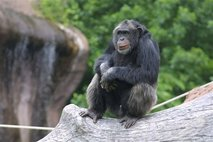
'Santino the chimpanzee's anti-social behavior stunned both visitors and keepers at the Furuvik Zoo but fascinated researchers because it was so carefully prepared.
According to a report in the journal Current Biology, the 31-year-old alpha male started building his weapons cache in the morning before the zoo opened, collecting rocks and knocking out disks from concrete boulders inside his enclosure. He waited until around midday before he unleashed a "hailstorm" of rocks against visitors, the study said.'"

Translation (Score:5, Insightful)
Translation: "I'm an intelligent primate who doesn't like being caged up for your amusement."
Re:Translation (Score:5, Funny)
Re:Translation (Score:5, Funny)
And they call me anti-social next they are going to call me a communist.
But doesn't anti-socialism lead to anti-communism?
Re:Translation (Score:5, Funny)
Wow I would simply not have made the connection without your helpful comment. Much obliged!
Re:Translation (Score:4, Insightful)
In other news, birds build nests before hatching eggs. Elephants travel days to go to salt-licks. Spiders build webs before catching prey.
I'm not saying that these aren't different from what this ape has done, but let us better characterize what that difference is first. How is building a pile of stones to throw different than a bird building a nest before laying eggs? Let us be careful and differentiate between planning, intentional planning, and be wary of attributing planning to behavior that **looks** human.
I would guess that the difference lies in the fact that the Chimps behavior was not a product of instinct, but that of cogent thought.
One might argue that birds building a nest before laying eggs is not forethought, but merely programming, as is the building of a web by a spider.
Re: (Score:3, Interesting)
I would guess that the difference lies in the fact that the Chimps behavior was not a product of instinct, but that of cogent thought.
Dunno about you but I indulge in cogent thought entirely by instinct.
Re:Translation (Score:5, Insightful)
A bird doesn't learn how to build a nest. Neither does a spider acquire the experience to spin a web after experimentation. That knowledge is built into them and is instinct, and not cogent though in spite of your high blown words like "multi dimensional gradient" and "quantization".
Without a doubt, the chimp in question learned a pattern. I leave it as an exercise to you to guess what that pattern was.
The distinction between instinct and cogent thought is very real unlike what you imply. If spiders had to learn how to spin a web, they would starve, and so in their case, cogent thought is neither needed nor important.
Re:Translation (Score:5, Insightful)
Another way to look at it is that birds that didn't think they had to build nests to lay eggs in didn't pass on their genetic wisdom since they had no one to pass it on to. So that trait was naturally selected out. At least it can be argued that birds didn't learn to build nests by having experimented with laying eggs without one and then realizing that they actually needed one!
However, stockpiling stones to fling at visitors aren't (in an obvious way, at least) something that is naturally a survival instinct. Flinging whatever is within reach is - fight or flight. However, foreseeing and preparing for a fight is not. Especially in the environment of a zoo, to which the chimps have only been subjected to for only for about a few hundred years. It had to have been learned. In their lifetime.
So, wordsmitthing aside, there is a difference and as the parent pointed out - it has to do with learning and applying that knowledge to an anticipated future event.
Re: (Score:3, Interesting)
The distinction between instinct and cogent thought is very real unlike what you imply. If spiders had to learn how to spin a web, they would starve, and so in their case, cogent thought is neither needed nor important.
To expand on the point, and to show one of the more elaborate examples: New Caledonian Crows [wikipedia.org]
Re: (Score:3, Insightful)
Repeat after me: there is no border between "day" and "night".
That doesn't mean there is no difference.
If I'm working on a mathematical proof, I'm reasonably sure that what I'm doing can't be called "instinctual".
On the other hand, I was once walking down a city street just before dawn, and I saw an absolutely huge gray animal shambling down the sidewalk; it was gray and furry and about the size of a kid's red wagon. I jumped out into the street -- and act I think can be reasonably called "instinctual" --
Re:Translation (Score:5, Insightful)
Because building a nest is genetically wired into the bird. Make the bird sterile, and it'll keep building nests anyway. Moreover, it's a behavior which has existed for millions of years. It's a completely different phenomenon than a chimp learning to use objects as weapons.
The big thing is that it demonstrates that chimpanzees have some rudimentary understanding of time. He's obviously able to observe his current situation, remember it as a past event, detect a recurring pattern, deduce that it's likely to repeat in the future, decide on an action to be carried out at a future time, and prepare materials required to carry it out. That's no small feat.
Re:Translation (Score:4, Interesting)
My dog does the same thing.
We went bird hunting. He pointed a rabbit. I shocked him via a remote shock collar. This scenario repeated a few times. Now when we go bird hunting he has decided to no longer point rabbits because he has deduced, correctly, that I will shock him if he does.
He didn't really prepare any materials though, and I didn't RTFA, so maybe this is something widly different.
I think many different animals exhibit complex behavior that people see as simple because it is common. My dog's natural inclination is to point at every interesting thing he finds. Through repeated exposure I've modified that inclination. I don't think it matters much whether that modification was purposeful on my part or accidental on the part of strangers visiting his kennel.
Re:Translation (Score:4, Interesting)
Because building a nest is genetically wired into the bird.
I wasn't aware that we had decoded genomes to that level of detail.
We don't need to. It's easy to test: hatch and bring up a bird in isolation from the rest of its species. If it starts building nests (maybe you'd have to artificially inseminate it first, not sure what triggers the behaviour) then you can fairly safely conclude that it is instinct rather than learnt behaviour. And I believe this is what happens.
Personally I find it incredible that behaviour so specific can be encoded in the genome, but it seems to be the case.
Re:Translation (Score:5, Interesting)
I have actually seen our dog understand how to catch rodents. The insight was an obvious watershed, because he went from zero successes over 5 or 6 years, to multiple successes per month for the rest of his "active" years after the realization:
Over here we have a type of rodent(in swedish they are called Skogssork, similar to or the same as Bank Voles) which creates a nest for its family by digging tunnel systems in the dirt. These tunnels can be several meters long so the Voles can exit the nest at many places.
Our dog had for many (annoying) years stood barking with his nose stuck down any of the tunnel openings, trying to dig his way to the Voles. He did this for hours at end and it was his best passtime.
One day when he had barked into an opening, I happened to be nearby and I saw a Vole exiting the nest by an opening far away from where our dog was, it having reacted to the dogs threat. I called out to our dog to chase it. Our dog saw the Vole and tried to get it, but could not catch it in time before it went underground again.
Now comes the cool thing:
He then (after years of stupid barking down tunnel openings), went to the opening where the Vole had gone in, barked really loud, and then silently snuck back to the opposite side of the nest where he waited silently. After many years of pointless barking, he finally caught his first Vole. After that day our dog regularly brought home Voles, because he had understood how to outthink his rodent enemy.
Re: (Score:3, Insightful)
Yes, because the UK's socialist Royal Mail and NHS definitely caused hammer-and-sickle flags to wave over the Houses of Parliament.
Re: (Score:3)
Yes, because the UK's socialist Royal Mail and NHS definitely caused hammer-and-sickle flags to wave over the Houses of Parliament.
Haven't you been reading the news? I mean the joke is practically "in Soviet UK,...". Near as I can tell, they're well past 1984 which was supposed to be a "if the commies ran Britain" kind of story anyway.
Re:Translation (Score:4, Informative)
Re:Translation (Score:5, Funny)
>> And you cannot represent every statement of concepts in a purely mathematical expression.
> Yes we can, it is the whole point of mathematics.
Had you said that in mathematics, I would have believed you.
Re:Translation (Score:5, Funny)
Re:Translation (Score:5, Informative)
In this case, the chimp remembered that people were outside of his cage on other days, and realized that that would probably be true again. He prepared for that prediction. Animals just don't tend to plan ahead, and it's exciting that this one did.
Translation:Cycles. (Score:2)
"In this case, the chimp remembered that people were outside of his cage on other days, and realized that that would probably be true again. He prepared for that prediction. Animals just don't tend to plan ahead, and it's exciting that this one did."
You mean like when elephants come back to the same grazing area year after year?
Re:Translation:Cycles. (Score:5, Interesting)
No. Elephants don't bring sticks and rocks to scare away lions they regularly meet at yearly watering holes.
This involved:
- detection of arbitrary cycles
- planning for how to deal with them
- relatively elaborate creation of tools to support plan
Pretty exciting stuff indeed.
Re:Translation:Cycles. (Score:5, Funny)
Pretty impress CV; I'd hire him.
Re:Translation:Cycles. (Score:5, Funny)
Re:Translation:Cycles. (Score:5, Funny)
Re:Translation:Cycles. (Score:4, Informative)
This post is funny while your is a troll. You're probably wondering why, so I thought I'd explain.
You see, the article was about the foresight and planning of a chimp. Therefore, when flyingsquid made reference to foresight and planning in his post and related these traits to Wall Street bankers, it was amusing.
Had he simply said, "Better qualified than a Wall Street banker", then appended a long diatribe explaining why he's not a racist, it would not have been funny.
As you may have already inferred (but probably haven't) the humor comes from creating relationships in the reader's mind between a chimp and a banker, first by stating several qualities displayed by the chimp, then by relating that to bankers.
If you had said instead, "Arguably, he demonstrated more foresight and planning than the primate who wrote the Federal budget," that may have been read as racist, and you may have still been flamed, but at least you would have displayed some humor (as well as an ability to connect both the president, a chimp, and the recent dust-up over that cartoon). We might then have appreciated your post as more than, well, you simply being a douche.
I hope this helps make your future contributions to slashdot more productive and enjoyable.
Re:Translation:Cycles. (Score:5, Interesting)
Arguably, he demonstrated more foresight and planning than the primates running the investment banks on Wall Street.
This is that far from the truth as you might think ;)
A while ago a Dutch TV show did a experiment on this very subject.
They had let a group of apes handpick a bunch of stocks and let a group of notable bankers do the same.
After 1 month the apes had yielded a higher net profit then the bankers did.....
Of course this was for shits and giggles but very funny nontheless.
Re: (Score:3, Interesting)
Re: (Score:3, Funny)
Bankers of which era? Recent bankers haven't been very conservative.
Re:Translation:Cycles. (Score:5, Funny)
Woah, woah, woah. You're saying that lending enormous amounts of money with extremely high interest rates to people who can't possibly afford to pay it back is a bad idea? Since when? Next you're going to tell me that trickle-down economics doesn't work and that two plus two doesn't equal five (even for very large values of two)! You obviously aren't an economics major.
Re: (Score:3, Insightful)
To be fair, after years of juvenile Bush-bashing by the democrats around here, it's kind of nice to see republicans returning the favour :)
During the Bush presidency there were WAY too many comments just like his which got modded "funny" or "insightful". Maybe seeing it from the other side will help people realize that such idiotic partisan drivel should be modded "troll", regardless of which party it's aimed at.
Re:Translation:Cycles. (Score:5, Interesting)
>This involved:
>- detection of arbitrary cycles
>- planning for how to deal with them
>- relatively elaborate creation of tools to support plan
I would even speculate that there is an element of "avoiding being caught executing the plan."
Does that imply a guilty conscience to some degree, or only fear of his handlers?
Re: (Score:3, Informative)
Pretty exciting stuff indeed.
Maybe if it had been a bear. Monkeys in general show very strong signs of human-level intelligence. They're pretty much on par with our children.
For those of you reading this who are interested in watching a short video showing just how smart monkeys are, check out this TED piece on Bonobos. [ted.com]
Re:Translation:Cycles. (Score:4, Insightful)
Re:Translation:Cycles. (Score:5, Insightful)
What exactly makes you think they don't learn from their parents? Squirrels don't exactly grow up in a vacuum.
I have plenty of ground squirrels [wikipedia.org] around, and they are fairly independent animals; they run alone, maintain their personal space, and when they meet it's usually to fight. They do maintain a collective behavior (when a hawk shows up, for example.) However nobody can learn from experience that one hasn't experienced before; and squirrels are not very good in "instruction", whatever you mean by that :-) - it would require fairly elaborate communication between generations, and already in April or May young squirrels live on their own, dig their burrows and such.
Again, the issue here is that an animal has one and only one chance to make a correct "life vs. death" decision when winter comes, and that decision (gathering food and fattening up) has to be made well ahead of cold time. To make matters worse, this decision is counter-intuitive, since the young squirrel never saw a winter and never participated in preparations. A lone human could figure out the need by reading books; a child could be told to do that by adults; but a small rodent does not have access to such complex communication mechanisms, and by nature is not a herd animal to blindly follow a leader. Other animals, like deer or sheep, are far better in introducing their young to the world.
Re:Translation (Score:5, Insightful)
Because it's an aspect of chimpanzee intelligence that hadn't previously been observed, apparently.
Years ago I read about some animal sanctuary where they were trying to keep chimpanzees in captivity. They had to run the place like a real jail for humans. If you forget to lock a door in (say) the elephant enclosure at the zoo you would be okay for a while. Not so with chimps.
I am surprised that anybody is surprised by this. Chimpanzees are nasty scheming vicious murderous animals. Just like us.
Re:Translation (Score:5, Insightful)
Years ago I read about some animal sanctuary where they were trying to keep chimpanzees in captivity. They had to run the place like a real jail for humans. If you forget to lock a door in (say) the elephant enclosure at the zoo you would be okay for a while. Not so with chimps.
I am surprised that anybody is surprised by this.
I think the key here is that the chimp anticipated future events and planned rather than just showing an understanding of the current situation, which are dramatically different capabilities. A chimp realizing the door is unlocked is one thing, that is interesting enough given what we usually think of non-human intelligence (I'd say ignorance rather than arrogance, I'm not around a lot of chimps). It's another to demonstrate that the chimp can forecast events that haven't occoured yet, this is something that humans seem barely capable of.
Maybe something in TFA backs me up on this... Holy crap, suprise of suprises, IT DOES!
To be honest, I'm suprised that you're suprised that people who study chimps are suprised by this. These seem to be people who know chimps pretty well, if this were an old result, you'd think they wouldn't be wasting their time. Whenever I've thought an expert in a field I don't know as well is wasting their time, I usually come to realize that I was actually not understanding the situation.
Re:Translation (Score:5, Funny)
Whenever I've thought an expert in a field I don't know as well is wasting their time, I usually come to realize that I was actually not understanding the situation.
You, or the guy that hands out the grant money..
Re:Translation (Score:5, Interesting)
Any zookeeper who has ever worked primates would tell you that this is pretty typical.
My wife worked as a keeper at a prominent chimp and orangutan sanctuary for several years. She would come home with tales that would make your skin crawl of how smart the apes (both chimps and orangutans) are. It turns out that the OUs (you don't say "orangs", as it offends some of the more hard-core keepers) are the more cunning of the two -- she likened them to engineers.
Some examples:
Did you know that the apes you see in TV ads (such as CareerBuilder) and films (such as Dunston Checks In) are never more than 3 or 4 years old, but have a lifespan only a little shorter than humans? They're only "cute" when they are very young, and quickly become uncontrollable, no matter how well-trained they are -- precisely because they have that kind of intelligence. (Roughly that of a 4- to 6-year-old child.)
After that, they are retired and put in cages (rarely zoos) for the rest of their lives. The entertainers wash their hands of them, then your tax dollars are spent to maintain them for the next 40+ years. Depending on the facility, this can be as much as $20,000USD per ape per year.
So every time you see a "funny monkey video", think about how much of your paycheck is going to support that ape in a few years.
Re:Translation (Score:5, Informative)
you don't say "orangs", as it offends some of the more hard-core keepers
That is really funny because "orang" is a Malay (and Indonesian) word for "person."
"Orang utan" literally means "forest person" (the languages put the adjective after the noun).
Re:Translation (Score:4, Funny)
Re: (Score:2, Interesting)
Animals just don't tend to plan ahead"
Please. Any kid with a subscription to zoobooks can tell you about arctic foxes burying portions of a kill for later use during winter. And what other animal has raped and exploited nature for its own immediate gains? Lets see where global warming takes us, then I'll ask you how good we are at 'thinking ahead'.
Re:Translation (Score:5, Informative)
In the fox case, for instance, the fox might be thinking ahead, and storing food for the future, or foxes might have a "when not hungry, bury available food" instinct. This doesn't mean that the fox isn't planning ahead; but you can't tell one way or the other.
Thus, researchers are always on the lookout for situations that can distinguish between the two. Novel situations where instincts wouldn't be expected to apply, pathological situations where instincts would fail if applied, etc.
Re:Translation (Score:5, Funny)
Thus, researchers are always on the lookout for situations that can distinguish between the two. Novel situations where instincts wouldn't be expected to apply, pathological situations where instincts would fail if applied, etc.
I wonder, do researchers do this instinctively or is it a cognitive process? If they are always on the lookout for these situations, then that suggests to me that it is instinctive, and that these instincts have helped lead them to succeed as researchers.
Re:Translation (Score:5, Insightful)
Any kid with a subscription to zoobooks can tell you about arctic foxes burying portions of a kill for later use during winter.
There is a VERY important difference here. Arctic foxes don't survive through a few winters without a food cache and think "hey I bet it's going to do that again next year, maybe I should stash some food this summer so I have more to eat next winter?". Evolution has taught them to do that. Same as any other instinctual behavior in any other animal. Babies don't learn to suck the tit.
These chimps identified a pattern, and prepared in advance to benefit themselves when they expected it to repeat. Gathering rocks in the morning to attack tourists in the afternoon is not evolutionary adaptation. Something like that could become an evolutionary behavioral adaptation, but not from 100 years of zoos.
Re: (Score:2)
Re:Translation (Score:4, Insightful)
Recognizing a scary object is not the same thing as remembering that a scary object might appear at a certain interval. If you're cat remembered that you took it to the vet on March 10, 2008, too, and it hid in the garage yesterday for that reason, then you'd have a scientific breakthrough.
Re: (Score:3, Funny)
Re: (Score:3, Funny)
Ok I giggled. If your cat has a brain the size of a tennis ball then it's got a huge fucking head.
Re: (Score:3, Insightful)
Re:Translation (Score:4, Interesting)
Animals just don't tend to plan ahead, and it's exciting that this one did.
I wonder what all the animals that prepare to hibernate in the winter would think of your statement?
Regardless, this may interest you: http://science.slashdot.org/article.pl?sid=07/09/09/1825206 [slashdot.org]
A parrot (now dead) that understood cause and effect. If he answered a question correctly, like counting the number of blocks of a certain colour, he was allowed a treat. (only if he asked for it)
If he got it wrong, no treat. Apparently he learned not to ask for treats after getting the answer wrong, which unless I'm mistaken (quite likely - I'm not an expert :P ) means he also re-examined his answers after giving them.
Pretty smart bird. Doesn't really surprise me that a genetically closer mammal was able to prepare for a future event.
Re:Translation (Score:5, Interesting)
I wonder what all the animals that prepare to hibernate in the winter would think of your statement?
You are under the assumption that it is planning that causes an animal to prepare to hibernate and not pure instinct leading them by the nose.
You don't eat because you realize that if don't various mechanisms in your body are going to fail. You eat because you are hungry. The same is true for hibernation, mating, and a pile of other "planned" behaviors. Two deer don't bang in the fall because they realize that this is their chance to make babies and if they miss the window they will have none. They got at it because they are horny.
Re: (Score:3, Interesting)
One of my favorite articles showing that animals plan ahead:
http://www.telegraph.co.uk/news/uknews/1543432/Birds-not-so-stupid-after-all.html [telegraph.co.uk]
And birds are often considered "stupid" compared to primates.
Re:Translation (Score:4, Insightful)
I don't know how many people I could hit from across a moat. Just saying...
Re:Translation (Score:5, Informative)
Re: (Score:3, Funny)
I don't think that the monkey had that bad of aim.
Chimps aren't monkeys. They're apes.
...I'm only saying because your mom doesn't like being called a monkey.
Re: (Score:3, Interesting)
Chimps are very bad in hand / eye coordination.
If you make experiments where they have to throw something at a 1 yard big target, 10 yards far away, they splatter the whole area 10 yards left and right of the target. Basically the same is true for distance.
Chimps "love" to throw stuff at others, other chimps or leopards or what ever seems threatening ... but they don't throw stuff during hunting, because they basically never hit anything (and you can not train them to hit).
angel'o'sphere
Re: (Score:3, Informative)
Intelligent? Maybe. Good aim? Definitely not. He didn't even seriously injure anyone. This is news why?
The morning radio show mentioned this today. Said he broke a couple arms, gave a few concussions and one guy is still "knocked out"...
Re:Translation (Score:5, Funny)
Re: (Score:3, Informative)
Maybe he hasn't "evolved" to the stage where he believes he needs to kill his problems yet. Give him some time :P
You've got a lot to learn. Killing your problems is only a human condition if you're a foolish liberal. Chimps are intensly territorial [nytimes.com], and there have even been documented incidents of chimp communities going to war with one another, to the extent that the larger group will hunt down and kill every member of the smaller group. The behavior isn't confined to chimps. Some species of ants actually enslave others [ncsu.edu].
The queen of an established slavemaking colony will produce new queens who leave the colony to develop their own colony. The young slavemaking queen will wait outside of the colony she is leaving and follow a group of raiding slave makers into her new colony. As the worker slavemakers raid this colony for eggs, the queen takes advantage of the battle by using it to sneak into the colony. Once it finds the queen, it kills her and takes her place. The new queen mimics the old queen by consuming pheromones from her body and releasing them to the attending ants. This new queen having mated with a slavemaking male earlier begins to produce new slave makers. Other variations on these hostile takeovers include one South American species whose workers secrete a chemical on a host colony that causes the ants of the host colony to evacuate the nest. In their haste to leave, pupae will be left behind. These developing ants are then taken back to the slave maker nest. Another variation is in a European species that attacks ants that are significantly larger in size. The queen invades a nest by clinging on the rightful queen and slowly chokes her to death.
Re:Translation (Score:5, Funny)
Clearly not intelligent enough - to really assert his intelligence he ought to be constructing small enclosures for other animals to keep for his own amusement.
Only intelligent animals keep other animals in cages.
Re: (Score:3, Interesting)
Only intelligent animals keep other animals in cages.
Herding Aphids: How 'Farmer' Ants Keep Control Of Their Food [sciencedaily.com]: ants have been known to bite the wings off the aphids in order to stop them from getting away and depriving the ants of one of their staple foods: the sugar-rich sticky honeydew which is excreted by aphids when they eat plants.
Re: (Score:3, Funny)
No, no - I wasn't joking, I was being scathing about the human race. This poor animal is so pissed off about being where it is that it stores up missiles to throw at its assailants. When was the last time you were in that situation?
Sadly, my commentary was interpreted as humour by the moderators, rather than the scalpel-sharp incisive wit that it was. Ah, well...
Re: (Score:3, Funny)
Re:Translation (Score:5, Funny)
Translation: "I'm an intelligent primate who doesn't like being caged up for your amusement."
They must be even more prepared than we originally suspected...
They've hired a translator!
Re: (Score:2)
Re: (Score:3, Informative)
Re:Translation (Score:5, Insightful)
Comparing Bush to a chimp is considered fair game. Comparing Obama to one is considered unacceptable. One president is afforded better treatment and respect because of the color of his skin, and somehow this is touted as preventing rather than exemplifying racism.
Re:Translation (Score:5, Insightful)
You really believe that that's the only difference between the two men?
Re:Translation (Score:4, Informative)
That wasn't his point. His point was that one could call Bush a monkey without reprisal but one could not call Obama a monkey without being called a racist.
That is a double standard.
Re:Translation (Score:5, Informative)
Re:Translation (Score:4, Insightful)
One president is afforded better treatment and respect because of the color of his skin
Nope, I shouldn't have to tell you this, but comparing blacks to monkeys is just dripping racism, so you can't use that slur without appearing racist. You can still mock him for being a slimy chicago politico or something - that's OK.
Jane Goodal (Score:4, Funny)
Re: (Score:3, Interesting)
And I for one... (Score:4, Funny)
Primate Dilemma (Score:5, Funny)
Rocks or feces...hmmmm.
Maybe I'll just stick with chairs.
Re:Primate Dilemma (Score:5, Funny)
I would throw feces. Look what throwing rocks gets you...
Re:Primate Dilemma (Score:5, Funny)
You get 1 point for getting the joke.
You forfeit all points for a period of 1 year for thinking that it is funny to say so.
Intelligence in animals (Score:4, Funny)
I'm always surprised when science finds out about something I already knew. Now, I know I probably know things that actually aren't true, but sometimes it's downright shocking that people didn't know something. :/
Re: (Score:2)
Re:Intelligence in animals (Score:4, Funny)
Because when I publish my knowledge, AC-holes like yourself give me shit. And plus, I'm busy.
Old news (Score:2)
> "...researchers observe Chimp drinking water in preparation to spit on humans lurking just outside cage."
C'mon - anyone visiting a zoo has had opportunity to observe such behavior...how is a monkey's ammo bunker such a surprise.
A Clear Causation (Score:2, Funny)
Re: (Score:3, Funny)
Although I have no basis for this observation, this new, violent behavior is clearly a result of exposure to violent video games.
I blame "Gorillas Gone Wild"
Re:A Clear Causation (Score:5, Funny)
Point and laugh. (Score:5, Funny)
"For a while, zoo keepers tried locking Santino up in the morning so he couldn't collect ammunition for his assaults, but he remained aggressive. They ultimately decided to castrate him in the autumn last year, but will have to wait until the summer to see if that helps."
Guns don't kill people...uh oh!
"It is normal behavior for alpha males to want to influence their surroundings ... It is extremely frustrating for him that there are people out of his reach who are pointing at him and laughing," Osvath said. "It cannot be good to be so furious all the time."
Now we know why review sites get sued.
Re: (Score:2)
Why is it that I know exactly how he feels?
Re: (Score:3, Insightful)
Okaaay, first I laughted at the post: WTF, an ape alpha male is upset when he can not control every bit of his sourrundings! ... Do I really need to say it?
Chimps are mean little effers (Score:5, Informative)
A good friend who past away a few years ago introduced me to some long time friends of his who own many chimps. One thing I was told flat out was, don't get near the cages. They are very good at trying to tempt people closer and never for any good. They will fondle themselves in front of you, throw stuff at you, and even be very violent should it be their wish. The problem is they are very very good at hiding the signs when it serves them. All of their chimps had their incisors (fang teeth) removed. For while they are very cute when young they would shame any unruly teenager when they are of age.
While I got a handshake and even a hug from one of the better behaved I was told that in no uncertain terms he was putting on a show to please them. Alone it would be a whole different story.
Re:Chimps are mean little effers (Score:5, Interesting)
I'll just leave this [esquire.com] here.
Found guilty (Score:2)
the 31-year-old alpha male
Not anymore - according to TFA he was castrated last year...
MI (Score:2, Funny)
Somebody with good aim (Score:2, Insightful)
No Wonder (Score:2)
Previous examples from - baboons (Score:4, Informative)
This is not news. Baboons do this too.
From: http://answers.google.com/answers/threadview?id=482576 [google.com]
The Austin Chronicle
http://www.austinchronicle.com/issues/dispatch/2001-07-27/cols_smartypants.html [austinchronicle.com]
"Stone-throwing baboons in Saudi Arabia waited three days on the side
of a mountain road to take revenge on a driver who had killed one of
their group.
Al-Riyadh reported on Saturday that the primates laid in wait and
ambushed the driver on the same mountain road in southwest Saudi
Arabia from Mecca to Taif where the baboon had been run down earlier
in the week.
After spotting the car responsible for the death, one of the apes
screamed out a signal to the rest to attack, provoking the frenzied
stone throwing. Although the driver was able to escape, the apes broke
out the windshield of his car.
At least 350,000 baboons live in the Gulf state."
LUSENET: STONE-THROWING BABOONS TAKE REVENGE ON DRIVER
http://www.greenspun.com/bboard/q-and-a-fetch-msg.tcl?msg_id=004CxB [greenspun.com]
"In Saudi Arabia, a man learned a lesson in baboon gang warfare.
Apparently, earlier in the week the man was driving through a
mountainous road where he ran over a baboon. Thinking nothing of it,
the driver got back in his car and resumed his life... Finally, the
grieving baboons implemented their revenge. They lay hiding on the
side of the exact mountainous road where their beloved pal had been
killed and waited for the driver. When the car was spotted, one of the
baboons screamed out a signal and the others began to bombard the car
with rocks and stones. The driver escaped, sporting newly soiled
underwear and a broken windshield."
Tablet Newspaper: Monkey Love
http://www.tabletnewspaper.com/vol2iss_21/features/monkeylove.htm [tabletnewspaper.com]
"Stone-throwing baboons waited three days for revenge on the side of a
mountain road in Saudi Arabia to take revenge on a motorist who had
killed one of their group. After finally spotting the car responsible
for the death, one of the apes screamed out a signal for the rest to
attack, provoking a frenzied bout of stone throwing. The baboons then
ripped out the windscreen of the car. The driver managed to escape the
attack, which took place on the same stretch of road, between Mecca
and Taif, where the baboon had been run down."
Ananova: Revenge attack by stone-throwing baboons
http://www-2.cs.cmu.edu/afs/cs/academic/class/16741-s05/www/baboons09122000.pdf [cmu.edu]
"Stone-throwing baboons in Saudi Arabia waited three days on the side
of a mountain road to take revenge on a driver who had killed one of
their group. Al-Riyadh reported on Saturday that the primates laid in
wait and ambushed the driver on the same mountain road in southwest
Saudi Arabia from Mecca to Taif where the baboon had been run down
earlier in the week. After spotting the car responsible for the death,
one of the apes screamed out a signal to the rest to attack, provoking
the frenzied stone throwing. Although the driver was able to escape,
the apes broke out the windshield of his car. At least 350,000 baboons
live in the Gulf state. Who says animals have no emotions? If you can
plot revenge, you must be able to feel anger."
The Jekyl Archives
http://www.jekyl.com/jekyl/arc_2000.htm [jekyl.com]
"Saudi Arabia is particularly baboon prone these days, with tales of
baboons raiding farms, houses, and even schools. But probably the
strangest report was where a troop deliberately wait in ambush.
According to newspaper accounts,
How long until... (Score:3, Funny)
We get that Shakespeare play from Bobo the chimp?
Maybe the keepers should leave a typewriter in there with him and see what develops.
Re: (Score:3, Funny)
No the fact that chimps are so close to us is a strong argument to wipe the little bastards out quick before they figure out a way to take us out! Every day we find out Chimpanzees are more and more like us... I don't know about you, but that scares the hell out of me!
Re: (Score:2)
Re: (Score:2)
Re: (Score:2)
I see your point, but how is this an example of confusing correlation with causation?