

Cassini Returns Photos of Hyperion 202
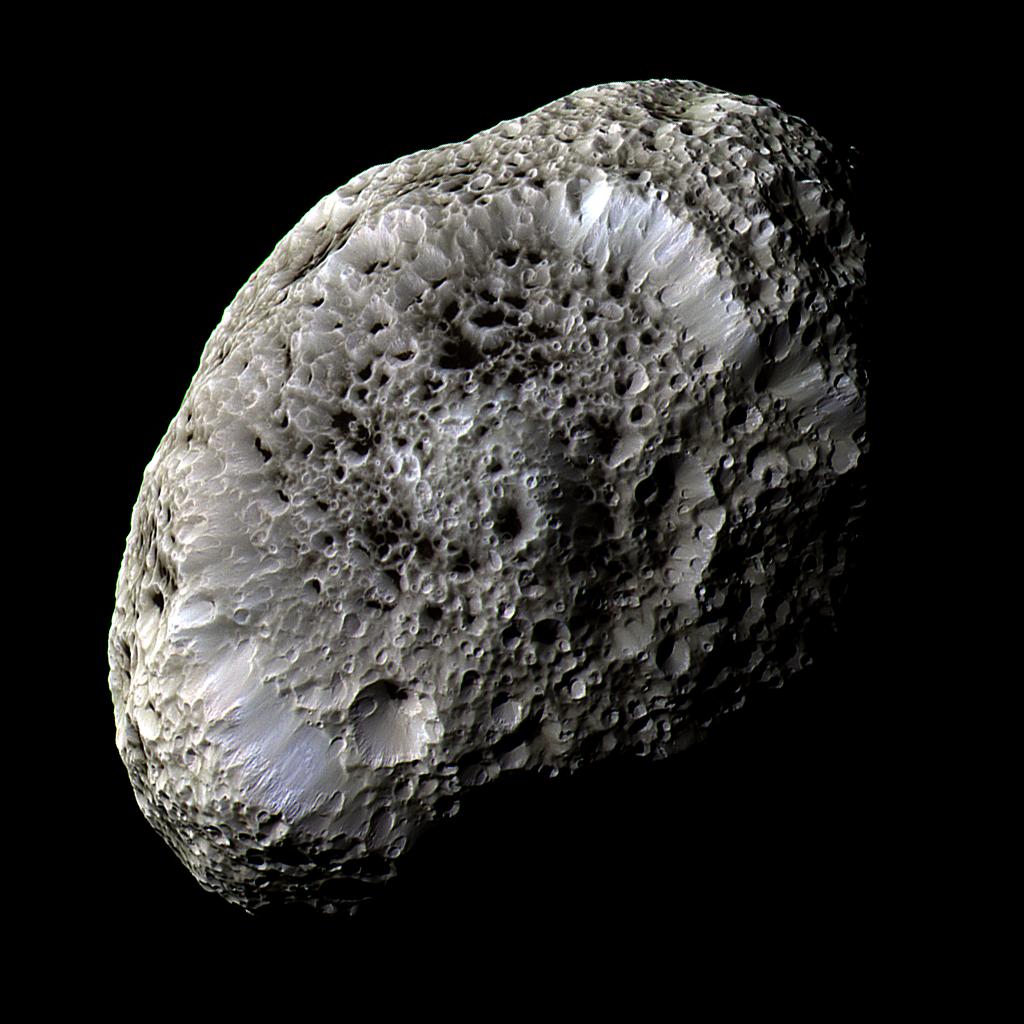
imipak writes "The Cassini Saturn probe has captured the previously unseen northern polar region of Saturn's moon Hyperion. Its weirdly eroded surface looks like nothing else in the solar system seen so far, demonstrating once again that when it comes to planetary exploration, "expect the unexpected" is more than just glib advice from the Hitch-hiker's Guide!"


What is that? (Score:3, Interesting)
Re:What is that? (Score:3, Informative)
Re:What is that? (Score:3, Funny)
[humor]
How did the Nazis get to Hyperion 60 years ago???
[/humor]
Re:What is that? (Score:3)
Re:What is that? (Score:5, Funny)
You mean the words that say, "DB_Session allocated the following problem: DB Error: connect failed"? Something tells me it is an earthy artifact.
Re:What is that? (Score:3, Interesting)
The JPL page says the straight line is probably a fault or other geological feature, but the absence of any others in that area is a little suspicious.
I blew up that section a bit, and it looks a LOT like something diamond- or arrowhead-shaped came screeching along the surface and plowed into the side of a hill, kicking up surface material and burying the leading edge. The "buried" object itself seems to be very sharply defined with straight lines, as opposed to the more "natural"
Re:What is that? (Score:4, Interesting)
The line really looks like a depression in that one, whereas in the false colour image it could be a protrusion.
I blew it up considerably in Photoshop and increased the contrast to see details better. There are a number of smaller craters directly in the path of the line. If it were a rock impact, to my (non-astrophysicist/geologist) eye it looks like it behaved like a skipping stone - There are some bigger craters near where the top of the image cuts off the line, and about halfway along there's a pair on opposite sides of what appears to be a hill, as if it were skating along, used the hill as a jump, landed, and continued its movement.
The bigger feature at the end of the line seems more symmetrical in this version. It looks kind of like a Concorde... or a giant bird footprint. Watch out Tethys, Colonel Sanders is too far away to save you.
Re:What is that? (Score:2, Informative)
If you rotate this photo 180 degrees the shadows and highlights may make more sense. The light is coming from the lower right of the picture, which may be disorienting as we expect light to come from the top of a photo and it becomes an optical illusion that makes craters look like plateaus and fault lines look like alien worms on the surface.
Re:What is that? (Score:3, Interesting)
Actually, if you look at the Hi res TIFF version [nasa.gov] you can see several more of them. None as large and obvious, but I found at least five or so linear formations in that picture. There is a cluster of three at the bottom beneath the obvious one.
Re:What is that? (Score:2)
My geology is a little rusty. If the big line is a fault, could the "chicken footprint" be where geologic activity caused some underground caverns to collapse?
Re:What is that? (Score:2)
Absolutely. And when I say that, I mean that my geology isn't rusty, it's non-existant. But it sounds good to me. What I find fascinating about all of this is that many of these moons are obviously more interesting than our own, which really just seems to be a big dumb rock in comparison.
Re:What is that? (Score:4, Informative)
Suddenly, it looks absolutely not "artificial" and a whole lot like a fault line. You can even see a bunch of other smaller/thinner lines in the image. The "buried" object looks irregular, with absolutely no sharp definition or straight lines at all. Looks like just an oddly eroded area.
Re:What is that? (Score:2)
The lines and blobs look a whole lot like the spatter and slag that results from arc or MIG/TIG welding. Perhaps the lines and blobs were formed from molten material landing back on the surface after an impact.
Re:What is that? (Score:2)
Re:What is that? (Score:2)
Not to me in this image [nasa.gov]. The line looks more like a merging of the surrounding material with an external source of stuff, kinda like a weld. It doesn't seem to be raised or depressed, just disturbed.
Re:What is that? (Score:2)
keep in mind most features on that image are depressions, not raised bumps.
Re:What is that? (Score:2)
Re:What is that? (Score:2)
Frankly it looks like the Millenium Falcon to me...
"A long time ago, in a galaxy far^H^H^H quite near here actually." ;-)
Justin.
Re:What is that? (Score:2)
A Crust (Score:2)
Man 1: So, what do you do for a crust?
Man 2: I don't shower for a few days.
Re:What is that? (Score:5, Funny)
Re:What is that? (Score:2, Funny)
The Internet has RESURRECTED interest in space! (Score:3, Interesting)
Cassini was helped to more funding because WE the geeks of Web/Net WANT TO KNOW. We want to see our world, our Universe. We join advocacy groups and science foundations.
Keep up the good work NASA. Let private groups continue as well.
I see a 2nd space renaissance soon!
Re:The Internet has RESURRECTED interest in space! (Score:1)
That's no moon... (Score:5, Funny)
Nothing else? (Score:2, Funny)
Is that what nothing else looks like, or is that what everything else looks like?
Either way, this article proves we shouldn't make general statements like that, doesn't it?
Re:Nothing else? (Score:4, Insightful)
Many uses! (Score:5, Funny)
That's no moon.... (Score:1)
Re:Many uses! (Score:2, Insightful)
That is because you leave all your grimey toy spaceships in the tub
Wrong moon. (Score:5, Informative)
It was a double flyby, hence the confusion.
Re:Wrong moon. (Score:5, Informative)
One of the links in the post is of Tethys, not Hyperion. Look for yourself!
http://saturn.jpl.nasa.gov/multimedia/images/imag
Someone should correct the post.
Re:Wrong moon. (Score:2, Insightful)
Re:Wrong moon. (Score:4, Insightful)
I must not be in the majority then. I took it to mean: "Here's a picture of something you won't find anywhere else in the solar system".
Re:Wrong moon. (Score:2)
Imagine (Score:4, Funny)
Re:Imagine (Score:5, Funny)
Re:Imagine (Score:2)
As usual, slashdot editing leaves a bit (Score:5, Informative)
The two pictures are from different moons, Tethys (second link), Hyperion (first link). Perhaps reading a caption from the real article at http://www.jpl.nasa.gov/index.cfm [nasa.gov] would help
Re:As usual, slashdot editing leaves a bit (Score:2, Insightful)
When you have 99.5% of all your submissions rejected, one tends to lose the motivation.
Uh oh... (Score:3, Funny)
big crater and then small ones (Score:4, Interesting)
But the first picture looks like there was just big collision (old big crater) followed by lots of small collisions, without any erosion in between. I *think* I have seen similar features on the moon.
To have this picture is nonetheless an astonishing accomplishment.
I think that simply the lighting makes this view impressive
Re:big crater and then small ones (Score:3, Interesting)
Re:big crater and then small ones (Score:2)
I have to admit, that's what I first thought when I saw the big crater feature - this is the "after" picture of a moon that's been moved (hard SF geek heritage showing here). Sadly, there's probably a more prosaic answer - maybe the moon is a fragment of a larger object, and the crater is the record of the impact that shattered it.
Re:big crater and then small ones (Score:2)
Weird (Score:2)
Re:Weird (Score:5, Interesting)
If it's a microscopic picture, I have to ask - what browser are you using to view it?
Bad jokes aside, this is what a magnified grain of salt looks like:
(it's pretty enough to make desktop wallpaper)
Re:Weird (Score:2)
Does anyone remember that old British sci-fi show UFO? They had an episode once where they managed to get a probe to follow one of the UFOs back to its home planet and send back pictures. But the probe malfunctioned and did not send back info regarding the scale of the pictures. They could not tell if they were looking at something very very large or something that was relatively small. And because they did not have any point of reference they could not tell
as heard on fark (Score:1, Redundant)
Oh please (Score:5, Funny)
this asteroid has been renamed (Score:1, Funny)
Re:this asteroid has been renamed (Score:2)
What about Blade Runner?. He looked more like Hyperion in that movie.
Kind of reminds me of something like... (Score:3)
Any photos of... (Score:2, Funny)
Re:Any photos of... (Score:2)
Re:Any photos of... (Score:2)
Ive scene this. (Score:3, Funny)
Re:Ive scene this. (Score:1)
Re:Ive scene this. (Score:2)
How about we avoid works from The Goatse School of Visual Articulation.
Wasps? (Score:1)
Hate to break it to ya... (Score:2)
That's a patently false statement. Walk up to any person with a printout of this photo, and ask them, "Hey, does this look like anything you've seen in the solar system so far?" They'll probably say, "Yeah, it looks like a sponge" or "Yeah, it looks like pumice" or "Yeah, it looks like my mother-in-law's face".
Perhaps it doesn't look like any other celestial body we've seen so far.
gross (Score:1)
Erosion- more like a beating (Score:1)
It looks worse than Noriega's face
Re:Erosion- more like a beating (Score:2)
It must have originally consisted of some volatile material (frozen ammonia?) which sublimated away when the local environment heated up. Perhaps it got hit by a smaller object and the resulting increase in temperature boiled part of the surface away.
The remaining material is probably water ice.
Re:Erosion- more like a beating (Score:2)
Looks Like Sublimated Ice (Score:3, Interesting)
Funny you should mention Mars (Score:2)
This stuff looks a great deal like features [msss.com] found all [msss.com] over Mars [msss.com], just enormously more concentrated, and steeper. (Notice particularly the flat-bottomed craters on hillsides and on the right side of the image.) Of course the mechanisms normally proposed for the Martian features ("collapse pits") are inconceivable applied to identical features on Hyperion. That doesn't reduce the objective similarity, of course, but it makes those mechanisms much less plausible for t
Re:Looks Like Sublimated Ice (Score:2, Interesting)
Material (Score:3, Funny)
IMHO (Score:3, Interesting)
A bit much? (Score:2)
hey, I've played there before (Score:2, Funny)
space bees (Score:2)
made by giant space bees.
Re:space bees (Score:2)
This is easy (Score:2, Funny)
Exactly what the spawn were, and what has become of them, is the subject of fierce debate. But we can be sure of two things: We have always been at war with Oceania, and these creatures don't like waffles.
Oh sure, my friends said, just try a little LSD. All that stuff about flashbacks and going psycho is bullshit
Great Expectorations (Score:3, Interesting)
Looks like nothing else in the solar system? (Score:3, Interesting)
http://images.google.ca/images?hl=en&q=c
JPEG vs TIFF (Score:3, Interesting)
What I'm trying to ask is, does anyone else notice a major difference between the two without using the GIMP @ 7 or 8X zoom?
Possible Interpretation (Score:5, Informative)
You can see the raised part in the centre, around which is part of the old crater wall.
Note the crater wall is significantly brighter than the surrounds - this is exposed materials, mainly water ice to judge from the brightness.
The other thing to note is that the crater is incomplete, and is itself riddled with craters, both the centre and the crater walls. This tells us that the large crater is very old. How old I would leave to an expert of the Saturnian system, who would no more about impact frequencies than me.
Hyperion is interesting in that it is the largest irregular body in the solar system. Anything larger (and many smaller objects) are pulled into a spherical shape by their own gravity. Hyperion is not that much smaller than Enceladus, and is of a similar make-up (frozen H2O) yet these object are very different.
I would hypothesise that a large impact has sheared off part of Hyperion- that's why the large crater is incomplete - the rest is gone, possibly to become part of the ring material but I don't know what the timing of that blast was.
The very strange not-really-craters next to the very large impact crater I would say were outgassing artefacts, not any type of impact crater. Basically the heat from the large impact caused volatiles to rocket out of Hyperion, leaving those sort of "exit valve" formations.
It looks to me (Score:2)
Re:conjecture (Score:2)
Re:something similar on asteroids, (to some extent (Score:4, Interesting)
However, in the asteroid belt especially, many collisions may be elastic, with bodies bouncing off each other like billiard balls, leaving behind large indentations. This could happen, as these bodies are moving in essentially the same direction and therefore collisions may not always have much force.
Re:something similar on asteroids, (to some extent (Score:3, Informative)
Re:Is it too much to ask... (Score:3, Informative)
That means "It is weirdly eroded surface".
http://en.wikipedia.org/wiki/Its [wikipedia.org]
Re:Is it too much to ask... (Score:2)
Re:Is it too much to ask... (Score:2)
Re:Is it too much to ask... (Score:2)
Re:Is it too much to ask... (Score:2)
And could they not spell "hitchhiker" correctly as well?
Furthermore, the expression "expect the unexpected" goes back at least to Wilde's play "An Ideal Husband" (1895): "To expect the unexpected shows a thoroughly modern intellect." (Act 3 [online-literature.com]).
The message of The Hitchhiker's Guide to the Galaxy is more like "the unexpected is stranger than you might expect".
Re:Uhmmm. We sure about these? (Score:5, Informative)
- In space, the lack of atmosphere gives things an "unreal" look in photographs. See if you can dig up the movie that was done by Messenger as it left Earth. It actually looks less "believable" than a modern Hollywood movie in some ways.
- The images are false colour. This is useful for conveying more information, but it does make them look a little "wrong."
For comparison, here's another version of the Tethys shot [nasa.gov]. It looks a lot less surreal, because it's greyscale.
Just think. (Score:2)
Re:Erosion? don't make me laugh (Score:5, Interesting)
1) Its by Saturn which has a massive gravitational pull. This causes Saturn to pull in a lot of comets, asteroids, and dust. Thus Saturn gets hit with a lot more debris then the planets in the inner solar system. This would also increase the risk of the moons getting hit with this debris as well and therefore will have more impacts then that of the planets and moons in which we know.
2) Saturn has rings filled with debris. So if the moon ever happened to swing into these rings it would go through hundreds if not thousands of impacts. That could have very well created the surface that you see. This could have happened at any time in the moons history and so is a very likely cause.
3) The moon could have some sort geological processes that are responsible for such a surface, however thats very unlikely.
Personally I would put my bet on number 2 cause it makes the most sense. If the moon went through on of Saturns rings especially when the rings might have just formed there would have been a lot of collisions leaving the surface scarred like you see in the picture.
Re:Erosion? don't make me laugh (Score:2)
Re:Erosion? don't make me laugh (Score:2)
Re:Erosion? don't make me laugh (Score:2)
Re:Erosion? don't make me laugh (Score:2)
Re:It's not a visible image (Score:3, Informative)
They can s
Re:Dan Simmons (Score:2)
With a sucky ending. Didn't make sense, and the merged resolution of the two most interesting particular characters was, I thought, both nonsensical and unsatisfying. The plot crux of the series
Re:Dan Simmons (Score:2)
it's worth it because, as you say, hugely rich and entertaining.
Go on. Give it a go. What else are you gonna do - watch more re-runs of Lost? hehehe
Re:Dan Simmons (Score:2)
Re:It's Obvious (Score:2)
My impression of reading Stephen Baxters books is that the Xeelee would never bother with something as minute as Hyperion.
Weren't they into creating galactic scale mischief?