

European Students to Put Microsatellite Into Orbit 117
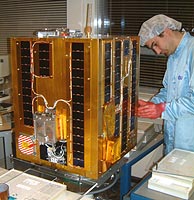
Astervitude writes "A Frankenstein's microsatellite made out of parts "donated" by university students across Europe will be launched on September 30 atop a Russian booster. Space.com reports that more than 400 students "spread across 23 universities and 12 countries" spent 18 months designing and building the SSETI Express. While its acronym sounds suspiciously similar to that of a project that seeks to uncover signs of intelligent life beyond Earth, the SSETI or Student Space Exploration Technology Initiative mission is actually part of an effort by the European Space Agency "to boost student interest in space technology and offer some hands-on experience." The satellite itself weighs a mere 136 pounds and is the "size of a small washing machine", as shown in this ESA photo. Visitors to the mission site may want to check out the contest page for ham radio operators to help collect data from the satellite."

More information (Score:5, Informative)
Payload systems:
The Attitude Control and Determination System controls the attitude of the spacecraft using a pair of magnetorquers and a passive magnet and determines the attitude of the spacecraft using a magnetometer and a pair of sun-sensors.
The camera uses CMOS technology and is capable of taking full colour pictures in the visual range at a ground resolution of about 100m per pixel, with an image size of 1280x1024 pixels. It will be used to take images of the Earth.
The S-Band unit is the secondary communications system. It contains a microwave transmitter and TNC and is capable of 38400bps data downlink, or transponding audio from UHF via three patch antennas (S-Band ANT), acting as a voice repeater for radio amateurs.
T-PODS - These three pods contain the three Cubesat passengers during the launch and coasting phases. After injection they will act as launcher tubes, ejecting the Cubesats from SSETI Express so that they can pursue their own missions.
SSETI Express will carry three small nano-satellites into orbit as passengers. These will be ejected from SSETI Express shortly after the launch, and will then undergo their own, separate, missions.
The three cubesats are:
NCUBE-2 -Developed by the Andøya Rocket Range, Norway. This Cubesat will track boats around the Norwegian coastline (and one reindeer on land).
[I, for one, welcome our new reindeer-tracking overlords!]
UWE-1 - Developed by the University of Würzburg, Germany. This Cubesat will test new communications protocols.
XI-V Developed by the University of Tokyo, Japan. This Cubesat will test commercial off-the-shelf technology and has a camera to take pictures of the Earth.
SSETI Express has two 'radios' on-board.
On UHF 437.250MHz there is a FM transceiver that can transmit and receive the AX25 packet telemetry and payload data at the data rate of 9k6bps. The transceiver produces approx 3 watts of RF output that feeds a canted 1/4 wave whip, which is mounted on the top plate. It incorporates a standard TNC7-Multi to convert the data to and from the OBC. It also has an audio and RSSI feed to the S-Band Tx. It was constructed by Holger Eckardt DF2FQ and is based upon his T7F UHF packet transceiver.
Communications - On S-Band there is a transmitter on 2401.835MHz which can transmit packet data at a data rate of 38k4bps. It can also be configured to work in a voice transponder configuration. It produces approximately 2.5 watts of RF output which feed a three way splitter to the three patch antennas. The enclosure, power splitter and antennas were provided by the University of Wroclaw SSETI team and the electronics were produced by five members of AMSAT-UK. The unit comprises of a switch mode power supply, exciter board, amplifier board, controller board and a sensor board. The TNC is identical to the TNC7 Multi being used in the UHF transceiver except that it is set for a different baud rate.
Typical Groundstation:
To receive data from SSETI Express the requirements are similar to those for previous 9k6 Pacsats.
To receive UHF telemetry, a steerable circularly polarised yagi with 12dBic gain with, preferably, a masthead preamplifier, should be satisfactory for reception of the data . The receiver must have an IF bandwidth of at least 20kHz and an audio output that is taken from the discriminator before any 'shaping'. This audio is then fed into a suitable KISS-enabled TNC which itself is connected to a PC normally via a serial port. To transmit to the satellite (when 'friendly telecommands' have been enabled) an RF output power of 10 watts on UHF should be sufficient.
To receive S-Band data, the antenna gain will need to be more than 21dBic and in this case RHCP (right hand circular polarisation) is a must. Again a mast mounted preamplifier will be required. As the data rate is 38k4bps the IF bandwidth will need to be approx 80kHz together with a K
Linux Decode Software (Score:3, Interesting)
Re:Linux Decode Software (Score:2)
Re:Linux Decode Software (Score:1)
long answer: in case of a crash you do not need to push the reset button. You could build in a watchdog card/timer that does that for you.
I myself have not been able to crash the likux 2.6 kernel. In my 20 years computer experience I have crashed many systems, even commercial unix systems. So to me the KERNEL is pritty stable. Maybe you have problems with X11 or other programs on your desktop, but I doubt a satelite would need those....
Re:Linux Decode Software (Score:2)
I haven't tried with a hardware one, but my linux 2.6 instabilities hang it beyond where it'll reboot thanks to the software watchdog.
Maybe you have problems with X11 or other programs on your desktop,
Nope, whatever it is is locking it up to where I get no response out of sshd, apache or anything else. X doesn't even have to be running.
I sense a connection... (Score:2, Funny)
Re:I sense a connection... (Score:5, Funny)
Re:I sense a connection... (Score:4, Funny)
Not at all, we have some really huge pricks in government.
Re:I sense a connection... (Score:3, Insightful)
Even one hundred years ago scientists were collaborating internationally, or at least thinking a long the same lines. An awful lot was driven by UK/US collaboration during WW2.
If I look at my desk at the gadgets I would think that Northern Europe and Japan was fuelling the current technological age. On it there is a
Re:I sense a connection... (Score:3, Insightful)
Damn near every usefull technological advance in the last 100 years has come from the US.
Last 100 years? You mean other than the first cloned mammal, microwave ovens, pennicillin, radar, television, the world wide web, mobile phones, xylitol, polyester, bakelite, modern rockets, the diesel engine, the electric car, aspirin, radio communication, the jacuzzi, velcro, cellophane, the helicopter, nuclear fission, relativity theory?
In addition, let's not forget that many American inventions were
Re:I sense a connection... (Score:1)
Well, in fact, yes. Such as compensating for having a realistic budget. I doubt that those schools could afford to build a bloody huge space shuttle, and the fuel to lift off all those hundreds of tons, just to put something washing-machine sized into orbit. It's basically like packing a half a pound chocolate bar in a few hundred pounds of hi-tech packaging before sending it by UPS: you're paying a lot more tha
Re:I sense a connection... (Score:5, Insightful)
However, we do have more things that are deemed to be the responsibility of the society. Things like education. Things like health service. Things that everyone generally need.
I think this is a good thing. It (tries to) give everyone equal opportunity, regardless if they come from a rich or a poor family. Of course, it's not absolute, there are still private health service, there's private schools. But the general idea is that there are some fundamental rights people have, that the government should provide.
Other than that, I (as a european) does not feel particularily that I live in a communist country.
But for a country where everything is so much skewed to the right as in US, I guess that everything else is communist...
Re:I sense a connection... (Score:1, Offtopic)
I would not call Europe communist at all, not even current Eastern Europe. If you knew what the actual real totalitarian communism was (and unfortunately still is in some corners of the World), you wouldn't even make the comparison.
Re:I sense a connection... (Score:3, Insightful)
Please don't assume that all Americans are raving right wing nut cases. Nearly 50% of us aren't.
Re:I sense a connection... (Score:2)
Americans tend to refer to social-democracy as communism. While I was just stating that there are fundamental differences.
What lies in social-democracy, is that a certain, pretty large, part of society is under government-control because it's deemed to be a fundamental right for people. Things like health care and educa
Re:I sense a connection... (Score:3, Interesting)
Americans tend to refer to social-democracy as communism. While I was just stating that there are fundamental differences.
This is a reflection of different historical development, I believe. It is more about words than political programs.
Before WWII socialism and communism was considered evil by mainstream media everywh
Re:I sense a connection... (Score:1)
But education is another huge issue. Frankly, American public education is pretty horrible. The average American can't even define socialism, let alone understand the positives and negatives of a social welfare state compared to our current situation. The average American doesn't vote because they believe their vote won't count. And who can blame them when they face several hour long lines at election booths, harass
Re:I sense a connection... (Score:1)
Re:I sense a connection... (Score:2)
In Europe Kerry would be a far-right candidate too.
Re:I sense a connection... (Score:1, Informative)
at lest the parties).
They are a small minority.
What makes you think we are communists?
I don't say the Americans are fascists!
By the way, a well known german ex-chancellor once said:
"Communists are red painted Nazi's"
(Willi Brandt)
Re:I sense a connection... (Score:3, Funny)
Re:I sense a connection... (Score:3, Interesting)
It's just that the international schools don't have the ITAR restrictions so they can actually get their satellites launched.
CubeSat has a bunch of American CubeSats ready to go, just waiting on the Russians to launch it now. http://www.cubesat.org/ [cubesat.org]
Re:I sense a connection... (Score:1)
Re:I sense a connection... (Score:2)
Most if not all of the CubeSats are entirely designed by students, at least the ones I've seen, which includes all of them waiting for launch right now...
To boost interest? (Score:3, Insightful)
I wish my school had a program like that, the closest we ever got to something like that was seeing who build the tallest free standing structure from a sheet of A4 Paper.
Old men, slow and 'Gattaca' (Score:2, Interesting)
Moving along to funding the taxpayer in america it seems would prefer that his/her children learn how god created the earth in six days.
To the staff of Nasa - it seems most of them where inspired by the moon landings, or 'rockets'. The book 'October Sky' by ex nasa employee Homer H Hickman sort of implies that.
How about Burt Rutan and his spaceshi
Re:To boost interest? (Score:2)
Have kids grown out of the idea of becoming astronauts?
Of course they have. It just isn't glamorous anymore. Manned space flight was done forty years ago. Modern day science fiction isn't about space flight but about computer networked big brother dystopias. Besides, modern media makes all scientists look nerdy and impopular. Why would a kid want to be an astronaut, of all professions?
Micro satellite and washing machine (Score:5, Insightful)
Then again, following Jobs naming scheme: Nano follows on mini.
Re:Micro satellite and washing machine (Score:1)
Compared to them, this is definitely micro!
And, of course, we still have the other prefixes to describe smaller things - nano, pico, femto, err...
Re:Micro satellite and washing machine (Score:2, Funny)
Clothing designers have similar stereotypes applied to them as apple users. I wonder if they use the same naming schemes.
Re:Micro satellite and washing machine (Score:3, Informative)
The first ARRL satellite, Oscar 1 [sstl.co.uk] was 10 pounds and the size of a shoe box. Mind you it could only say HI, and couldn't hear your reply, so I guess we've had some progress in 44 years...
Re:Micro satellite and washing machine (Score:1)
JP Aerospace's PongSat program (Score:5, Interesting)
A PongSat is an experiment that fits inside of a ping pong ball.
These ping pong ball 'satellites' are flown to the edge of space by balloon or launched in sounding rockets. The PongSats are then returned to the student.
It's an easy and inexpensive way to get students excited about science and engineering.
There are endless possibilities for experiments that can fit inside a ping pong ball. PongSat's can be as simple or complex as you want them to be. Experiments can be as simple as comparing how high a ball bounces before and after being exposed to vacuum. The PongSat can carry seeds to see if exposure to cosmic rays effect their growth. Several small inexpensive computers and other electronics can fit inside a PongSat. These can be used to create a wide range of experiments. Whether carrying a marshmallow to see if it puffs up in the vacuum of near space or an entire sophisticated satellite in miniature, PongSat can create motivation, drive
and passion in the classroom.
PongSats are flown at no cost to the student or school.
The Russian Boosters share some credit... (Score:5, Insightful)
Launching on a Russian Rocket & Booster is so cheap that its one of the best kept secrets... Now that these students have found out that Launching isn't that hard compared to building a Satellite, Serious fun is about to begin...
Let the mass migration of Hackers to hacking and building Satellites begin!
Re:A word about the Russian boosters (Score:1, Insightful)
Re:A word about the Russian boosters (Score:5, Insightful)
Think this way: Now they are free, but poor. They get a less-than-fair (but always, some) share of the cash in form of pensions, social support etc. Now in the name of shunning the relics of the regime you can let them starve and let all their hard work go to waste, or get the sats to fly, give these people some well-deserved money and understand, the tech as such is not evil nor guilty, and now as the regime is gone, there's no real reason not to use it.
Re:A word about the Russian boosters (Score:3, Informative)
If you refer to GULAG and other prison camps, I highly doubt that any of these prisoners contributed in any way to the boosters t
Re:A word about the Russian boosters (Score:2)
Re:The Russian Boosters share some credit... (Score:1)
I'd rather get something into space on a shuttle than on a submarine ICBM.
Re:The Russian Boosters share some credit... (Score:1)
Oh goody... (Score:3, Insightful)
-A camera with a 100m per pixel resolution (ridiculously low res, plenty of other picture taking sats available).
-A Cubesat that will track boats around the Norwegian coastline, and one reindeer (just one reindeer? And can't we track boats with other means?)
- A Cubesat testing new communications protocols (why can't this be done terrestrially or with equipment on the ISS?).
- Another Cubesat that takes pictures and tests some gear (send it to the ISS).
So, we've got 4 satellites up there, doing tasks which we can do via other means, wasting space. Why not send the equipment to the ISS? We did put it up there for a reason, didn't we?
Re:Oh goody... (Score:2, Funny)
Yes,,,,the ever extending never ending space is going to be filled up soon if we dont stop young knowledge seekers and FAST.
Re:Oh goody... (Score:1)
Exactly what knowledge are these "young knowledge seekers" seeking, anyway? As I mentioned in my other post, the experiments they're conducting have little to know scientific merit? Are they hoping to learn about any of these topics?:
- Building a satellite: Probably, but humans already know how to do that.
- How to build a rocket: They won't learn this, because the Russians are handling it and already know.
- Rocket and Orbit trajectories: I
Re:Oh goody... (Score:2)
If someone just had a satellite and wanted it launched, they would go to the cheapest vendor. I bet the Russian launchers will quote a price that undercuts anyone else by a substantial margin.
Re:Oh goody... (Score:3, Interesting)
Last I heard it was something like $20 mil to be sent up to the ISS via the Russian Space Agency. If it's that much for a person and their gear, surely it would be a lot cheaper to send an inanimate object?
Re:Oh goody... (Score:3, Informative)
Fr
Re:Oh goody... (Score:2)
Re:Oh goody... (Score:2)
Space junk is an issue a grant... but why not then just argue that there should be a de-orbit plan that will take it out of orbit. Not argue it shouldn't be up there period.
Re:Oh goody... (Score:2)
I wouldn't mind anywhere near as much if their project was doing something useful. It doesn't have to be development of a warp engine or anything. The reindeer and fishing boat thing could be a decent project if they expanded the sc
Re:Oh goody... (Score:3, Insightful)
Re:Oh goody... (Score:2)
And you know what, nobody has ever been killed by exploding the sun before, right? So why don't we just go and do that?
Oh, and check out the nice 500 pound piece of junk in this article [space.com] that almost hit some guy's house in Texas, as an example of something that was almost damaged. In any case, I know it's unlikely
Re:Oh goody... (Score:1)
It is a huge problem. NORAD tracks countless pieces of space junk but there are plenty of things that are too small for NORAD to track, and those are the ones the we really fear. A collision, even with something very small, at orbital velocities can be catostrophic.
Re:Oh goody... (Score:2)
Furthermore speed determines your orbit altitude so anything in a more or less eastward orbit at the same altitude has essentially the same speed. Now there are issues with stuff in different orbits like say a 45 degree offset of intersecting orbits at which the relative velocities
Re:Oh goody... (Score:3, Informative)
Uh, I hate to break it to you, but there are already a bunch up there. And more on the way. In the US alone, Stanford has launched a couple of satellites (Sapphire being the only one I can remember off the top of my head), Utah State & Weber State have launched one (NUsat), the Air Force Academy has put up several (FalconSat), and the University of Colorado has launched at least one (SNOE) - I've probably missed a bunch because I'm doing this
Re:Oh goody... (Score:1)
Re:Oh goody... (Score:2)
As for the utility of the rez of the camera it may surprise you to discover that many pictures provided by ISS ops are of similar or lower resolution. Neither are of any real significance when talking about high rez sattelite photography. Hell we don't even know what state of the
Re:Oh goody... (Score:2)
The problem isn't so much about mass, it's about all the
Sorry, links got truncated.. (Score:2)
http://www.space.com/images/h_space_junk_esa_02.g i f [space.com]
http://www.space.com/images/h_space_junk_nasda_02. jpg [space.com]
The page they came from is here [space.com].
Sorry for the screwup.
Re:Micro satellite and washing machine (Score:1)
I thought it was to provide a target for other space junk.
Re:Oh goody... (Score:3, Interesting)
Re:Oh goody... (Score:2)
Re:Oh goody... (Score:1)
> wasting space
It's called Space for a reason...because there's shit-loads of it! When it becomes a problem someone will send up another sat to bump the old crap ones out of earth orbit (or towards the earth if they want a fireworks display).
My Microsatellite (Score:2, Funny)
Radio Amateur (Score:1)
My school has a MicroSat program too (Score:2, Interesting)
http://microsat.usc.edu/
Re:My school has a MicroSat program too (Score:2)
Where are washing machines on the scale (Score:4, Interesting)
Actually, given the dimensions and capability of the first artificial Earth satellite, Sputnik, it would be interesting to know how it compares. It would be amusing if the second space race - the race to be cheap, not to do things regardless of cost - was basically being led by a new generation of Sputniks on top of a new generation of Russian rockets.
Re:Where are washing machines on the scale (Score:1)
Idea for the guy in the cardboard transport box (Score:2, Funny)
Re:Mission to mars... (Score:1)
One thing is sure: You have to be real drunk to do those things those Polish students did, it actually sounds more like something which happens with certain drugs (LSD for example).
Some previous references... (Score:3, Informative)
Previous story on SlashDot about micro satelites:
http://science.slashdot.org/article.pl?sid=05/08/
(30. June 2003)
http://dtusat.dtu.dk/ [dtusat.dtu.dk]
http://www.cubesat.auc.dk/ [cubesat.auc.dk]
http://www.utias-sfl.net/nanosatellites/CanX1/Can
Air cooled satellite??? (Score:2, Funny)
Re:Air cooled satellite??? (Score:2)
No, silly, that's an attitude adjustment fan.
Re:Air cooled satellite??? (Score:1)
Why are they bothering w/ this... (Score:2)
Catching up to the Boy Scouts (Score:1)
I wonder how come the ESA doesn't launch things like this. Russia that hungry for business maybe?
Re:Catching up to the Boy Scouts (Score:1)
Russians are much cheaper, but the ESA still owns half the world market because it is more likely to deliver the payload unharmed and in the right orbit. Still ESA itself also sends up payloads on Russian rockets for reasons of economy. Apparently they decided that this payload is not valuable enough to pay for a trip on an Ariane. The students can always build another one.
Please change title (Score:3)
A bunch of students building a satellite is kinda neat, but far short of the neatness of actually putting it in orbit.
I, for one.... (Score:1)
Oh damn... (Score:1)
ohwell...
US has been doing this for years (Score:2)
Meanwhile american students learn about... (Score:1, Troll)
Right, so as I was saying we don't want these liberal scum in our God fearing great country, ble
We beat 'em to it a long time ago (Score:1)
It involved our Electrical Engineering, Computer Science, and Mechanical Engineering departments in a multidisciplinary development team.
Been there - done it. I guess their claim to fame is they built it with scraps and donations...
Re:Fratenities send offspring to space (Score:2)
Actually, I wonder what kind of weird creatures would it breed when applied to a woman now and here, without being launched into orbit...
Re:Very "interesting" (Score:1, Funny)
Oh wait, you don't have a girlfriend. Never mind, and mod this post down, as always.
Re:Very "interesting" (Score:5, Funny)
Since the resolution of the camera is 100m per pixel, that must be a pretty large girlfriend.